

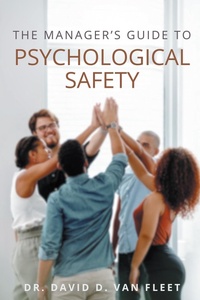
The Manager's Guide to Psychological Safety
Description

The Manager's Guide to Psychological Safety presents a simple and easy-to-understand way to achieve psychological safety in organizations. Psychological safety is an organizational culture where no one will be punished for asking questions, speaking their minds, reporting mistakes and talking about them, and expressing concerns or proposing new ideas without being asked.
While relevant topics such as change, communication, motivation, and safety are covered, the concern is with the people in organizations-assuring that they are treated with dignity and respect for the benefit of all thus creating for them a psychologically safe place in which to work.
Approaches to achieving psychological safety are presented and present a unique framework (V-REEL®) for analyzing the organization and its internal environment that may hinder or help it become psychologically safe. Psychological safety, once attained, enhances the organization's reputation and its bottom line.
More details
Other editions
Additional editions
Person
Content
- Front cover
- Half title
- Title
- Copyright
- Description
- Contents
- Testimonials
- Preface
- Acknowledgments
- Educational Features
- Readable
- Interesting
- Up-to-Date
- Accurate
- Audience
- Unique
- CHAPTER 1 What Is Psychological Safety?
- Origins1
- Definitions
- How Psychological Safety Relates to Performance Standards
- Conditions
- Impediments
- Case Study
- Case Questions
- Think About This Chapter
- Chapter Questions
- Actions
- CHAPTER 2 Psychological Contracts and Managers
- Organizational Relationships
- Why Managers?
- What and Who
- Complex
- Pervasiveness
- Levels
- Areas
- So?
- Case Study
- Case Questions
- Think About This Chapter
- Chapter Questions
- Actions
- CHAPTER 3 Change
- Steps in Change
- Resistance to Change
- Overcoming Resistance to Change
- Areas of Change
- Case Study
- Case Questions
- Think About This Chapter
- Chapter Questions
- Actions
- CHAPTER 4 Communication
- Process
- Barriers
- Types
- Roles and Direction
- Informal Communication
- Nonverbal Communication
- Improving Communication Effectiveness
- Case Study*
- Case Questions
- Think About This Chapter
- Chapter Questions
- Actions
- CHAPTER 5 Motivation
- Introduction
- Goals
- Ways and Schedules
- Case Study1
- Case Questions
- Think About This Chapter
- Chapter Questions
- Actions
- CHAPTER 6 Safety and Security
- Workplace Safety1
- Dangerous/Emergency Situations
- The S.A.F.E.T.Y. Model
- Example
- Workplace Violence Prevention Policy/Plan
- Case Study2
- Case Questions
- Think About This Chapter
- Chapter Questions
- Actions
- CHAPTER 7 Approaches
- Four Stages1
- Stage 1-Inclusion Safety
- Stage 2-Learner Safety
- Stage 3-Contributor Safety
- Stage 4-Challenger Safety
- Five Pillars*
- Pillar 1-Self
- Pillar 2-Social
- Pillar 3-Collaboration
- Pillar 4-Curiosity
- Pillar 5-Creativity
- The Psychological Safety Playbook2
- Communicate Courageously
- Master the Art of Listening
- Manage Your Reactions
- Embrace Risk and Failure
- Design Inclusive Rituals
- Summary
- Case Study3
- Case Questions
- Think About This Chapter
- Chapter Questions
- Actions
- CHAPTER 8 V-REEL1
- Value and Rareness
- Eroding Factors
- Enabling Factors
- Longevity
- Final Results
- Case Study2
- Case Questions
- Think About This Chapter
- Chapter Questions
- Actions
- CHAPTER 9 How to Foster Psychological Safety in Your Group
- Use the V-REEL Framework
- Demonstrate Engagement
- Show Understanding
- Be Inclusive in Interpersonal Settings
- Be Inclusive in Decision Making
- Show Con dence and Conviction Without Appearing In exible
- Examples From Organizations2
- NASA
- Buffer
- Unqork
- Oak9
- Achievers
- Case Study3
- Case Questions
- Think About This Chapter
- Chapter Questions
- Actions
- Sources Specific to This Chapter
- CHAPTER 10 A Cautionary Note
- A Humanist's Guide for Managers1
- Appendix
- Helpful Organizations
- Glossary1
- Notes
- Chapter 1
- Chapter 5
- Chapter 6
- Chapter 7
- Chapter 8
- Chapter 9
- Chapter 10
- Glossary
- References and Recommended Readings
- References and Recommended Readings1
- About the Author
- Index
- Back cover
