

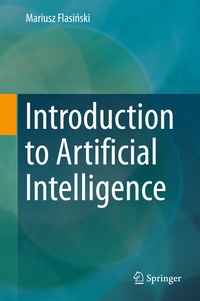
Introduction to Artificial Intelligence
Description

In the chapters in Part I of this textbook the author introduces the fundamental ideas of artificial intelligence and computational intelligence. In Part II he explains key AI methods such as search, evolutionary computing, logic-based reasoning, knowledge representation, rule-based systems, pattern recognition, neural networks, and cognitive architectures. Finally, in Part III, he expands the context to discuss theories of intelligence in philosophy and psychology, key applications of AI systems, and the likely future of artificial intelligence. A key feature of the author's approach is historical and biographical footnotes, stressing the multidisciplinary character of the field and its pioneers.
The book is appropriate for advanced undergraduate and graduate courses in computer science, engineering, and other applied sciences, and the appendices offer short formal, mathematical models and notes to support the reader.
Reviews / Votes
"The book is very useful for computer science, engineering, and allied science students, particularly because of the extensive appendices giving formal mathematical models for AI methods. However, because AI is a multi-disciplinary area today, students and researchers from disciplines like psychology, philosophy, and linguistics who are interested in studying and researching AI further will also benefit from using this book for a first AI course . ." (C. S. Arora, Computing Reviews, January, 2017)More details
Other editions
New editions
Additional editions
Person
Mariusz Flasinski is a Full Professor in the Dept. of Information Technology Systems of the Jagiellonian University in Cracow, Poland. His research interests include artificial intelligence, computational intelligence, pattern recognition and image processing, and information management. He is a member of the Geoinformatics Commission of the Polish Academy of Arts and Sciences.
Content
History of Artificial Intelligence.- Symbolic Artificial Intelligence.- Computational Intelligence.- Search Methods.- Evolutionary Computing.- Logic-Based Reasoning.- Structural Models of Knowledge Representation.- Syntactic Pattern Analysis.- Rule-Based Systems.- Pattern Recognition and Cluster Analysis.- Neural Networks.- Reasoning with Imperfect Knowledge.- Defining Vague Notions in Knowledge-Based Systems.- Cognitive Architectures.- Theories of Intelligence in Philosophy and Psychology.- Application Areas of AI Systems.- Prospects of Artificial Intelligence.
