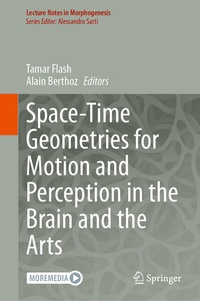
Space-Time Geometries for Motion and Perception in the Brain and the Arts
Description

This book is based on a two-day symposium at the Paris Institute of Advanced Study titled "space-time geometries and movement in the brain and the arts". It includes over 20 chapters written by the leading scientists and artists who presented their related research studies at the symposium and includes six sections; the first three focus on space-time geometries in perception, action and memory while the last three focus on specific artistic domains: drawing and painting, dance, music, digital arts and robotics. The book is accompanied by a dedicated webpage including related images and videos.
There is an ever-growing interest in the topics covered by this book. Space and time are of fundamental importance for our understanding of human perception, action, memory and cognition, and are entities which are equally important in physics, biology, neuroscience and psychology. Highly prominent scientists and mathematicians have expressed their belief that our bodies and minds shape the ways we perceive space and time and the physical laws we formulate. Understanding how the brain perceives motion and generates -bodily movements is of great significance. There is also growing interest in studying how space, time and movement subserve artistic creations in different artistic modalities (e.g., fine arts, digital and performing arts and music). This interest is inspired by the idea that artists make intuitive use of the principles and simplifying strategies used by the brain in movement generation and perception. Building upon new understanding of the spatio-temporal geometries subserving movement generation and perception by the brain we can start exploring how artists make use of such neuro --geometrical and neuro-dynamic representations in order to express artistic concepts and emotionally affect the human observers and listeners. Scientists have also started formulating new ideas of how aesthetic judgements emerge from the principles and brain mechanisms subserving motor control and motion perception.
Covering novel and multidisciplinary topics, this advanced book will be of interest to neuroscientists, behavioral scientists, artificial intelligence and robotics experts, students and artists.
More details
Other editions
Additional editions