

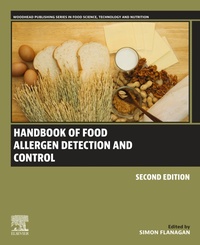
Handbook of Food Allergen Detection and Control
2nd Edition
Published on 17. March 2025
448 pages
978-0-323-98416-4 (ISBN)
Description

Handbook of Food Allergen Detection and Control, Second Edition continues to be an essential resource of scientific and technical information in the food and analytical communities. This book provides information on current and emerging technologies for detecting and reducing allergens to improve allergen control overall. Written by experts in the field, it offers a wide scientific perspective on allergens and includes hot topics such as food allergen labeling and consumer perspectives on food allergen labels. Chapters are fully revised to include the latest information in the industry, including practical applications of new methods and control strategies. The book is useful for anyone in the food supply chain.The book reviews current and emerging technologies for detecting and reducing allergens, as well as issues such as traceability, regulation, and consumer attitudes. Following an introductory chapter by a distinguished expert, Part One covers allergen management throughout the food chain. Part Two details current and emerging methods of allergen detection in food, with Part Three covering methods for reducing and eliminating allergens in food. Finally, Part Four focuses on the control and detection of individual food allergens and the risks each one presents in food manufacturing.
- Provides new insights from clinical studies such as allergy treatments and thresholds
- Presents new developments in risk assessment, and in the risk management of allergens
- Includes the application of new methods and sampling strategies for food allergens
More details
Other editions
Additional editions
Simon Flanagan
Handbook of Food Allergen Detection and Control
Book
06/2025
2nd Edition
Woodhead Publishing
€303.50
Shipment within 15-20 days
Previous edition
Simon Flanagan
Handbook of Food Allergen Detection and Control
E-Book
10/2014
Woodhead Publishing
€240.00
Available for download
Content
Part I Managing allergens in the food chain1. Introduction to food allergy2. Regulatory aspects of allergen management in the food chain3. Traceability of allergens in the food chain4. Developing food allergen management thresholds5. Assessment and communication of allergen risks in the food chain6. Labelling of food allergens and packaging issues7. Consumer attitudes to allergens in foodPart II Detecting allergens in food8. Sampling for allergens in food9. ELISA assays for detecting allergens in food10. Lateral flow devices for detecting allergens in food11. Biosensors for detecting allergens in food12. PCR methods for detecting allergens in food13. Optical thin film biochips for detecting allergens in food14. IgE analysis for detecting allergens in food15. Validation, standardisation and harmonisation of analytical methods and test kits for detecting allergens in foodPart III Methods of reducing/eliminating allergens in food16. Hygienic design and cleaning as an allergen control measure17. Genetic manipulation for reducing allergens in18. Heat treatment as an allergen control measure19. Minimal processing for reducing allergens in food20. Quality control systems for reducing allergens in foodPart IV Control and detection of specific food allergens21. Milk as a food allergen22. Eggs as a food allergen23. Peanuts as a food allergen24. Tree nuts as food allergens25. Soybeans as a food allergen 26 Gluten as a food allergen27. Fish, shellfish and molluscs as food allergens29. Mustard and sesame as food allergens30. Emerging allergens in food
