

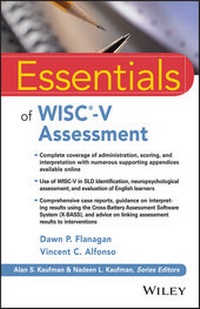
Essentials of WISC-V Assessment
Description

Essentials of WISC-V Assessmentprovides step-by-step guidance for administering, scoring, and interpreting the Wechsler Intelligence Scale for Children (WISC-V). Packed with practical tips for more accurate assessment, this informative guide includes numerous case studies that illustrate a range of real-world issues. Special attention is devoted to the assessment of individuals who have significant learning difficulties, such as learning disabilities, and who speak English as a second language. The WISC-V is a valuable assessment tool, but it must be administered and scored appropriately to gain meaning from score interpretation. This book gives you an in-depth understanding of the WISC-V assessment and interpretive process to assist practitioners in:
- Conducting efficient and informative WISC-V assessments
- Utilizing WISC-V in cross-battery and neuropsychological assessment
- Applying WISC-V in the identification of specific learning disabilities
- Utilizing WISC-V in nondiscriminatory assessment of English language learners
- Writing theory-based WISC-V reports
- Linking WISC-V findings to interventions based on individual performance
As the world's most widely-used intelligence test for children, the WISC-V is useful in diagnosing intellectual disabilities and specific learning disabilities, as well as in identifying giftedness. In this volume, sample reports demonstrate how WISC-V assessment results may be linked to interventions, accommodations, modifications, and compensatory strategies that facilitate positive outcomes for children. Essentials of WISC-V Assessment is the all-in-one practical resource for both students and practitioners. The book can be used on its own or with companion software (purchased separately) that provides a user-friendly tool for producing psychometrically and theoretically defensible interpretations of WISC-V performance, and may be used to develop interventions based on each child's strengths and weaknesses.
More details
Other editions
Additional editions
Persons
Dawn P. Flanagan, PhD, is Professor of Psychology at St. John's University and Clinical Assistant Professor of Psychology at Yale Child Study Center, Yale University School of Medicine. She serves as an expert witness, learning disabilities consultant, and psychoeducational test/measurement consultant and trainer for national and international organizations. Dr. Flanagan is an author of numerous publications and best known for her development of the Cross-Battery Assessment approach and the development of an operational definition of specific learning disability.
Vincent C. Alfonso, PhD, is the Dean of School of Education at Gonzaga University. He is the past president of Division 16 (School Psychology) of the American Psychological Association, fellow of Divisions 16 and 5 of the APA, and a certified school psychologist and licensed psychologist. He has been providing psychoeducational services to individuals across the lifespan for more than 20 years. He is the co-editor with Dawn Flanagan of Essentials of Specific Learning Disability Identification, and co-author of Essentials of Cross-Battery Assessment, Third Edition.
Content
Acknowledgments xi
Series Preface xiii
Foreword xv
Susie Engi Raiford
One Overview of the WISC-V 1
W. Joel Schneider, Dawn P. Flanagan, and Vincent C. Alfonso
Two How to Administer the WISC-V 53
Three How to Score the WISC-V 133
Four How to Interpret the WISC-V 167
Five Strengths and Weaknesses of the WISC-V 279
Six A Neuropsychological Approach to Interpretation of the WISC-V 287
George McCloskey, Jamie Slonim, Robert Whitaker, Samantha Kaufman, and Naoko Nagoshi
Seven Use of the WISC-V in the Identification of Specific Learning Disabilities 405
Eight Illustrative Case Report 511
Erin M. McDonough
Nine Assessment of English Learners With the WISC-V 539
Samuel O. Ortiz, Kristan E. Melo, and Meghan A. Terzulli
Ten WISC-V and Q-interactive 591
Carlea Dries, Ron Dumont, and Kathleen D. Viezel
Epilogue Dorothea McCarthy Remembered 617
Alan S. Kaufman
Appendices A-F can be accessed and downloaded from https://www.wiley.com/Essentials+of+WISC-V+Assessment-p- 9781118980996
Appendix A A Brief Overview of the Cattell-Horn-Carroll (CHC) Theory
Appendix B Norms Tables for New WISC-V Clinical Composites
Appendix C Case Reports
Gail Cheramie, Jamie Chaffin, and Robert Lichtenstein
Appendix D Form for Manifestations of Cognitive Weaknesses
Appendix E Definition of Terms and Clarification of Concepts Used in the Dual Discrepancy/ Consistency Model of SLD and the Cross-Battery Assessment Software System (X-BASS)
Appendix F Task Characteristics of WISC-V Subtests
Marlene Sotelo-Dynega
About the Authors 621
Contributors 622
Index 623
Foreword
Susie Engi Raiford
In February 2015, the National Association of School Psychologists (NASP) held their first annual convention after the publication of the Wechsler Intelligence Scale for Children-Fifth Edition (WISC-V; Wechsler, 2014). The manuals and data were available, and many school districts had purchased the test. Drs. Dawn Flanagan and Vincent Alfonso were to give a talk about use of the WISC-V in the context of their cross-battery assessment (XBA) approach to interpretation.
I arrived late to a room with a capacity for 200 people. Every seat was full, and dozens of additional people stood in the back and sat crammed in the aisles on the floor. It was hot and crowded, but the room was buzzing with excitement and anticipation. Attendees delighted as Dawn and Vinny joked about the tight space and the fire code, but no attendees left and more hopefuls crowded around the door in the foyer. The school psychology field knew this was a big moment.
I sat quietly in the aisle, snapping pictures and awaiting their thoughts about use of the test that had been carefully and thoughtfully nurtured through a five-year revision process to publication. When you are involved in conceptualization and design of the WISC-V from beginning to end, you watch it take shape and pour your life into it on a daily basis. As its research director, you revise and write items, author the manuals, oversee data collection and scoring, ensure its technical integrity and quality, and help to launch and support it. The feeling is akin to bearing and raising a child, and NASP 2015 felt like the first day of kindergarten.
It was with good reason, then, that I was sitting on the edge of my metaphorical seat (since no real seats were available) awaiting their talk. XBA transcends individual instruments and focuses instead on comprehensively addressing referral questions (Flanagan, Ortiz, & Alfonso, 2013). However, XBA is highly relevant to the clinical utility of individual tests. The modern Wechsler scales are influenced by XBA and Dawn, Vinny, and colleagues' dual discrepancy/consistency pattern of strengths and weaknesses (PSW) method for learning disability identification (Flanagan, Alfonso, Mascolo, & Sotelo-Dynega, 2012). Using dialectical reasoning processes, the Wechsler theoretical framework of intelligence simultaneously considers these important works alongside other structural models of intellect, clinical utility evidence (e.g., clinical sensitivity, predictive validity, neuroscience), functional models of cognition (e.g., neuropsychological processing theory), and specific ability models (e.g., working memory). The Wechsler theoretical framework informs development to ensure each revision of the WISC is innovative, contemporary, and draws on the best that these different lines of inquiry have to offer.
Dawn, Vinny, and colleagues' collective writings also resonate with the modern Wechsler theoretical framework. They have sought in their own conceptualization of cognitive assessment to link and reconcile the same approaches to their own. For example, they have linked Cattell-Horn-Carroll with the Lurian and neuropsychological approaches (Flanagan, Alfonso, Ortiz, & Dynda, 2010) and have incorporated George McCloskey's neuropsychologically oriented process approach to psychoeducational evaluations (McCloskey, Hartz, & Slonim, 2016) into their own interpretive systems (Flanagan & Kaufman, 2005, 2009). Essentials of WISC-V Assessment features interpretation from the general to the specific in the spirit of Alan Kaufman's intelligent testing, beginning with global score selection (e.g., FSIQ, GAI, or NVI) and interpretation at the index score level. Their approach acknowledges that assessment is part science and part art: potentially clinically meaningful findings are investigated further. McCloskey's process approach (see Chapter 6) provides optional analyses that permit the test user to examine weaknesses through drilling down to the subtest and item level to examine the multiple processes involved in carrying out any WISC-V task.
Dawn and Vinny have the breadth and depth of knowledge and practicality that comes from devouring every article about assessment and test technical manual that was available and mentoring trainees and practitioners for decades. As a result, their thinking is steeped in psychometric knowledge and clinical utility, and seeks what will be useful in practice and clear to clinicians. Their approaches to interpretation of test results endeavor to link science to practice in ways that are understandable and useful. They don't just achieve this goal, they knock the ball out of the park. Their model is beautiful in its simplicity and sophistication; a masterpiece of practicality built on a strong theoretical foundation and psychometric excellence. Practitioners who follow their approach to comprehensive assessment and interpretation find it accessible and effective.
Research- and theory-based approaches to cognitive test interpretation now dominate the cognitive assessment scene (Kamphaus, Winsor, Rowe, Kim, & 2012), and they are here to stay. A systematic approach based firmly on research and theory helps us to make sense of the data we obtain so that we can explain assessment results to teachers and parents in a way that makes sense and that is defensible theoretically and empirically, and can help children to learn successfully. The sum total of human knowledge now doubles every 12 months and is projected soon to double every 12 hours (IBM, 2006). That knowledge is accessible to nearly everyone in the digital age, so teachers and parents expect answers that make sense and have scientific merit. Clinicians who approach test interpretation from sound underlying theoretical frameworks that stand up to psychometric investigations and are bolstered by neuroscience, such as the system presented in Essentials of WISC-V Assessment, are at a distinct advantage and are more likely to be able to help more children to learn effectively.
Remarkably, Dawn and Vinny don't rest on their laurels. They are keen to improve upon their methods. They seek criticism of their models and make refinements in response to new empirical findings. For example, Essentials of WISC-IV Assessment (Flanagan & Kaufman, 2005, 2009) recommended that if a 23-point discrepancy was present between the highest and lowest index scores, the FSIQ was to be considered invalid and should not be interpreted. Essentials of WISC-V Assessment marks a departure from this recommendation, in response to psychometric investigations demonstrating that such a discrepancy is quite common in both normative and clinical samples (Kaufman, Raiford, & Coalson, 2016; Orsini, 2014; Raiford & Coalson, 2014) and that cognitive ability composite scores show equal predictive validity in relation to achievement whether or not such a discrepancy is present between its component parts (Daniel, 2007, 2009). In response, Essentials of WISC-V Assessment features an updated interpretation approach to the WISC-V that relies on base rates to determine what is unusual, rather than using a cutoff of 23 points. Furthermore, the FSIQ is not considered invalid, but merely lacking sufficient detail to describe the child's abilities comprehensively.
Given their works' influence on the field in general and on the Wechsler theoretical framework in particular, it should come as no surprise that XBA, the dual-discrepancy PSW approach, and the modern WISC-V are highly compatible. The test was designed from the start to accommodate XBA and to complement cutting-edge achievement instruments such as the KTEA-3 (Kaufman & Kaufman, 2014) and the WIAT-III (Pearson, 2009) to optimize use within PSW approaches. When the WISC-V is administered with one of these measures, together they cover the major cognitive processes that have been shown to be important to learning and sensitive to learning problems and are necessary for PSW analyses (Breaux & Lichtenberger, 2016).
I held my breath as their presentation began. It quickly became apparent to me that they had detected the careful planning that went into the WISC-V. They discussed slide after slide that showed which WISC-V subtests and index scores would be appropriate measures of the constructs research had shown important to reading, math, and written expression skills. Their verdict? The new WISC-V has great utility within XBA. I looked around me at these school psychologists hanging on their every word and was overwhelmed with a sense of gratitude because Dawn and Vinny are helping clinicians to use the WISC-V well and impacting thousands of children by helping them to learn effectively. I exhaled as I remembered what I remind myself of on a daily basis: The test isn't my kid, it's for the kids. That's why we do what we do.
Because of the WISC-V's compatibility with XBA, this book provides interpretive assistance through a link with the XBA using the Cross-Battery Assessment Software System (X-BASS; Ortiz, Flanagan, & Alfonso, 2017). Administration and scoring are reviewed in depth in Chapters 2 and 3, with the helpful "Essentials" features and callout boxes that highlight important points to remember and provide strategies to avoid common errors. New clinical composites, exclusive analyses with the actual WISC-V standardization data, and a fresh approach to interpretation arm the reader with invaluable insights in the use and interpretation of the contemporary WISC-V.
References
- Breaux, K. C.,...
