

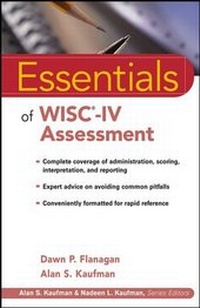
Essentials of WISC-IV Assessment
Published on 28. October 2004
374 pages
978-0-471-70370-9 (ISBN)
Description

A successor to the extremely popular Essentials of WISC-III/WPPSI-R Assessment(0-471-34501-6), Essentials of WISC-IV Assessment provides beginning and seasoned clinicians comprehensive guidelines to administering, scoring, and interpreting the latest revision of the Wechsler Intelligence Scales for Children. Featuring the popular Essentials format of call-out boxes, Test Yourself questions and step-by-step instructions, this handy resource also includes strengths and weaknesses of the instrument, practical clinical applications, and illustrative case reports. This detailed guide to using this immensely popular measure of intelligence is a must-have for anyone involved in the psychological testing of children.
More details
Persons
Dawn P. Flanagan, PhD, is a Professor of Psychology at St.John's University, Jamaica, New York, and the author ofseveral books, including Essentials of Cross-Battery Assessment(with Ortiz) and Essentials of WJ III® Cognitive AbilitiesAssessment (with Schrank, Woodcock, and Mascolo). The theory uponwhich the WISC®-IV is interpreted in this book-CHCtheory-was first introduced in Dr. Flanagan's book onthe Wechsler Scales, published in 2000 (with McGrew and Ortiz).
Alan S. Kaufman, PhD, is a Professor at Yale University Schoolof Medicine and is a series editor for the Essentials ofPsychological Assessment series. He has written numerous books onthe Wechsler Scales and intelligence testing, and is the author ofseveral widely used assessment instruments.
Content
Series Preface.
One: Introduction and Overview.
Two: How to Administer the WISC-IV.
Three: How to Score the WISC-IV.
Four: How to Interpret the WISC-IV.
Five: Strengths and Weaknesses of the WISC-IV.
Six: Clinical Applications: A Review of Special Group Studieswith the WISC-IV and Assessment of Low-Incidence Populations.
Seven: Clinical Applications: Assessment of Gifted, LearningDisabled, and Culturally and Linguistically DiversePopulations.
Eight: Illustrative Case Reports.
Appendix A: Definitions of CHC Abilities.
Appendix B: CHC Abilities Measured by Major IntelligenceTests.
Appendix C: WISC-IV Subtest g-Loadings, by Age Group andOverall Sample.
Appendix D: Psychometric, Theoretical, and QualitativeCharacteristics of the WISC-IV.
Appendix E: WISC-IV Interpretive Worksheet.
Appendix F: General Ability Index (GAI) Conversion Table.
Appendix G: Summary of Analyses of WISC-IV Indexes.
Appendix H: Norms Tables for Clinical Clusters.
References.
Annotated Bibliography.
Index.
Acknowledgments.
Authors.
Contributors.
