

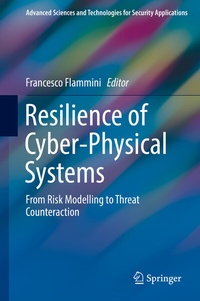
Resilience of Cyber-Physical Systems
Description

This book addresses the latest approaches to holistic Cyber-Physical System (CPS) resilience in real-world industrial applications. Ensuring the resilience of CPSs requires cross-discipline analysis and involves many challenges and open issues, including how to address evolving cyber-security threats.
The book describes emerging paradigms and techniques from two main viewpoints: CPSs' exposure to new threats, and CPSs' potential to counteract them. Further, the chapters address topics ranging from risk modeling to threat management and mitigation. The book offers a clearly structured, highly accessible resource for a diverse readership, including graduate students, researchers and industry practitioners who are interested in evaluating and ensuring the resilience of CPSs in both the development and assessment stages.
More details
Other editions
Additional editions
Person
He has been an ACM Distinguished Speaker and Adjunct Professor of Computer Science (University of Naples) and Software Engineering (Second University of Naples), and he is regularly teaching seminars in post-degree courses on Homeland Security (University of Rome Campus Biomedico - Italy, University of Girona - Spain). He is presently an Adjunct Professor of Cybersecurity at the University of Maryland University College (UMUC) Europe.
He has authored more than 80 scientific publications and he has served as an editor-in-chief, guest editor, chairman, invited speaker, member of the International Program Committee, and a reviewer for several international books, journals, workshop and conferences on computer safety, reliability and security.
For his research and innovation activity, he has won several awards, including best paper awards, business plan and innovation awards.
He is an IEEE Senior Member and the Chairman of the Technical Committee on Homeland Security of the IEEE Systems, Man and Cybernetics (SMC) Society. He has served as the Vice-Chair of the IEEE Computer Society Italy Chapter. He is also a member of Formal Methods Europe (FME), of the European Workshop on Industrial Computer Systems Reliability, Safety and Security (EWICS TC7), of theERCIM Working Group on Formal Methods for Industrial Critical Systems (FMICS), and of the ESRA TC on Operational Safety and Security of Interconnected Critical Infrastructures.
