

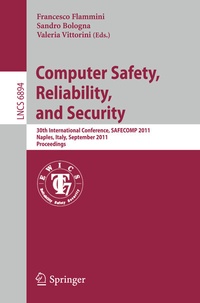
Computer Safety, Reliability, and Security
30th International Conference, SAFECOMP 2011, Naples, Italy, September 19-22, 2011, Proceedings
Published on 15. September 2011
XI, 482 pages
978-3-642-24270-0 (ISBN)
Description

This book constitutes the refereed proceedings of the 30th International Conference on Computer Safety, Reliability, and Security, SAFECOMP 2011, held in Naples, Italy, in September 2011.
The 34 full papers presented together were carefully reviewed and selected from 100 submissions. The papers are organized in topical sections on RAM evaluation, complex systems dependability, formal verification, risk and hazard analysis, cybersecurity and optimization methods.
More details
Other editions
Additional editions
Francesco Flammini | Sandro Bologna | Valeria Vittorini
Computer Safety, Reliability, and Security
30th International Conference, SAFECOMP 2011, Naples, Italy, September 19-22, 2011, Proceedings
Book
09/2011
Springer
€53.49
Shipment within 7-9 days
Content
- Title
- Preface
- Organization
- Table of Contents
- Session 1: Ram Evaluation 1'
- The Effect of Correlated Failure Rates on Reliability of Continuous Time 1-Out-of-2 Software
- Motivation
- The Problem
- Model of the System
- Diagrammatic Representation of the Model
- Möbius Model Parameters
- Measure of Interest
- Littlewood's Semi-markov Model of Software Reliability
- Discussion
- Relevant Literature
- Conclusion and Future Work
- References
- Model-Driven Availability Evaluation of Railway Control Systems
- Introduction
- The MARTE-DAM Profile
- A DAM Extension for Maintenance and Fault Tolerance
- Automated Generation of RFT Models
- The Radio Block Centre
- DAM Model
- Generation of the RFT Model
- Conclusions and Future Work
- References
- Session 2: Complex Systems Dependability 1
- Vertical Safety Interfaces - Improving the Efficiency of Modular Certification
- Introduction
- Related Work
- Running Example
- The Interface Language
- Common Language
- Application Language
- Platform Language
- Industrial Evaluation
- Conclusion and Future Work
- References
- DALculus - Theory and Tool for Development Assurance Level Allocation
- Introduction
- Development Assurance Level Allocation Process
- Aims of the DAL
- DAL Allocation Rules According to ARP4754a
- Item Independence According to ARP4754A
- DAL Allocation as a Constraint Satisfaction Problem
- Independence Identification
- DAL Allocation
- Tool Support and Experimentations
- Pseudo-Boolean Constraint Solving
- The DALculator
- Lessons Learnt from the First Experimentations
- Conclusion and Perspectives
- Related Work
- Perspectives
- References
- Towards Cross-Domains Model-Based Safety Process, Methods and Tools for Critical Embedded Systems: The CESAR Approach
- Introduction
- State of the Art and of the Practice
- Safety Standards
- Safety Process and Methods: The Safety Views
- Safety Requirements for the Reference Technology Platform
- Safety Process
- Challenges of Process Modelling
- The CESAR Approach to Process Modelling
- Requirements Engineering
- Preliminary Assessment and Way Forward
- References
- Session 3: Formal Verification 1
- From Probabilistic Counterexamples via Causality to Fault Trees
- Introduction
- Counterexamples and Fault Trees
- Computing Fault Trees from Counterexamples
- Case Study
- Related Work
- Conclusion
- References
- Rigorous Evidence of Freedom from Concurrency Faults in Industrial Control Software
- Introduction - Intrinsic Software Faults
- Tool-Based Methodology - Outline
- Theoretical Framework and Tools
- Static Analysis for Model Extraction and the MIEL Tool
- Geometric Semantics for Concurrency Analysis, ALCOOL Tool
- Case Study
- Industrial Control System Software
- Verification of Synchronization Properties
- Related Work
- Conclusion
- References
- Session 4: Risk and Hazard Analysis
- Evolutionary Risk Analysis: Expert Judgement
- Changes and Risks
- Related Work on Risk Analysis
- ATM Case Study
- Organisational Level Change
- Security Properties
- Model-Driven Risk Analysis: The CORAS Approach
- Expert Judgement in Evolutionary Risk Analysis
- Conclusions
- References
- Computer-Aided PHA, FTA and FMEA for Automotive Embedded Systems
- Introduction
- Related Work
- Safety Engineering Workflow
- Computer-Aided Checking
- Automated Synthesis
- Model Correction
- Fault Tree and FMEA Table Synthesis
- Experimental Evaluation
- Conclusion
- References
- Session 5: Cybersecurity
- A Statistical Anomaly-Based Algorithm for On-line Fault Detection in Complex Software Critical Systems
- Introduction
- The Detection Framework
- Assumptions
- The Detection Approach
- Limitations of the Static Thresholds
- Using SPS Algorithm to Estimate Adaptive Thresholds
- SPS-Based Detection Algorithm
- SPS Assumptions
- The Detector Equipped with SPS
- Comparison between Adaptive and Static Thresholds Algorithm
- Metrics for Performance Evaluation
- Experimental Campaign
- Case Study Description
- The Experimental Activity
- The Post Processing Phase
- Results Analysis
- Conclusion and Future Work
- References
- Security Analysis of Smart Grid Data Collection Technologies
- Rationale and Contribution
- Smart Grids and Phasor Measurement Units
- Experimental Testbed and Campaign
- Testbed Setup
- Key Findings and Results
- Conclusions
- References
- Session 6: RAM Evaluation 2
- Modeling Aircraft Operational Reliability
- Introduction
- Description of Mission Achievement
- Related Work
- Modeling Approach
- Structure of the Model
- SANs Formalism
- CMS Presentation
- The Model
- The System Level Sub Model
- The Requirement Level Sub Model
- The Operational Level Sub Model
- The Global Model
- Example of Results
- Conclusion
- References
- An Integrated Approach for Availability and QoS Evaluation in Railway Systems
- Introduction
- Quality of Service and Service Availability for a Railway System
- Quality of Service and Passengers Satisfaction
- Service Availability in Railway Systems
- Relationships between QoS and SA in Railway Systems
- Simulation System Architecture
- Operational Strategies Module
- State of Subsystems Module
- Passengers Travel Demand Module
- Movement on Track Module
- Case Study: A Mass Rapid Transit System
- First Operational Strategy: Return to Depot and Successively Substitution
- Second Operational Strategy: Preventive Insertion
- Third Operational Strategy: Store Away on Pocket Track
- Conclusions and Future Works
- References
- Session 7: Case Studies
- Using a Software Safety Argument Pattern Catalogue: Two Case Studies
- Introduction
- Software Safety Argument Pattern Catalogue
- Identifying Assurance Deficits
- Case Studies
- Prototype Autonomous Vehicle Case Study
- Aircraft Safety Critical Software System Case Study
- Conclusions
- References
- Integration of a System for Critical Infrastructure Protection with the OSSIM SIEM Platform: A dam case study
- Introduction
- Related Work
- Use of SIEMs for Critical Infrastructure Protection
- Advanced Monitoring and Control for Dam Infrastructure
- Dam Monitoring and Control
- Dam Sensors
- SIEMs Overview
- OSSIM
- Changing the SIEMs to Provide Safety
- Examples of Misuses and Malicious Activities on the Dam Monitoring and Control System
- Customizing OSSIM to Process New Events
- Conclusion and Future Works
- References
- A Case Study on State-Based Robustness Testing of an Operating System for the Avionic Domain
- Introduction
- Related Work
- Testing Approach
- Modeling the File System
- Experimentation
- Experimental Setup
- Results
- Conclusion and Future Work
- References
- Session 8: Formal Verification 2
- Formal Methods for the Certification of Autonomous Unmanned Aircraft Systems
- Introduction
- Approach
- Paper Structure
- Model Checking
- Selecting Rules of the Air for Model Checking
- Reactive UAS Agents
- Modelling a Reactive UAS Agent in Promela
- Model Checking the Rules of the Air in Spin
- Rational UAS Agents
- Model Checking Reasoning UAS Agents
- Model Checking More Advanced Autonomy in UAS Agents
- Conclusions
- Impact
- Related and Future Work
- References
- Verifying Functional Behaviors of Automotive Products in EAST-ADL2 Using UPPAAL-PORT
- Introduction and Main Themes
- Background
- EAST-ADL2
- UPPAAL-PORT
- Approach and Proposed Solution
- Architecture and Behavioral Semantics Mapping
- Behavior Specification
- Verification: Model Checking
- Current Result and Example
- Related Work
- Conclusion and Future Work
- References
- Poster Session
- Establishing Confidence in the Usage of Software Tools in Context of ISO 26262
- Introduction
- State of the Art
- Problem Statement
- Proposed Approach
- Project Analysis
- Workflow Analysis
- Working Step Analysis
- Use Case Determination
- Identification of Tool Errors
- Analysis of Error Prevention and Detection
- Conclusion and Outlook
- References
- Fault-Based Generation of Test Cases from UML-Models - Approach and Some Experiences
- Introduction and Motivation
- Related Work
- Fault-Based Test Case Generation (FBTCG) from UML in MOGENTES
- Terms and Concepts
- Test Case Generation Steps
- The MOGENTES UML/OOAS Tool Chain
- Example Use Case - Car Alarm System (CAS)
- Results and Discussion
- Test Case Generation
- Source Code Coverage with Model-Based Test Case Generation
- Modeling Experiences
- Test Case Application - Adaptive Test Cases
- Summary and Outlook
- References
- ISO/IEC 15504-10: Motivations for Another Safety Standard
- Introduction
- ISO/IEC 15504-10 Safety Extension
- ISO/IEC 15504: Overview
- ISO/IEC 15504-10: Overview
- Comparison of ISO/IEC 15504-10 with the IEC 61508 Family Standards
- Integrating ISO/IEC 15504-10 with Existing Safety Standards
- Conclusions
- References
- Automatic Synthesis of SRN Models from System Operation Templates for Availability Analysis
- Introduction
- Availability Model Synthesis Method
- Definition of System Designs
- Overview of Availability Assessment Process
- Approach for Availability Model Synthesis
- Availability Model Synthesis Process
- Case Study
- Classification of Operations
- Numerical Example
- Summary and Future Work
- References
- A Collaborative Event Processing System for Protection of Critical Infrastructures from Cyber Attacks
- Introduction
- Cyber Attacks: Distributed Stealthy Port Scan
- Collaborative Port Scan Detection System Architecture
- Line Fitting Implementation in Esper
- Experimental Evaluation
- Related Work
- Concluding Remarks
- References
- A Fault-Tolerant, Dynamically Scheduled Pipeline Structure for Chip Multiprocessors
- Introduction
- Background
- Superscalar Processors
- The Proposed Technique
- Hardware Details
- Highly-Reliable Mode
- High-Performance Mode
- Switching between High-Performance and Highly-Reliable Mode
- Experimental Results
- Fault Model
- Results
- Related Work
- Conclusion
- References
- FloGuard: Cost-Aware Systemwide Intrusion Defense via Online Forensics and On-Demand IDS Deployment
- Introduction
- Architecture
- Vulnerability-Detector DB
- Attack Graph Templates
- Intrusion Forensics
- Monitor Selection
- Evaluations
- Related Work
- Conclusion
- References
- Reducing Complexity of Data Flow Testing in the Verification of a IEC-62304 Flexible Workflow System
- Introduction
- Testing Requirements for a Computer Assisted Surgery System
- Testing Requirements for IEC 62304
- Abstraction and Problem Formulation
- Data Flow Perspective
- Reducing Complexity through Design for Testability
- Reducing Complexity through Test Equivalence
- Application to Our Case Study
- Conclusions
- References
- Improvement of Processes and Methods in Testing Activities for Safety-Critical Embedded Systems
- Introduction
- ERTMS Level 1 and ASTS Pilot Application
- State of Art in Testing Activities
- Technical Innovation Needed in Testing Activities
- Proposed Solution: ASTS Pilot Application
- Instance of RTP with ASTS Use Case
- DODT (Domain Ontology Design Tool)
- Example of Requirements Formalization
- ATG (Automatic Test Generator)
- Results
- Conclusions and Way Forward
- References
- Session 9: Formal Verification 3
- On the Adoption of Model Checking in Safety-Related Software Industry
- Introduction
- Background: Model Checking and Temporal Logic
- Safety Guidelines
- Safety Integrity Level
- Revision of Current Guidelines
- Tool Qualification
- Safety Properties
- Bounded Model Checking of Safety Properties
- Adoption of Model Checking
- Model Checking within Model Based Design
- Software Model Checking
- Abstraction
- Counterexample-Guided Abstraction Refinement
- Software Model Checkers
- Conclusions
- References
- Equivalence Checking between Function Block Diagrams and C Programs Using HW-CBMC
- Introduction
- Related Work
- Equivalence Checking
- Function Block Diagram
- Transformation from FBDs into Verilog
- HW-CBMC
- Equivalence Checking
- Equivalence Checking Process
- Verilog Program for HW-CBMC
- Case Study
- th_X_Pretrip Program
- Implementation of ANSI-C Program
- Euqivalence Checking
- Conclusion
- References
- A Framework for Simulation and Symbolic State Space Analysis of Non-Markovian Models
- Introduction
- Sirio Functional Responsibilities
- Sirio Base Libraries
- Sirio Tools
- Sirio SW Architecture: Base Libraries
- Petri Net Library
- Symbolic Calculus Library
- Sample Generator Library
- Sirio SW Architecture: Tools
- Simulation Tool
- Analysis Tool
- Conclusions
- References
- Session 10: Optimization Methods
- Model-Based Multi-objective Safety Optimization
- Introduction
- Case Study
- Model-Based Safety Analysis
- Formal Model Construction
- Qualitative Safety Analysis
- Quantitative Safety Analysis
- Summary
- Model-Based Safety Optimization
- Multi-objective Optimization
- Safety Optimization
- Optimization of the Case Study
- Selection of System Design
- Related Work
- Conclusion
- References
- Tradeoff Exploration between Reliability, Power Consumption, and Execution Time
- Introduction
- Principle of the Method and Overview
- Models
- Application Algorithm Graph
- Architecture Model
- Execution Characteristics
- Static Schedules
- Voltage, Frequency, and Power Consumption
- Failure Hypothesis
- Global System Failure Rate (GSFR)
- The Tricriteria Scheduling Algorithm TSH
- Decreasing the Power Consumption
- Decreasing the GSFR
- Scheduling Heuristics
- Simulation Results
- Related Work
- Conclusion
- References
- Session 11: Complex Systems Dependability 2
- Criticality-Driven Component Integration in Complex Software Systems
- Introduction
- Related Work
- Integration Strategy
- Background: System Model and Criticality Levels
- Assumptions
- Algorithm
- Case Study
- ATC System
- Integration Strategy
- Failure-Modes Emulation Campaign
- ATC Components: Facade and Processing Server
- Analysis of the DDS_1
- Analysis of the DDS_2
- Design Implications and Lessons Learnt
- References
- On the Use of Semantic Technologies to Model and Control Security, Privacy and Dependability in Complex Systems
- Introduction
- Overview on Semantic Technologies
- The Requirements Workflow
- The Analysis Workflow
- The Design Workflow
- The Implementation Workflow
- TheTest Workflow
- pSHIELD Methodology
- Structural Ontology
- Functional Ontology
- SPD Ontology
- Application Scenario
- Conclusion and Future Works
- References
- Author Index
