

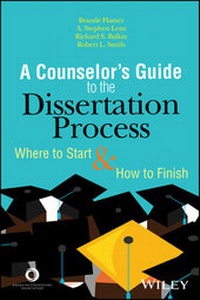
A Counselor's Guide to the Dissertation Process
Description

Reviews / Votes
"This book will help doctoral students in counselor education programs navigate the difficult waters of moving beyond 'ABD' to graduation. The authors demystify the dissertation process and illustrate how to avoid common pitfalls, stay on track, and successfully complete a dissertation. Students and their faculty will benefit from this easy-to-follow and fun guide for getting it done!" --Kelly Coker, PhD, Assistant Dean, School of Counseling, Walden University "This is exactly the kind of resource that every counseling doctoral student needs to be successful.The authors bring their wealth of experience to a book that is sure to inform, encourage, and guide students through their dissertation journeys. A true gem for counseling students and educators!" --Thelma Duffey, PhD, The University of Texas at San Antonio "This book offers a balanced and highly pragmatic stance toward the entire dissertation process, from conception of the research topic to dissemination of results to effect social change. Most helpful is a reminder that successful completion of the dissertation requires attention to the personal wellness of the doctoral student as a human being." --David M. Kleist, PhD, Idaho State UniversityMore details
Other editions
Additional editions
Persons
Brandé Flames, PhD, NCC, LPC is a licensed professional counselor and clinical professor in the Counseling and Special Populations department at Lamar University. She is also the CEO and Founder of the nonprofit Serving and Learning Together (SALT) world Inc., which provides volunteer services to developing countries.
A. Stephen Lenz is the author of A Counselor's Guide to the Dissertation Process: Where to Start and How to Finish, published by Wiley.
Richard S. Balkin, Ph.D., LPCC, NCC is a Professor and Doctoral Program Coordinator at the University of Louisville. Dr. Balkin is a Fellow of the American Counseling Association, the editor for the Journal of Counseling and Development, the flagship journal for the American Counseling Association, and past president for the Association for Assessment and Research in Counseling. Dr. Balkin has over 65 publications, which include textbooks, published tests and technical manuals.
Robert L. Smith is the author of A Counselor's Guide to the Dissertation Process: Where to Start and How to Finish, published by Wiley.
Content
- Cover
- Title Page
- Copyright
- Dedication
- Preface
- Acknowledgments
- About the Authors
- Chapter 1: The Doctoral Dissertation
- Chapter 2: Staying Well Throughout the Dissertation Process
- Appendix A: Example of a Student Wellness Plan
- Chapter 3: Selecting the Dissertation Committee and Narrowing Down the Topic
- How Do You Select a Committee?
- Roles of Committee Members and the Selection Process
- Managing Committee Issues: Politics and Personalities
- Recommendations for Addressing Political or Personality Issues
- How Do Doctoral Students Select a Dissertation Topic?
- Self-Assessment Inventory
- Guidelines for Selecting a Dissertation Topic
- Narrowing Down a Dissertation Topic
- Summary
- Checklist
- Additional Resources
- Chapter 4: Writing a Proposal
- Starting Out: Identifying What Constitutes a Proposal for Your Department
- The Dissertation Proposal Format: Traditional and Three-Chapter Proposals
- Review of Proposal Options
- Dissertation Proposal and Research Designs
- Additional Research Designs and Example Dissertation Proposal Outlines
- Recommendations for Writing a Successful Proposal
- Summary
- Checklist
- 12 Self-Assessments
- Additional Resources
- Appendix B: Example Quantitative Proposal
- Appendix C: Example Qualitative Proposal
- Chapter 5: The Literature Review
- Appendix D: Example of a Literature Review Outline
- Chapter 6: Creating the Problem Statement, Purpose Statement, and Research Questions
- Chapter 7: Research Methodology and Ethics
- Appendix E: Subject Informed Consent
- Appendix F: Subject Assent
- Chapter 8: Collecting and Analyzing Data
- Chapter 9: Presenting and Discussing the Results
- Chapter 10: Preparing for the Defense
- Chapter 11: Disseminating the Project to the Professional Community
- Appendix G: Example Authorship Agreement
- References
- Index
- Technical Support
- End User License Agreement
