

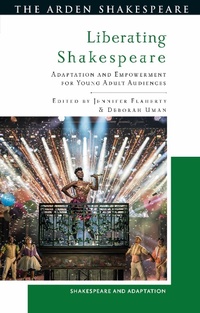
Liberating Shakespeare
Adaptation and Empowerment for Young Adult Audiences
1st Edition
Published on 18. May 2023
240 pages
978-1-350-32028-4 (ISBN)
Description

The collective trauma of the COVID-19 pandemic. Digital shaming. Violence against women. Sexual bullying. Racial slurs and injustice. These are just some of the problems faced by today's young adults. Liberating Shakespeare explores how adaptations of Shakespeare's plays can be used to empower young audiences by addressing issues of oppression, trauma and resistance.
Showcasing a wide variety of approaches to understanding, adapting and teaching Shakespeare, this collection examines the significant number of Shakespeare adaptations targeting adolescent audiences in the past 25 years. It examines a wide variety of creative works made for and by young people that harness the power of Shakespeare to address some of the most pressing questions in contemporary culture - exploring themes of violence, race relations and intersectionality.
The contributors to this volume consider whether the representations of characters and situations in YA Shakespeare can function as empowering models for students and how these works might be employed within educational settings. This collection argues that YA Shakespeare represents the diverse concerns of today's youth and should be taken seriously as art that speaks to the complexities of a broken world, offering moments of hope for an uncertain future.
Showcasing a wide variety of approaches to understanding, adapting and teaching Shakespeare, this collection examines the significant number of Shakespeare adaptations targeting adolescent audiences in the past 25 years. It examines a wide variety of creative works made for and by young people that harness the power of Shakespeare to address some of the most pressing questions in contemporary culture - exploring themes of violence, race relations and intersectionality.
The contributors to this volume consider whether the representations of characters and situations in YA Shakespeare can function as empowering models for students and how these works might be employed within educational settings. This collection argues that YA Shakespeare represents the diverse concerns of today's youth and should be taken seriously as art that speaks to the complexities of a broken world, offering moments of hope for an uncertain future.
More details
Series
Edition
1. Auflage
Language
English
Place of publication
London
United Kingdom
Publishing group
Bloomsbury Publishing PLC
Target group
College/higher education
Illustrations
5 bw illus
ISBN-13
978-1-350-32028-4 (9781350320284)
Copyright in bibliographic data and cover images is held by Nielsen Book Services Limited or by the publishers or by their respective licensors: all rights reserved.
Schweitzer Classification
Other editions
Additional editions
Jennifer Flaherty | Deborah Uman
Liberating Shakespeare
Adaptation and Empowerment for Young Adult Audiences
Book
06/2023
The Arden Shakespeare
€31.50
Shipment within 15-20 days
Persons
Jennifer Flaherty is Professor of English at Georgia College, USA. She co-edited Arden's The Taming of the Shrew: The State of Play (2021) with Heather Easterling. Her research emphasizes adaptation, global Shakespeare, and girlhood; her publications include articles on Young Adult appropriations of Ophelia and Macbeth, published in Borrowers and Lenders and Shakespeare and Millennial Fiction.
Deborah Uman is Professor of English and Dean of the Lindquist College of Arts & Humanities at Weber State University, USA. In addition to her monograph, Women Translators in Early Modern England (2011), she co-edited Staging the Blazon in Early Modern Theater (2013) with Sara Morrison and has published numerous essays on translation, adaptation and gender in Shakespeare's plays.
Deborah Uman is Professor of English and Dean of the Lindquist College of Arts & Humanities at Weber State University, USA. In addition to her monograph, Women Translators in Early Modern England (2011), she co-edited Staging the Blazon in Early Modern Theater (2013) with Sara Morrison and has published numerous essays on translation, adaptation and gender in Shakespeare's plays.
Content
List of Illustrations
Notes on Contributors
Acknowledgements
Introduction: Taking Young Adult Shakespeare Seriously, Jennifer Flaherty and Deborah Uman
Section I: Trauma and Survival
1. Teaching Romeo and Juliet in Plague Time: A Trauma-Informed Approach, Ariane Balizet (AddRan School of Liberal Arts, TCU, USA)
2. Nothing/Something: YA Much Ado Novels in the World of Digital Shaming and Virtual Outcasts, Laurie Osborne (Colby College, USA)
3. 'I will not be a frozen example, a statued monument': Self-Actualization After Trauma in Pandosto, The Winter's Tale, and Exit, Pursued by a Bear, Sara Morrison (William Jewell College, USA)
4. Exposing Hate: Violence of Racialized Slurs in Young Adult Adaptations of Shakespeare, Charlotte Spielman (Independent scholar, USA)
5. When Romeo and Juliet Fought the Texas Rangers: Race, Justice, and Appropriation in Shame the Stars by Guadalupe García McCall, Jesus Montaño (Hope College, USA)
6. Young Adults and the Position of Trauma in Adaptations of Shakespeare, M. Tyler Sasser (University of Alabama, USA)
Section II: Empowerment and Education
7. Ophelia: A New Hope, Natalie Loper (University of Alabama, USA)
8. 'You Should Be Women': The Figure of the Witch in YA adaptations of Shakespeare's Macbeth, Melissa Johnson (Texas Christian University, USA)
9. Intersectionality in Aoibhean Sweeney's Among Other Things, I've Taken Up Smoking, Lawrence Manley (Yale University, USA)
10. 'Hello, people of the Internet!': Nothing Much to Do and the Young Adult Creators and Communities of Vlog-Shakespeare, Jane Wanninger (Bard College at Simon's Rock, USA)
11. Emotion, Empathy, and the Internet: Transforming Shakespeare for Contemporary Teens, Jules Pigott (Screenwriter and director, USA)
12. Promoting Companion Texts for Reading Shakespeare Plays: Future Teachers, Young Adult Literature, and Connecting Adolescents to Romeo and Juliet, Laura Turchi (Arizona State University, USA)
Afterword: Adaptation Studies and Interactive Pedagogies, Alexa Alice Joubin (George Washington University, USA)
Selected Bibliography
Index
Notes on Contributors
Acknowledgements
Introduction: Taking Young Adult Shakespeare Seriously, Jennifer Flaherty and Deborah Uman
Section I: Trauma and Survival
1. Teaching Romeo and Juliet in Plague Time: A Trauma-Informed Approach, Ariane Balizet (AddRan School of Liberal Arts, TCU, USA)
2. Nothing/Something: YA Much Ado Novels in the World of Digital Shaming and Virtual Outcasts, Laurie Osborne (Colby College, USA)
3. 'I will not be a frozen example, a statued monument': Self-Actualization After Trauma in Pandosto, The Winter's Tale, and Exit, Pursued by a Bear, Sara Morrison (William Jewell College, USA)
4. Exposing Hate: Violence of Racialized Slurs in Young Adult Adaptations of Shakespeare, Charlotte Spielman (Independent scholar, USA)
5. When Romeo and Juliet Fought the Texas Rangers: Race, Justice, and Appropriation in Shame the Stars by Guadalupe García McCall, Jesus Montaño (Hope College, USA)
6. Young Adults and the Position of Trauma in Adaptations of Shakespeare, M. Tyler Sasser (University of Alabama, USA)
Section II: Empowerment and Education
7. Ophelia: A New Hope, Natalie Loper (University of Alabama, USA)
8. 'You Should Be Women': The Figure of the Witch in YA adaptations of Shakespeare's Macbeth, Melissa Johnson (Texas Christian University, USA)
9. Intersectionality in Aoibhean Sweeney's Among Other Things, I've Taken Up Smoking, Lawrence Manley (Yale University, USA)
10. 'Hello, people of the Internet!': Nothing Much to Do and the Young Adult Creators and Communities of Vlog-Shakespeare, Jane Wanninger (Bard College at Simon's Rock, USA)
11. Emotion, Empathy, and the Internet: Transforming Shakespeare for Contemporary Teens, Jules Pigott (Screenwriter and director, USA)
12. Promoting Companion Texts for Reading Shakespeare Plays: Future Teachers, Young Adult Literature, and Connecting Adolescents to Romeo and Juliet, Laura Turchi (Arizona State University, USA)
Afterword: Adaptation Studies and Interactive Pedagogies, Alexa Alice Joubin (George Washington University, USA)
Selected Bibliography
Index
