

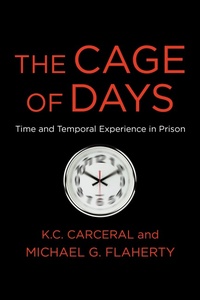
The Cage of Days
Time and Temporal Experience in Prison
1st Edition
Published on 19. April 2022
320 pages
978-0-231-55505-0 (ISBN)
Description

Prisons operate according to the clockwork logic of our criminal justice system: we punish people by making them "serve" time. The Cage of Days combines the perspectives of K. C. Carceral, a formerly incarcerated convict criminologist, and Michael G. Flaherty, a sociologist who studies temporal experience. Drawing from Carceral's field notes, his interviews with fellow inmates, and convict memoirs, this book reveals what time does to prisoners and what prisoners do to time.
Carceral and Flaherty consider the connection between the subjective dimensions of time and the existential circumstances of imprisonment. Convicts find that their experience of time has become deeply distorted by the rhythm and routines of prison and by how authorities ensure that an inmate's time is under their control. They become obsessed with the passage of time and preoccupied with regaining temporal autonomy, creating elaborate strategies for modifying their perception of time. To escape the feeling that their lives lack forward momentum, prisoners devise distinctive ways to mark the passage of time, but these tactics can backfire by intensifying their awareness of temporality. Providing rich and nuanced analysis grounded in the distinctive voices of diverse prisoners, The Cage of Days examines how prisons regulate time and how prisoners resist the temporal regime.
Carceral and Flaherty consider the connection between the subjective dimensions of time and the existential circumstances of imprisonment. Convicts find that their experience of time has become deeply distorted by the rhythm and routines of prison and by how authorities ensure that an inmate's time is under their control. They become obsessed with the passage of time and preoccupied with regaining temporal autonomy, creating elaborate strategies for modifying their perception of time. To escape the feeling that their lives lack forward momentum, prisoners devise distinctive ways to mark the passage of time, but these tactics can backfire by intensifying their awareness of temporality. Providing rich and nuanced analysis grounded in the distinctive voices of diverse prisoners, The Cage of Days examines how prisons regulate time and how prisoners resist the temporal regime.
More details
Other editions
Additional editions
Book
02/2022
Columbia University Press
€144.84
Shipment within 10-20 days
Book
02/2022
Columbia University Press
€37.14
Shipment within 10-20 days
Persons
K. C. Carceral (a pseudonym) was incarcerated for thirty-one years in twelve different prisons until his parole in 2013. He is the author of Behind a Convict's Eyes: Doing Time in a Modern Prison (2004) and Prison, Inc.: A Convict Exposes Life Inside a Private Prison (2006).
Michael G. Flaherty is professor of sociology at Eckerd College and the University of South Florida. He is the author of A Watched Pot: How We Experience Time (1999) and The Textures of Time: Agency and Temporal Experience (2011). He is a coeditor of Time Work: Studies of Temporal Agency (2020).
Michael G. Flaherty is professor of sociology at Eckerd College and the University of South Florida. He is the author of A Watched Pot: How We Experience Time (1999) and The Textures of Time: Agency and Temporal Experience (2011). He is a coeditor of Time Work: Studies of Temporal Agency (2020).
Content
Acknowledgments
Introduction
1. A Temporal Regime
2. Time and Space
3. Temporal Allowances
4. Serving Time
5. No Future on the Horizon
6. Marking Time
7. Resistance and Temporal Agency
Notes
Selected Bibliography
Index
Introduction
1. A Temporal Regime
2. Time and Space
3. Temporal Allowances
4. Serving Time
5. No Future on the Horizon
6. Marking Time
7. Resistance and Temporal Agency
Notes
Selected Bibliography
Index
