

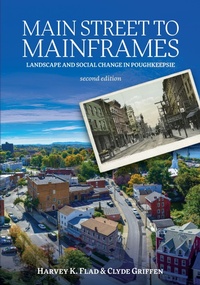
Main Street to Mainframes
Description

Traces the history of Poughkeepsie's development from the nineteenth through the twentieth and into the challenges of the twenty-first century.
Main Street to Mainframes is an in-depth study of a small American city and its evolution in the twentieth and early twenty-first century. It describes the economic and social changes, as well as the challenges that face the community. This includes Poughkeepsie's unique history and characteristics, as well as trends that are common in many other communities. The text integrates both social history and spatial analysis, describing the city's physical form through time along with its economic growth, decline, and efforts at renewal post-COVID-19 pandemic. The historical narrative is followed by an appendix containing examples of cultural features unique to Poughkeepsie's past and present, with questions that can serve as discussion points for readers and groups.
As an exploration of a small city that has undergone many of the social and economic problems of much larger urban systems, this book adds important insight into the organic nature of urban systems, including issues of immigration, ethnicity and race, housing and the unhoused, health care, and economic changes in the nation, especially in the growth of the creative and arts-centered economy.
More details
Other editions
Additional editions
Persons
Harvey K. Flad is Professor Emeritus of Geography at Vassar College. His recent publications include essays on the preservation of historic and cultural landscapes and the history of artists and landscape designers in the Hudson Valley. He lives in Poughkeepsie, New York. Clyde Griffen (1929-2015) was Lucy Maynard Salmon Professor Emeritus of American History. His previous books include Natives and Newcomers: The Ordering of Opportunity in Mid-Nineteenth-Century Poughkeepsie (with Sally Griffen) and Meanings for Manhood: Construction of Masculinity in Victorian America (coedited with Mark C. Carnes). He resided in Bowie, Maryland.
Content
List of Illustrations
Illustration Credits
Acknowledgments
Preface
Introduction
Part I. Before 1900
1. The Valley Setting
2. Poughkeepsie Grows from Village to City
3. Improvements and Conflicts in the Late Nineteenth Century
Part II. A Diversified Industrial Economy and Society
4. The Cityscape at the Turn of the Twentieth Century
5. A New Wave of Immigrants Changes the Citizenry
6. Municipal Reform and Urban Planning
7. Changes to the Space Economy Between the Wars
8. Business and Labor in the 1920s and 1930s
9. Depression in FDR's Home County
Part III. IBM Remakes the Region as Its Largest Employer
10. Technological Revolution Transforms the Region: IBM
11. IBM Triumphs with the 360 Mainframe Computer
12. The Quest for Inner-City Revitalization: Urban Renewal
13. Social Planning: The Model Cities Experiment
14. Issues and Causes of the 1960s
15. Change in Higher Education in the Valley
16. IBM Downsizes, but the Valley Recovers
Part IV. Postindustrial Poughkeepsie and the Valley
17. The Nonprofit Service Sector Grows in Importance
18. Hospitals in Transition
19. Main Street Struggles to Return Amid Suburban Sprawl
20. Civic Identity and Social Change in the 1990s
21. City and Region at the End of the Twentieth Century
22. City and Region from the End of the Twentieth Century into the Twenty-First
23. Main Street and the Twenty-First-Century Cultural Landscape
24. Landscapes of Social Change: 2010 to 2025
Appendices
A. Redlining: Poughkeepsie's Residential Security Map, 1938
B. Demographic Table: Population Change in Dutchess County, City, and Town of Poughkeepsie
C. "PO'KEEPSIE. MY KEEPSIE," complete poem by Bettina "Poet Gold" Wilkerson
D. Case Example 1 The Usable Past: Land Acknowledgment Practices
E. Case Example 2 The Usable Past: Citizens Create a New Neighborhood Park
F. Case Example 3 The Usable Past: Poughkeepsie Rowing After the Regatta
Notes
Annotated Bibliography
Index
