

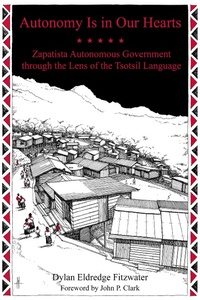
Autonomy Is in Our Hearts
Description

Following the Zapatista uprising on New Year's Day 1994, the EZLN communities of Chiapas began the slow process of creating a system of autonomous government that would bring their call for freedom, justice, and democracy from word to reality. Autonomy Is in Our Hearts analyzes this long and arduous process on its own terms, using the conceptual language of Tsotsil, a Mayan language indigenous to the highland Zapatista communities of Chiapas.
The words "Freedom," "Justice," and "Democracy" emblazoned on the Zapatista flags are only approximations of the aspirations articulated in the six indigenous languages spoken by the Zapatista communities. They are rough translations of concepts such as ichbail ta muk' or "mutual recognition and respect among equal persons or peoples," a'mtel or "collective work done for the good of a community" and lekil kuxlejal or "the life that is good for everyone." Autonomy Is in Our Hearts provides a fresh perspective on the Zapatistas and a deep engagement with the daily realities of Zapatista autonomous government. Simultaneously an exposition of Tsotsil philosophy and a detailed account of Zapatista governance structures, this book is an indispensable commentary on the Zapatista movement of today.
More details
Other editions
Additional editions
Persons
Dylan Eldredge Fitzwater has encountered the Zapatistas as a human rights observer, a participant in several international gatherings, and as a student at the Zapatista language school in Oventik. He currently lives in Portland, OR, and works at Burgerville, a regional Oregon fast-food chain, where he is an organizer for the Burgerville Workers Union, an affiliate of the Industrial Workers of the World.
Content
- Front Cover
- Title Page
- Half Title
- Copyright
- Contents
- Acknowledgments
- Foreword by John P. Clark
- Introduction
- "This Is Our Work": The Escuelita and the Zapatista Experiences of Autonomous Government
- The Study of Social Movements in Tsotsil: Pask'op
- Part One
- The History of Autonomous Government
- chapter one
- A Genealogy of Zapatista Political Aspirations: From the Dictatorship of the Proletariat to the Self-Determination of Peoples in Struggle
- The Zapatista Form of Liberation
- The Struggle for National Liberation
- The Revolution Within the Revolution: Zapatista Women's Struggle
- The Dangers of the EZLN's Military Hierarchy
- Conclusion
- Chapter Two
- The Zapatista Clandestine Organization: The Creation of a Collective Heart (O'on) and Collective Potentiality (Ch'ulel)
- The Tsotsil Understanding of Collective Heart (O'on) and Potentiality (Ch'ulel)
- Clandestine Organizing: The Creation of the Collective Heart of the EZLN
- Women's Participation in the Organization of the Collective Heart
- Strengthening the Collective Heart of the Organization between Communities
- Conclusion
- Chapter Three
- The Creation of the Caracoles: Relationships of Difference in the Collective Heart (Ko'ontik, Ko'onkutik)
- The Double Sense of Collectivity in Tsotsil
- Governing by Obeying: The Creation of the Autonomous Government
- Conclusion
- Part Two
- The Practice of Autonomous Government
- Chapter Four
- "The Community Has the Final Say": The Assembly and the Collective Work of Governance (A'mtel)
- A'mtel: Government as Work for Collective Survival
- Creation and Recreation of a Collective Heart: The Assembly of the Zone
- The Assembly of the Zone and the Creation of Trabajos Colectivos: An Example from La Realidad
- Zapatista Justice
- Conclusion
- Chapter Five
- Decolonizing Work: Zapatista Collective Work (A'mtel) and the Struggle against Systems of Desperation-Dependence-Displacement (Kanal)
- Cycles of Desperation-Dependence-Displacement: The Kanal of the Finca and Its Contemporary Reproduction
- The Contradictions of NGO Aid
- The A'mtel of the Trabajos Colectivos
- The Progress of Trabajos Colectivos in the Five Caracoles and the Importance of Autonomous Cows
- Inequality in the Development of Trabajos Colectivos and the Struggle of Caracol II Oventik
- Conclusion
- Chapter Six
- Challenges in the Work of Collective Governance (A'mtel): Circumscribing Power, Creating Accountability, and Women's Participation
- Elections through the Assembly and the Obligations of Zapatista Authorities
- Preventing the Formation of Political and Economic Elites
- The Government and Communities Are One and the Same: Rotation Systems in the Five Caracoles
- Watching Over the Autonomous Governments: Accountability Structures in the Five Caracoles
- The State of Women's Participation in Autonomous Government in the Five Caracoles
- "How Can We Change if the Compañeros Don't Know How to Make Tortillas?" Barriers to Women's Participation in Autonomous Government
- Conclusion
- Epilogue
- Another World Is Possible
- Notes
- Bibliography
- Index
- About the Authors
