

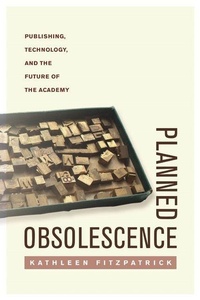
Planned Obsolescence
Publishing, Technology, and the Future of the Academy
Published on 1. November 2011
254 pages
978-0-8147-2896-3 (ISBN)
Description

Choice's Outstanding Academic Title list for 2013
A bold approach to re-envisioning the future of academic publishing
Academic institutions are facing a crisis in scholarly publishing at multiple levels: presses are stressed as never before, library budgets are squeezed, faculty are having difficulty publishing their work, and promotion and tenure committees are facing a range of new ways of working without a clear sense of how to understand and evaluate them.
Planned Obsolescence is both a provocation to think more broadly about the academy's future and an argument for re-conceiving that future in more communally-oriented ways. Facing these issues head-on, Kathleen Fitzpatrick focuses on the technological changes-especially greater utilization of internet publication technologies, including digital archives, social networking tools, and multimedia-necessary to allow academic publishing to thrive into the future. But she goes further, insisting that the key issues that must be addressed are social and institutional in origin.
Springing from original research as well as Fitzpatrick's own hands-on experiments in new modes of scholarly communication through MediaCommons, the digital scholarly network she co-founded, Planned Obsolescence explores these aspects of scholarly work, as well as issues surrounding the preservation of digital scholarship and the place of publishing within the structure of the contemporary university. Written in an approachable style designed to bring administrators and scholars into a conversation, Planned Obsolescence explores both symptom and cure to ensure that scholarly communication will remain relevant in the digital future.
Related Articles:
"Do 'the Risky Thing' in Digital Humanities"-Chronicle of Higher Education
"Academic Publishing and Zombies"-Inside Higher Ed
A bold approach to re-envisioning the future of academic publishing
Academic institutions are facing a crisis in scholarly publishing at multiple levels: presses are stressed as never before, library budgets are squeezed, faculty are having difficulty publishing their work, and promotion and tenure committees are facing a range of new ways of working without a clear sense of how to understand and evaluate them.
Planned Obsolescence is both a provocation to think more broadly about the academy's future and an argument for re-conceiving that future in more communally-oriented ways. Facing these issues head-on, Kathleen Fitzpatrick focuses on the technological changes-especially greater utilization of internet publication technologies, including digital archives, social networking tools, and multimedia-necessary to allow academic publishing to thrive into the future. But she goes further, insisting that the key issues that must be addressed are social and institutional in origin.
Springing from original research as well as Fitzpatrick's own hands-on experiments in new modes of scholarly communication through MediaCommons, the digital scholarly network she co-founded, Planned Obsolescence explores these aspects of scholarly work, as well as issues surrounding the preservation of digital scholarship and the place of publishing within the structure of the contemporary university. Written in an approachable style designed to bring administrators and scholars into a conversation, Planned Obsolescence explores both symptom and cure to ensure that scholarly communication will remain relevant in the digital future.
Related Articles:
"Do 'the Risky Thing' in Digital Humanities"-Chronicle of Higher Education
"Academic Publishing and Zombies"-Inside Higher Ed
Reviews / Votes
Fitzpatrick is well qualified to discuss alternate forms of publishing and unexpected futures for the academy...Chapters titled 'Peer Review,' 'Authorship,' 'Texts,' 'Preservation,' and 'The University' methodically dismantle arguments for the status quo, with sections debating accepted beliefs and practices such as the anonymous basis of peer review; recognizable, individual authorship; for-profit university presses; and the rejection of open access as a tenable scholarly publishing model. * Library Journal * [A] desire for pre-eminence, authority and disciplinary power is what blogs and the digital humanities stand against. The point is made concisely by Kathleen Fitzpatrick in her new book, Planned Obsolescence: Publishing, Technology, and the Future of the Academy. * New York Times - Opinionator Blog * [Fitzpatrick] is one of the more persuasive advocates for understanding digital scholarship, and she acknowledges that while tenure and academic career building are still tethered to being published, institutions are starting to rethink and redefine what form that scholarly work can take. -- Bret McCabe * John Hopkins Magazine * At a time of great uncertainty about the future of the humanities, this informed and stimulating book buzzes with excitement for the opportunities that digital technology can offer to humanities researchers...Planned Obsolescence is a wonderfully clear and honest assessment of the present state of academic publishing and possible future directions. The digital age offers us a chance to exit the ivory tower and engage in more meaningful collaborations with peers and a more inclusive dialogue with readers. Fitzpatrick's study is a must-read, not just for all of those directly involved - academics, publishers, university administrators, librarians - but also for anybody interested in the future of the humanities. -- Alessandra Tosi * Times Higher Education * The narrative arc of Planned Obsolescence is tight, coherent, eloquent--propulsively staking its territory from micro to macro, personal to global. -- Neil Baldwin, Creative Research Center at Montclair State University: Director's Blog This primer on innovations in academic publishing is a must-read for all participants: university administrators, faculty authors, librarians, publishers, technologists, and informed general readers. -- P.E. Sandstrom * CHOICE * Thoughtful...Fitzpatrick is well-qualified. -- Henrietta Thornton-Verma * Library Journal's "Xpress Reviews" * Anyone who is serious about understanding the future of scholarly publishing--and anyone who cares about knowledge and society should share this concern--will find Fitzpatrick's book an essential, thought-provoking, and highly approachable introduction to the conversation. * A Thaumaturgical Compendium * Fitzpatrick's Planned Obsolescenceits title a sardonic speculation on the future of the printed bookconsiders how academic publishing might best resolve this challenging dilemma. As co-founder of the digital scholarly network MediaCommmons, Fitzpatrickwho lectures in Media Studies at Pomona College in Californiais well placed to observe the development of digital culture in academia. * The Los Angeles Review of Books *More details
Edition
Library
Language
English
Place of publication
New York
United States
Target group
Professional and scholarly
Illustrations
Illustrations
File size
6,60 MB
ISBN-13
978-0-8147-2896-3 (9780814728963)
DOI
8574/nyu/9780814728963.001.0001
Copyright in bibliographic data and cover images is held by Nielsen Book Services Limited or by the publishers or by their respective licensors: all rights reserved.
Schweitzer Classification
Other editions
Additional editions
Book
11/2011
New York University Press
€36.50
Shipment within 15-20 days
Book
11/2011
New York University Press
€99.50
Shipment within 15-20 days
Person
Kathleen Fitzpatrick is Professor of Media Studies at Pomona College and founding editor of the digital scholarly network MediaCommons. She is the author of The Anxiety of Obsolescence: The American Novel in the Age of Television and has blogged at Planned Obsolescence since 2002.
