

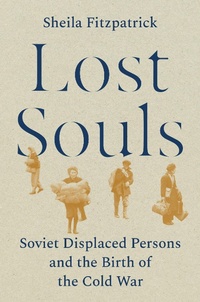
Lost Souls
Soviet Displaced Persons and the Birth of the Cold War
1st Edition
Published on 6. November 2024
352 pages
978-0-691-23003-0 (ISBN)
Description

A vivid history of how Cold War politics helped solve one of the twentieth century's biggest refugee crises
When World War II ended, about one million people whom the Soviet Union claimed as its citizens were outside the borders of the USSR, mostly in the Western-occupied zones of Germany and Austria. These "displaced persons," or DPs-Russians, prewar Soviet citizens, and people from West Ukraine and the Baltic states forcibly incorporated into the Soviet Union in 1939-refused to repatriate to the Soviet Union despite its demands. Thus began one of the first big conflicts of the Cold War. In Lost Souls, Sheila Fitzpatrick draws on new archival research, including Soviet interviews with hundreds of DPs, to offer a vivid account of this crisis, from the competitive maneuverings of politicians and diplomats to the everyday lives of DPs.
American enthusiasm for funding the refugee organizations taking care of DPs quickly waned after the war. It was only after DPs were redefined-from "victims of war and Nazism" to "victims of Communism"-in 1947 that a solution was found: the United States would pay for the mass resettlement of DPs in America, Australia, and other countries outside Europe. The Soviet Union protested this "theft" of its citizens. But it was a coup for the United States. The choice of DPs to live a free life in the West, and the West's welcome of them, became an important theme in America's Cold War propaganda battle with the Soviet Union.
A compelling story of the early Cold War, Lost Souls is also a rare chronicle of a refugee crisis that was solved.
When World War II ended, about one million people whom the Soviet Union claimed as its citizens were outside the borders of the USSR, mostly in the Western-occupied zones of Germany and Austria. These "displaced persons," or DPs-Russians, prewar Soviet citizens, and people from West Ukraine and the Baltic states forcibly incorporated into the Soviet Union in 1939-refused to repatriate to the Soviet Union despite its demands. Thus began one of the first big conflicts of the Cold War. In Lost Souls, Sheila Fitzpatrick draws on new archival research, including Soviet interviews with hundreds of DPs, to offer a vivid account of this crisis, from the competitive maneuverings of politicians and diplomats to the everyday lives of DPs.
American enthusiasm for funding the refugee organizations taking care of DPs quickly waned after the war. It was only after DPs were redefined-from "victims of war and Nazism" to "victims of Communism"-in 1947 that a solution was found: the United States would pay for the mass resettlement of DPs in America, Australia, and other countries outside Europe. The Soviet Union protested this "theft" of its citizens. But it was a coup for the United States. The choice of DPs to live a free life in the West, and the West's welcome of them, became an important theme in America's Cold War propaganda battle with the Soviet Union.
A compelling story of the early Cold War, Lost Souls is also a rare chronicle of a refugee crisis that was solved.
More details
Other editions
Additional editions
Book
11/2024
Princeton University Press
€37.50
Shipment within 10-20 days
Person
Sheila Fitzpatrick is the author of many books, including On Stalin's Team: The Years of Living Dangerously in Soviet Politics (Princeton), The Shortest History of the Soviet Union, and The Russian Revolution. She is professor of history at the Institute of Humanities and Social Science at the Australian Catholic University and Distinguished Service Professor Emerita at the University of Chicago.
Content
- Cover
- Contents
- Introduction
- Part I. The Great Power Story
- 1. UNRRA and Its Mandate
- UNRRA's Establishment
- Getting Started
- The Problem of Jewish DPs
- Which Displaced Persons Fell under UNRRA's Mandate?
- UNRRA under La Guardia
- Cold War and the End of UNRRA
- 2. Repatriation to the Soviet Union and Allied Conflict
- Forcible Repatriation and Resistance
- Filtration
- Running Conflicts over Repatriation
- Soviet Efforts to Locate and Contact DPs
- Rhetorical Framing of the Repatriation Debate
- Lost Children
- War Criminals
- Part II. The DP Story
- 3. Organization of DP Life
- Varieties of DP Agency
- Life in the Camps
- Mönchehof: A Russian Camp
- Esslingen: A Latvian Camp
- DP Choices
- "Free-Living" DPs
- DP Politics
- 4. DP Occupations
- Black Market
- Jobs in Germany
- Working for the Amis
- Jobs outside Germany
- Studying
- 5. Other DP Activities and Entertainments
- Options for Young Women
- Tourism and Adventure
- Sports
- Cultural Nationalism
- Part III. Solving the Problem
- 6. IRO and Its Mandate
- Prehistory of Resettlement
- IRO's Overseas Resettlement Policy and the Cold War
- Continuing Conflict over Repatriation and Resettlement
- Tolstoy Foundation
- "Liberalizing" Eligibility Criteria: The Case of the Baltic Waffen-SS
- Ukrainian and Russian Collaborators
- 7. Resettlement as Policy
- United States
- Australia
- Canada
- Other Destinations (Latin America, Israel, Morocco)
- Race Issues: Turks and Kalmyks
- Security Concerns
- 8. DPs Weigh the Options
- Looking for the Right Exit
- Telling a Good Story
- Finding Supporters and Sponsors
- Belatedly Choosing Repatriation
- The Process of Departure
- 9. Unfinished Business
- Hard Core
- Remaining in Germany and Austria
- Returns and Deportations after Resettlement
- Continued Soviet Efforts to Repatriate Its Citizens
- Extradition and Punishment of "War Criminals
- Conclusion
- Acknowledgments
- Appendix: IRO Resettlement of Russian / Soviet / Baltic and Jewish DPs, 1947-51
- Notes
- Bibliography
- Index
