

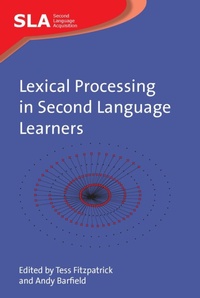
Lexical Processing in Second Language Learners
Papers and Perspectives in Honour of Paul Meara
Published on 20. May 2009
176 pages
978-1-84769-985-5 (ISBN)
Description

This book presents studies from authors at the cutting edge of second language vocabulary research, whose output represents much of the current focus and direction of work in this area. The authors address various aspects of L2 lexical processing and explore different models of acquisition, processing and storage. The studies are linked by the fact that the authors have all belonged to the same dynamic and influential vocabulary acquisition research group led by Paul Meara. Alison Wray provides an overview of how Meara has led this group's research activities in an innovative PhD programme, and John Read and Paul Nation contribute a critical evaluation of Meara's wide-ranging contributions to the field of vocabulary acquisition research. The research studies presented here are relevant and replicable, offering researchers and teachers many valuable and critical insights into lexical processing in second language learners.
Reviews / Votes
In this book scholars from across the world pay tribute to Paul Meara's outstanding achievements in the field of Second Language Acquisition research. One of main achievements of this book is that it brings together the work of researchers who focus on theoretical issues and findings of researchers wishing to improve the L2 classroom. The breadth and depth of the studies offered to Meara in this volume make this a must read for all scholars interested in vocabulary acquisition, knowledge and use. -- Jeanine Treffers-Daller, Professor of Linguistics, University of the West of England, Bristol, UKMore details
Series
Language
English
Place of publication
Bristol
United Kingdom
Publishing group
Channel View Publications Ltd
Target group
Professional and scholarly
ISBN-13
978-1-84769-985-5 (9781847699855)
Copyright in bibliographic data and cover images is held by Nielsen Book Services Limited or by the publishers or by their respective licensors: all rights reserved.
Schweitzer Classification
Other editions
Additional editions
Tess Fitzpatrick | Andy Barfield
Lexical Processing in Second Language Learners
Papers and Perspectives in Honour of Paul Meara
Book
05/2009
Multilingual Matters
€48.00
Shipment within 10-20 days
Persons
Tess Fitzpatrick is a senior lecturer in Applied Linguistics at Swansea University. Her main research interests and publications are in the areas of vocabulary acquisition, storage and retrieval, with a specific focus on word association studies and vocabulary measurement tools. In particular she attempts to challenge the assumptions which often underlie our understanding of the nature of vocabulary knowledge. A qualified and experienced language teacher and teacher trainer, she has also worked on projects exploring extreme language learning methodologies and the role of formulaic sequences in second language use.
Andy Barfield teaches in the Faculty of Law at Chuo University, Tokyo, Japan. His research interests include learners' L2 collocation development and learner autonomy in second language education. His book publications include Reconstructing Autonomy in Language Education: Inquiry and innovation (2007; co-edited with S. Brown; Palgrave Macmillan) and Researching Collocations in Another Language: Multiple Interpretations (2009; co-edited with H. Gyllstad; Palgrave Macmillan).
Andy Barfield teaches in the Faculty of Law at Chuo University, Tokyo, Japan. His research interests include learners' L2 collocation development and learner autonomy in second language education. His book publications include Reconstructing Autonomy in Language Education: Inquiry and innovation (2007; co-edited with S. Brown; Palgrave Macmillan) and Researching Collocations in Another Language: Multiple Interpretations (2009; co-edited with H. Gyllstad; Palgrave Macmillan).
Content
Preface - Alison Wray
1. Introduction: Meara's Contribution to Research in L2 Lexical Processing - John Read and Paul Nation
2. Putting Yes/no Tests in Context - John Shillaw
3. Tangled Webs: Complications in the Exploration of L2 Lexical Networks - Clarissa Wilks
4. Word Association Profiles in a First and Second Language: Puzzles and Problems - Tess Fitzpatrick
5. Revisiting Classrooms as Lexical Environments - Marlise Horst
6. A Close Look at the Use of Pocket Electronic Dictionaries for Receptive and Productive Purposes - Hilary Nesi and Atipat Boonmoh
7. Repeated L2 Reading With and Without a Dictionary - Jim Ronald
8. Exploring Productive L2 Collocation Knowledge - Andy Barfield
9. The Messy Little Details: A Longitudinal Case Study of the Emerging Lexicon - Huw Bell
10. Meaning-last Vocabulary Acquisition and Collocational Productivity - Brent Wolter
11. Acting on a Hunch: Can L1 Reading Instruction Affect L2 Listening Ability? - Richard Pemberton
12. Taking Stock - Andy Barfield and Tess Fitzpatrick
1. Introduction: Meara's Contribution to Research in L2 Lexical Processing - John Read and Paul Nation
2. Putting Yes/no Tests in Context - John Shillaw
3. Tangled Webs: Complications in the Exploration of L2 Lexical Networks - Clarissa Wilks
4. Word Association Profiles in a First and Second Language: Puzzles and Problems - Tess Fitzpatrick
5. Revisiting Classrooms as Lexical Environments - Marlise Horst
6. A Close Look at the Use of Pocket Electronic Dictionaries for Receptive and Productive Purposes - Hilary Nesi and Atipat Boonmoh
7. Repeated L2 Reading With and Without a Dictionary - Jim Ronald
8. Exploring Productive L2 Collocation Knowledge - Andy Barfield
9. The Messy Little Details: A Longitudinal Case Study of the Emerging Lexicon - Huw Bell
10. Meaning-last Vocabulary Acquisition and Collocational Productivity - Brent Wolter
11. Acting on a Hunch: Can L1 Reading Instruction Affect L2 Listening Ability? - Richard Pemberton
12. Taking Stock - Andy Barfield and Tess Fitzpatrick
