

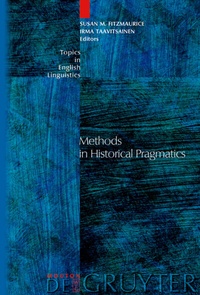
Methods in Historical Pragmatics
Description

This volume represents a timely collective review and assessment of what it is we do when we do English historical pragmatics or historical discourse analysis. The context for the volume is a critical assessment of the assumptions and practices defining the body of research conducted on the history of the English language from the perspective of historical pragmatics, broadly construed. The aim of the volume is to engage with matters of approach and method from different perspectives; accordingly, the contributions offer insights into earlier communicative practices, registers, and linguistic functions as gleaned from historical discourse.
The essays are grouped according to their orientations within the scope of the study of language and meaning in historical texts, both literary and non-literary. The structure of the volume thus represents a critical convergence of traditions of reading texts and analyzing discourse and this in turn exposes key questions about the methods and the outcomes of such readings or analyses. The volume contributes to the growing maturity of historical pragmatic research approaches as it exemplifies and extends the range of approaches and methods that dominate the research enterprise.
Contributors are prominent international scholars in the fields of linguistics, literature, and philology: Dawn Archer, Birte Bös, Laurel Brinton, Gabriella Del Lungo Camiciotti, James Fitzmaurice, Susan Fitzmaurice, Monika Fludernik, Andreas Jucker, Thomas Kohnen, Ursula Lenker, Lynne Magnusson, and Irma Taavitsainen.
Reviews / Votes
"[...] this volume really brings together alternative, enriching methods to face the functional study of historical discourse."Federico Navarro in: Linguist List 04/2008More details
Other editions
Additional editions
Persons
Content
2 - Contents [Seite 5]
3 - Introduction [Seite 7]
4 - Historical pragmatics: What it is and how to do it [Seite 17]
5 - The development of I mean: Implications for the study of historical pragmatics [Seite 43]
6 - Soþlice, forsoothe, truly - communicative principles and invited inferences in the history of truthintensifying adverbs in English [Seite 87]
7 - Speech act verbs and speech acts in the history of English [Seite 113]
8 - Text types and the methodology of diachronic speech act analysis [Seite 145]
9 - A pragmatics for interpreting Shakespeare's Sonnets 1 to 20: Dialogue scripts and Erasmian intertexts [Seite 173]
10 - Developing a more detailed picture of the English courtroom (1640-1760): Data and methodological issues facing historical pragmatics [Seite 191]
11 - What do you lacke? what is it you buy? Early Modern English service encounters [Seite 225]
12 - Letters as narrative: Narrative patterns and episode structure in early letters, 1400 to 1650 [Seite 247]
13 - Historical linguistics, literary interpretation, and the romances of Margaret Cavendish [Seite 273]
14 - Discoursal aspects of the Legends of Holy Women by Osbern Bokenham [Seite 291]
15 - Backmatter [Seite 313]
