

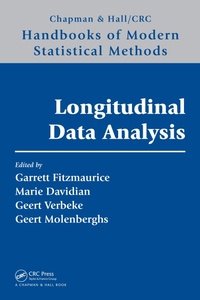
Longitudinal Data Analysis
Published on 11. August 2008
632 pages
978-1-4200-1157-9 (ISBN)
Description

Although many books currently available describe statistical models and methods for analyzing longitudinal data, they do not highlight connections between various research threads in the statistical literature. Responding to this void, Longitudinal Data Analysis provides a clear, comprehensive, and unified overview of state-of-the-art theory
Reviews / Votes
The scope is remarkable, and the degree of integration and polish is admirable. The contributors include many of the most innovative researchers in the field, and happily, many of the clearest writers as well. ... a lively text with clear-eyed positions and well-argued recommendations on how to analyze data of specific structures. ... [material] is all accessible, well explained, and well illustrated using examples ... a very good book ... an excellent resource for a graduate class for statisticians or biostatisticians, and as a reference for quantitatively minded researchers.-Statistics in Medicine, 2011
The volume's editors have assembled a world-class panel of contributors; many have made seminal contributions to the field (this includes the editors themselves). Immediately apparent is the uniformity of notation and writing style not typically found in volumes of this kind. The editors clearly have taken great care to ensure a whole document rather than a disjointed patchwork typical of similar collections. Chapters reflect contributor diversity while suppressing distracting idiosyncrasies. ... Experienced researchers and those new to the field will find useful material here. ... several chapters provide fresh insights. For graduate students and new researchers, the book provides a useful introduction and comprehensive reference material for the topics it covers. Case studies and software enable readers to implement some methods described in the book, with supplemental datasets and programs appearing on a useful website. ... A strong inaugural volume for Chapman & Hall's new series on modern statistical methods, Longitudinal Data Analysis provides an outstanding model for future entries.
-Biometrics, September 2010
... Longitudinal Data Analysis is the first book to collect and sort through many of the most important developments. The authors make clear the assumptions of the statistical methods and their consequences. Coupled with an abundance of examples, the book guides the practitioner about when to apply one method as opposed to another. The book has remarkable breadth and contains material that would likely be new even to those that analyze longitudinal data on a regular basis. Longitudinal Data Analysis would be useful for applied statisticians looking to expand their analytical toolkit and statistical researchers familiar with the area but looking for a good reference. ...an excellent text for a special topics course for Ph.D. students in statistics. It has a good balance of statistical theory and applications, with a large number of real data examples and case studies to illustrate how to use the methods described therein. ...a well organized, excellent overview of the state of the art in modeling longitudinal data and would make a useful supplement to the library of anyone that analyzes this type of data.
-Journal of the American Statistical Association, June 2010
...a concise but complete encyclopedia on longitudinal data analysis. The editors have made a great effort to produce a volume providing a comprehensive and up-to-date view of the theory and application of longitudinal data analysis. ... One of the strengths of the book is the organizational structure and the fact that the book has been written by well-known experts in the field. ... I find this book very useful for statisticians and researchers in many fields where the interest relies on studying the change of an outcome or multiple outcomes over time. Many of the chapters include examples and case studies in different disciplines and some of this material can be found in the website of this book (http://www.biostat.harvard.edu/ fitzmaur/lda). I would like to congratulate the editors and all the contributing authors for preparing this comprehensive handbook on many interesting and complementary aspects of the theory and applications of longitudinal data analysis. This handbook will have, without any doubt, an important place on the shelf of those statisticians and applied researchers working with longitudinal data.
-Journal of Applied Statistics, Vo. 36, No. 10, October 2009
This is public-service broadcasting at its best. Many of the leading internationally recognized experts in the field have been assembled to write a series of expository articles on an important area of modern statistics. ... Care has clearly been taken to make the book hang together-it's not like some 'edited tomes' consisting of a set of papers stapled together. There is a mixture of theory and applications with real data, some of which is available on a website. In my opinion the book will be a must-have for anyone seriously involved with repeated measures or longitudinal data.
-International Statistical Review, 2009
Other longitudinal data books do not have the breadth of this one. ... I highly recommend this book to anyone interested in learning about modern methods for longitudinal data analysis. I think it would make a particularly good book for a Ph.D.-level reading course or as a supplement to a longitudinal data textbook in a graduate-level course. I especially recommend this book to statistical researchers, as it makes a great reference book.
-Journal of Biopharmaceutical Statistics, Issue 4, 2009
More details
Series
Language
English
Place of publication
London
United Kingdom
Publishing group
Taylor & Francis Ltd
Target group
Professional and scholarly
Researchers and graduate students in statistics and biostatistics; applied statisticians; quantitative researchers.
Illustrations
106 s/w Abbildungen, 64 s/w Tabellen
106 b/w images, 64 tables and 521 equations
File size
10,34 MB
ISBN-13
978-1-4200-1157-9 (9781420011579)
Copyright in bibliographic data and cover images is held by Nielsen Book Services Limited or by the publishers or by their respective licensors: all rights reserved.
Schweitzer Classification
Other editions
Additional editions
Garrett Fitzmaurice | Marie Davidian | Geert Verbeke
Longitudinal Data Analysis
A Handbook of Modern Statistical Methods
Book
08/2008
1st Edition
Chapman & Hall/CRC
€205.50
Shipment within 15-20 days
Persons
Garrett Fitzmaurice, Marie Davidian, Geert Verbeke, Geert Molenberghs
Content
Introduction and Historical Overview. Parametric Modeling of Longitudinal Data. Nonparametric and Semiparametric Methods for Longitudinal Data. Joint Models for Longitudinal Data. Incomplete Data. Index.
