

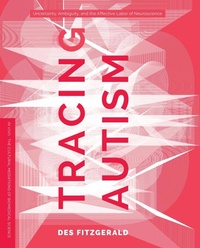
Tracing Autism
Description

In Tracing Autism, Des Fitzgerald offers an up-close account of the search for a neurological explanation of autism. As autism has gained cultural prominence with more diagnoses and more controversy, its biological causes remain elusive.
Through in-depth interviews with neuroscientists, psychologists, and psychiatrists, Fitzgerald examines what it means to do scientific research in the ambiguous terrain of autism research, a field marked by shifting horizons of uncertainty and ambivalence. He draws out how autism scientists talk and feel their way through their research, demonstrating its profoundly affective character, and expanding our understanding of what is at stake in the new brain sciences.
More details
Other editions
Additional editions
Person
Des Fitzgerald is lecturer in sociology at Cardiff University. He is the coauthor of Rethinking Interdisciplinarity across the Social Sciences and Neurosciences.
Content
- Cover
- Title
- Copyright
- Dedication
- Contents
- Acknowledgments
- Introduction: Looking for the Monolith
- 1 / This Thing Called Autism: Between Biological Disorder and Diagnostic Convenience
- 2 / The Trouble with Brain Imaging
- 3 / The Throbbing Emotion of the Past: Memory, Scientific Subjectivity, and the Affective Labor of Autism Neuroscience
- 4 / Compromising Positions: Psychology and Autism between Science and the Social
- 5 / Seeing the Unicorn
- Conclusion: The Pursuit and the Mark
- Notes
- Bibliography
- Index
