

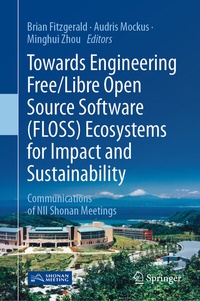
Towards Engineering Free/Libre Open Source Software (FLOSS) Ecosystems for Impact and Sustainability
Description

Free/libre open source software (FLOSS) ecosystems such as Linux have had a tremendous impact on computing and society and have captured the attention of businesses, researchers, and policy makers. Research on FLOSS has been ongoing for almost two decades. From an economic perspective, the most common topics involve motivation and organization. As commercial participation in FLOSS has become common, the question of how to combine FLOSS practice with commercial practice has been the subject of research, particularly with a view to understanding how to ensure sustainability of the ecosystem.
This book is based on a Shonan meeting on FLOSS ecosystem sustainability held in June 2017. The meeting brought together a blend of established and young researchers who were actively studying the FLOSS phenomenon. These researchers were drawn from a variety of disciplines including software engineering, human computer interaction, information systems, computer-supported cooperativework, data mining, cognitive science, psychology, operations research, and management. Industry practitioners who were active in the FLOSS space also participated. This book presents the results of discussion on fundamental questions related to the impact and sustainability of FLOSS ecosystems, including:
· How does an ecosystem form? How do different stakeholders work together to form a community that develops and maintains valuable and freely available software, and how does an ecosystem with millions of repositories and developers operate given the lack of centralized planning?
· How does an ecosystem evolve in response to the environment as technology and needs evolve over time?
· How do newcomers learn the protocols and practices of an ecosystem? How would they sustain the ecosystem? What is the relationship between people and ecosystem sustainability?More details
Other editions
Additional editions
Persons
Brian Fitzgerald is the director of Lero, the Irish Software Research Centre. He holds the Frederick Krehbiel II Professorship in Innovation in Business and Technology at the University of Limerick, Ireland. His research focuses on software development, encompassing open source, agile, lean, continuous software engineering, and global software development.
Audris Mockus is the Ericsson-Harlan D. Mills Chair Professor of Digital Archeology and Evidence Engineering in the Department of Electrical Engineering and Computer Science at the University of Tennessee. His research interests include software engineering, open source, operational data, statistics, and optimization.
Minghui Zhou is a professor in the Institute of Software at Peking University. Her research interests include software engineering, open source, and mining software repositories.
