

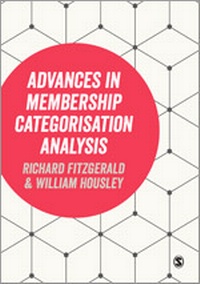
Advances in Membership Categorisation Analysis
1st Edition
Published on 23. March 2015
208 pages
978-1-4739-1786-6 (ISBN)
Description

This is an exciting addition to the dynamic, multidisciplinary field of membership categorization analysis. Bringing together the biggest names in MCA this landmark publication provides a contemporary analysis of the field and a platform for emerging researchers and students to build upon.
The book sets out the current methodological developments of MCA highlighting its analytic strength - particularly when examining social identity and social knowledge. It provides a sophisticated tool of qualitative analysis and draws from a wide range of empirical studies provided by global scholars.
The culmination of years of international research this agenda-setting text will be essential reading for academics and advanced students using membership categorization across the social sciences; particularly in media and communication studies, sociology, psychology, education, political science and linguistics.
The book sets out the current methodological developments of MCA highlighting its analytic strength - particularly when examining social identity and social knowledge. It provides a sophisticated tool of qualitative analysis and draws from a wide range of empirical studies provided by global scholars.
The culmination of years of international research this agenda-setting text will be essential reading for academics and advanced students using membership categorization across the social sciences; particularly in media and communication studies, sociology, psychology, education, political science and linguistics.
Reviews / Votes
MCA provides an orientation, set of questions, and identification of discrete discourse devices to aid understanding of the moral work being accomplished by speakers' and writers' as they select category terms and tie them to descriptions. Fitzgerald and Housley's Advances in Membership Categorization Analysis brings together cutting edge theoretical explication with fascinating examples ( YouTube posts, intimates video chatting, a review board assessing parole, a research team meeting, online breaking news updates) and is a must-read for anyone interested in identities and interaction.-- Karen Tracy A state of the art collection which is essential reading for anyone interested in social identity and social order. -- David Silverman Membership categories are central to the organization of culture. They set up inferential relations between classes of people, they implicate actions and thoughts, and they mark moral statuses. Membership categorization analysis develops the tradition of work started by Harvey Sacks and shows that the issues he explored are still urgent and significant. In this volume an A-list of contributors provide state of the art analyses that illustrate the ongoing vitality of membership categorization analysis. It is essential reading for anyone interested in this topic. -- Jonathan Potter Richard Fitzgerald and William Housley are to be congratulated for further developing the field. In taking up such questions as the ethnomethodology of categorization (a masterful discussion by Rod Watson), the omni-relevance of categories, the precise nature of the connections between categories and predicates, the temporal reference of category usage, the relationship of categorization to "doing being ordinary" and the place of categorization in the "social life of methods," the contributors truly bear out the promise expressed in the title of advancing membership categorization analysis. -- Peter Eglin
More details
Language
English
Place of publication
London
United Kingdom
Target group
College/higher education
Professional and scholarly
ISBN-13
978-1-4739-1786-6 (9781473917866)
Copyright in bibliographic data and cover images is held by Nielsen Book Services Limited or by the publishers or by their respective licensors: all rights reserved.
Schweitzer Classification
Other editions
Additional editions
Richard Fitzgerald | William Housley
Advances in Membership Categorisation Analysis
Book
04/2015
1st Edition
SAGE Publications Ltd
€111.50
Shipment within 15-20 days
Richard Fitzgerald | William Housley
Advances in Membership Categorisation Analysis
Book
04/2015
1st Edition
SAGE Publications Ltd
€207.80
Shipment within 15-20 days
Persons
Richard Fitzgerald is Professor of Communication at the University of Macau, China (SAR). Before joining the University of Macau in 2014 he has held posts at Cardiff University and the University of Queensland. He has researched and written extensively on broadcast and digital media and methods of qualitative Discourse Analysis. His recent major publications include Advances in Membership Categorization Analysis (2015, Sage) co-edited with William Housley, and On Sacks. Methodology, Materials and Inspirations (2021, Routledge) co-edited with Robin Smith and William Housley. He is a former Editor in Chief of Discourse, Context and Media where he remains an Honorary Member of the Editorial Board and is currently a Senior Research Fellow at the Institute of Advanced Studies in Humanities and Social Sciences, University of Macau.
William Housley PhD, DSc.Econ. FAcSS is Professor of Sociology at Cardiff University. He is an internationally recognised expert in qualitative and social research methods, sociological theory, the study of practical reason, science and technology studies, ethnomethodology, membership categorization analysis, social interaction and digital sociology. His contribution to Sociology was confirmed through the award of a DSc Econ. by Cardiff University in 2012 for his internationally recognized work in the field of interaction, communication and social organization. He has served as an editor of Qualitative Research (SAGE) and the editorial board of Big Data and Society (SAGE). Professor Housley was awarded the prestigious Vincent Wright Chair, at Sciences Po, Paris, for 2017. He has published numerous papers and books, including Society in the Digital Age: An Interactionist Perspective (2021, SAGE).
William Housley PhD, DSc.Econ. FAcSS is Professor of Sociology at Cardiff University. He is an internationally recognised expert in qualitative and social research methods, sociological theory, the study of practical reason, science and technology studies, ethnomethodology, membership categorization analysis, social interaction and digital sociology. His contribution to Sociology was confirmed through the award of a DSc Econ. by Cardiff University in 2012 for his internationally recognized work in the field of interaction, communication and social organization. He has served as an editor of Qualitative Research (SAGE) and the editorial board of Big Data and Society (SAGE). Professor Housley was awarded the prestigious Vincent Wright Chair, at Sciences Po, Paris, for 2017. He has published numerous papers and books, including Society in the Digital Age: An Interactionist Perspective (2021, SAGE).
Content
Chapter1: Introduction to Membership Categorization Analysis - William Housley & Richard Fitzgerald
Chapter2: De-Reifiying Categories - Rod Watson
Chapter 3: Prospective and Retrospective Categorization: Category proffers and inferences in social interaction and rolling news media - Elizabeth Stokoe & Frederick Attenborough
Chapter 4: Categorization Work in the Courtroom: The 'foundational' character of membership categorization analysis - Christian Licoppe
Chapter 5: Challenging Normativity: re-appraising category, bound, tied and predicated features - Edward Reynolds & Richard Fitzgerald
Chapter 6: Omnirelevance in Technologized Interaction: Couples coping with video calling distortions - Sean Rintel
Chapter7: Membership Categorization and Methodological Reasoning in Research Team Interaction - William Housley & Robin James Smith
Chapter2: De-Reifiying Categories - Rod Watson
Chapter 3: Prospective and Retrospective Categorization: Category proffers and inferences in social interaction and rolling news media - Elizabeth Stokoe & Frederick Attenborough
Chapter 4: Categorization Work in the Courtroom: The 'foundational' character of membership categorization analysis - Christian Licoppe
Chapter 5: Challenging Normativity: re-appraising category, bound, tied and predicated features - Edward Reynolds & Richard Fitzgerald
Chapter 6: Omnirelevance in Technologized Interaction: Couples coping with video calling distortions - Sean Rintel
Chapter7: Membership Categorization and Methodological Reasoning in Research Team Interaction - William Housley & Robin James Smith
