

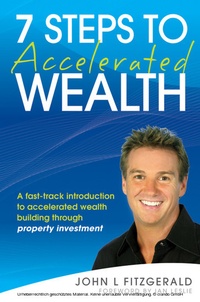
7 Steps to Accelerated Wealth
Description

In Seven Steps to Accelerated Wealth John Fitzgerald shares his seven key principles of accelerated wealth building through property. This practical guide shows readers how to make $1 million by following the author\'s simple and proven system of developing a low-maintenance, low-risk portfolio of investment property as an asset base.
Author John Fitzgerald is a property investor and developer. A self-made success story, he made his first million at age 23, having developed a successful formula for real estate investment. He has since bought and sold over 8000 properties.
John Fitzgerald is the author of two books - Seven Steps To Wealth and We Can Be Heroes(self published). He has educated thousands of ordinary Australians on how to build wealth (even to become millionaires).
More details
Other editions
Additional editions
Content
Who is John L Fitzgerald
This is an introduction to me and how I learned about building wealth. First lesson in wealth building: if someone says 'Trust me', ask Why?' How do you know that they know what they're talking about?
One of the key points of this book is that you don't need to have a track record of success in order to become a success; your past doesn't define who you are. If you're starting from scratch on a wealth-building journey, you'll need to have a little faith about that! But, if you're going to take advice, coaching or information from someone else on 'how to be a success', to be blunt, make bloody sure they do have a long-term, verifiable track record of having done it themselves! Otherwise, you're getting second-hand, second-rate, off-the-shelf ideas that may - or may not - have been road-tested before you get behind the wheel! Enough said. I'll move on.
If you've read my other books, you can skip this section. The point is that I'm pretty much an average person: if anything, a bit below average academically and a bit above average in sport. I recently bought a table tennis table ('flat packed for easy home assembly') and after half an hour of wrestling with the instructions, I found a nearby 15 year old who put the whole thing together, as advertised, in about three minutes. If I can build wealth, you can. Seriously. And if that's all you really need to know, feel free to skip to chapter 1.
I was born in Melbourne in 1963 and spent my first eight years in the middle-class suburb of Moorabbin. My father was a menswear retailer and went into business on his own at the age of 30. By the time he was 37, he had built up three menswear shops in Collingwood, Belgrave and Stawell. He was a devout Catholic from an Irish Catholic family, with five children (all in Catholic schools). My mother ran the home full time, having left a career as a ballroom dancing instructor to marry dad.
The school holidays of September 1972 changed my life - all our lives - suddenly and forever. My oldest brother David (then aged 12) went, as we often did, to visit Uncle Morris's farm near Shepparton. We heard later that he and our cousin Peter were lighting a fire when David, who was practising his famous balancing act on a log, lost his balance and fell into the fire. Uncle Morris took him to the hospital, where he was found to have third-degree burns from knee to ankle, and given skin grafts. I still remember visiting David at the Shepparton hospital, the slick lino floors and the cold concrete walls.
David was in hospital for six weeks. One Tuesday morning Dad drove out to visit him - and never returned. On his way home, the car was sandwiched between two semitrailers and driven off the road. He was killed instantly.
Even at nine years old, I sensed that there was a purpose behind those rollercoaster days. Somehow I believed then, as I believe now, that everything happens for a reason. The loss of my father, hard as it was, was the start of what I now see as a journey to discover my own purpose in the world - a journey that has since become linked to the creation and use of wealth. (If there's a 'bigger' purpose to your reading this book, I hope it will become clear as you read on.)
My mother had to take over the businesses, as well as run the family. She did a tremendous job, showing amazing business acumen for someone with no direct experience. But to help her cope, we three boys were sent away to boarding schools.
It was pretty clear from the first that I'd make my mark on the sports field, not in the classroom. I made the First 18 football team in form 4 (grade 10), despite being a year younger than my classmates, and I excelled in athletics and various other sports. All rather costly in terms of academic achievement. I left school in 1979, having just scraped enough of an aggregate to get my Higher School Certificate (HSC). I was expected to go to university (or to repeat my HSC to improve my marks), but by then I had decided that academic life was not for me. Boarding school makes you independent: I had hardly lived at home since I was 10 years old, and the sum total of my worldly possessions fitted into a locker 1.8 metres high by 40 centimetres wide. Now it was time to 'get in amongst it' and see what life was all about.
A friend and I had planned to hitchhike to Queensland. (I wasn't yet old enough to drive a car.) In January 1980, the friend pulled out, so I packed a knapsack and headed off alone for the Gold Coast, with about $200 to my name and all of it in my pocket.
The Gold Coast was in the midst of a property boom, and I immediately knew I wanted to be a part of it. I applied for several real estate positions as a salesman and eventually, through contacts, got a start with Bert Cockerel, who had an office in Surfers Paradise. (To call Bert a 'jack-of-all-trades' would be an understatement. I remember going round to visit a motel he owned on the highway in Surfers, called the Golden Sun Motel: now the site of a 30-storey high-rise tower called Zenith. Bert also owned the picture theatre at Palm Beach, and used to do the fishing report on the local radio station. A great guy.)
I went round to see him about signing my application for a licence as a real estate salesman. I had to disclose to him that I wasn't yet 17, but Bert wasn't fazed by technicalities, and neither, it seemed, was whoever rubber-stamped the application forms. Despite being up-front about my date of birth, I was duly and officially licensed for real estate sales. (Does that make me the youngest ever? Perhaps it's better not to ask.)
Less that a year after I joined Bert, I was introduced to George Margolis, who had built a fortune in real estate during the 1960s, and lost it in the crash of 1974 to 1975. Now he was re-emerging and he had a good plan: with his knowledge and contacts, and my energy, we would make a tremendous partnership. So at 17 years and nine months old, I became an associate partner of Cousins Real Estate. I still didn't know anything about real estate as such. Fortunately, I was a fast learner.
These were the heady days of the early 1980s; looking back, actually, 'incredible' is more the word that comes to mind. At my age and with my experience (neither one particularly impressive), I could advertise for people willing to invest in a private property trust to develop units, and secure dozens of investors who were prepared to punt $50 000 or $100 000 on my ability to acquire a site, build a building and make a profit. (My 'ability'. Like I say, incredible.)
Booms and busts, and bad decisions
I remember all too well the high-rise buildings going up along Old Burleigh Road and the Surfers Paradise strip, where units would be settling in a building such as the brand-new, state-of-the-art (at the time) 'Aquarius'. The developer would attend settlement, only to see the property transferred two or three times on the spot!
Greed was the underlying factor. Real estate agents were promising that if speculators bought, they could onsell the unit immediately because of the sky-high demand. It was not uncommon to see units, sold off the plan by the developer for $150 000, resell for $250 000, then $400 000, then $500 000 at settlement! (I call this the 'bigger fool' theory - if you invest in real estate on this basis, you have to be sure there's a bigger fool than you coming along behind to give you a back door.)
On the heels of greed, as ever, came the crash. In 1982, you couldn't give high-rise units away for love nor money. Tens of millions of dollars were wiped off the (over-inflated) prices paid by investors at the height of the feeding frenzy.
The ups and downs of the early 1980s taught me a lesson. Real estate is an ever-changing market, and while buildings are its prime 'product', it's the land that is the true, limited, value-holding commodity. People repeatedly made the mistake of paying a premium above already over-inflated prices for a building that in itself was commonplace, easily replaceable and soon depreciated to zero.
Things haven't changed much: speculators are still madly snapping up inner-city units in Melbourne and Sydney, despite (at the time of writing) one in five having to take a loss on resale. (What percentage of Australians do you think buy units to live in, as owner-occupiers? Take a guess. The answer is just 6 per cent.)
Becoming a wealth builder
In 1985, I acquired my first house in Shailer Park, Brisbane, for the tidy sum of $49 000. I borrowed approximately $47 000, which seemed like a lot of money in those days! But it meant I could start out with just $2000 of my own money. (Actually, I didn't have $2000 of my own money: I put it on my credit card.) Today that property is worth over $400 000.
That's where I started. I had cottoned on to the fact that it was land that appreciated, not buildings, and that this created some rather encouraging mathematical effects - namely, if the house goes up by 10 per cent, the land will go up by 20 per cent. Armed with this information, and with a couple of houses under my belt, in 1987 I approached one of Australia's largest developers, Dainford Limited, and asked it to bankroll me into land estates. Dainford generally took 'long positions' in the market (that is, committed to products that wouldn't provide...
