

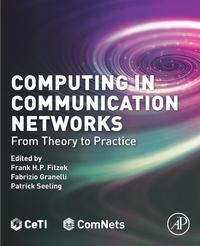
Computing in Communication Networks
From Theory to Practice
Published on 20. May 2020
522 pages
978-0-12-820904-2 (ISBN)
Description

Computing in Communication Networks: From Theory to Practice provides comprehensive details and practical implementation tactics on the novel concepts and enabling technologies at the core of the paradigm shift from store and forward (dumb) to compute and forward (intelligent) in future communication networks and systems. The book explains how to create virtualized large scale testbeds using well-established open source software, such as Mininet and Docker. It shows how and where to place disruptive techniques, such as machine learning, compressed sensing, or network coding in a newly built testbed. In addition, it presents a comprehensive overview of current standardization activities.
Specific chapters explore upcoming communication networks that support verticals in transportation, industry, construction, agriculture, health care and energy grids, underlying concepts, such as network slicing and mobile edge cloud, enabling technologies, such as SDN/NFV/ ICN, disruptive innovations, such as network coding, compressed sensing and machine learning, how to build a virtualized network infrastructure testbed on one's own computer, and more.
- Provides a uniquely comprehensive overview on the individual building blocks that comprise the concept of computing in future networks
- Gives practical hands-on activities to bridge theory and implementation
- Includes software and examples that are not only employed throughout the book, but also hosted on a dedicated website
More details
Other editions
Additional editions
Frank H. P. Fitzek | Fabrizio Granelli | Patrick Seeling
Computing in Communication Networks
From Theory to Practice
Book
05/2020
Academic Press
€126.27
Shipment within 15-20 days
Content
PART 1 FUTURE COMMUNICATION NETWORKS AND SYSTEMS1. On the need of computing in future communication networks2. Standardization activities for future communication networks
PART 2 CONCEPTS3. Network slicing4. Mobile edge cloud5. Content distribution
PART 3 ENABLING TECHNOLOGIES6. Software-defined networks7. Network function virtualization
PART 4 INNOVATION TRACK8. Machine learning9. Network coding10. Compressed sensing
PART 5 BUILDING THE TESTBED11. Mininet: An insant virtual network on your computer12. Docker: Containerize your application13. ComNetsEmu: A lightweight emulator
PART 6 EXAMPLES14. Realizing network slicing15. Realizing mobile edge clouds16. Machine learning for routing17. Machine learning for flow compression18. Machine learning for congestion control19. Machine learning for object detection20. Network coding for transport21. Network coding for storage22. In-network compressed sensing23. Security for mobile edge cloud
PART 7 EXTENSIONS24. Connecting to the outer world25. Integrating time-sensitive networking26. Integrating software-defined radios
PART 8 TOOLS27. Networking tools
