

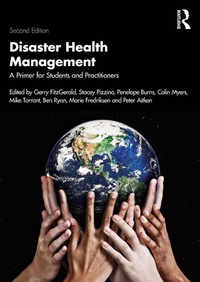
Disaster Health Management
A Primer for Students and Practitioners
2nd Edition
Published on 17. January 2024
428 pages
978-1-003-82965-2 (ISBN)
Description

The second edition of this leading textbook provides the definitive guide to disaster health management. From the key concepts, principles and terminology, to systems for mitigation, planning, response and recovery, it gives readers a comprehensive overview of every aspect of this emerging field.
Split into eight parts, the book begins by drawing the parameters of disaster health management before outlining key elements such as communication, community engagement and legal issues. It then moves on to discuss preparing for potential disasters, managing and mitigating their impact, and then recovering in the aftermath. Offering key insights into evaluation, leadership and the psychosocial aspects of disaster health management, the new edition also features a range of international case studies, including those outlining the management of COVID-19.
It is essential reading for both students and practitioners engaging in this important work.
Split into eight parts, the book begins by drawing the parameters of disaster health management before outlining key elements such as communication, community engagement and legal issues. It then moves on to discuss preparing for potential disasters, managing and mitigating their impact, and then recovering in the aftermath. Offering key insights into evaluation, leadership and the psychosocial aspects of disaster health management, the new edition also features a range of international case studies, including those outlining the management of COVID-19.
It is essential reading for both students and practitioners engaging in this important work.
More details
Edition
2nd edition
Language
English
Place of publication
London
United Kingdom
Publishing group
Taylor & Francis Ebooks
Target group
College/higher education
Illustrations
28 Tables, black and white; 81 Line drawings, black and white; 10 Halftones, black and white; 91 Illustrations, black and white
ISBN-13
978-1-003-82965-2 (9781003829652)
Copyright in bibliographic data and cover images is held by Nielsen Book Services Limited or by the publishers or by their respective licensors: all rights reserved.
Schweitzer Classification
Other editions
Additional editions
Gerry FitzGerald | Stacey Pizzino | Penelope Burns
Disaster Health Management
A Primer for Students and Practitioners
Book
01/2024
2nd Edition
Routledge
€79.80
Shipment within 10-20 days
Gerry FitzGerald | Stacey Pizzino | Penelope Burns
Disaster Health Management
A Primer for Students and Practitioners
Book
01/2024
2nd Edition
Routledge
€207.70
Shipment within 10-20 days
Persons
Gerard FitzGerald retired in July 2019 as Professor of Public Health at QUT and discipline Leader of Health Management and Disaster Management.
Stacey Pizzino is a humanitarian epidemiologist and global health expert focused on strengthening the evidence base for vulnerable populations impacted by disasters, armed conflict and complex humanitarian emergencies.
Penelope Burns is a General Practitioner, and a local Disaster Manager with appointments at the Australian National University and Western Sydney University.
Colin Myers has recently retired from a career in Emergency, Retrieval and Disaster Medicine and holds current appointments as adjunct Associate Professor in the Public Health Faculty at Queensland University of Technology and as Adjunct Professor, School of Public Health, Faculty of Medicine, James Cook University.
Michael Tarrent holds an adjunct appointment Associate Professor in the Public Health Faculty at Queensland University of Technology.
Ben Ryan is a Professor in the Thomas F. Frist, Jr. College of Medicine at Belmont University in Nashville, Tennessee, United States of America.
Marie Fredriksen is a senior Paramedic with the Queensland Ambulance Service and a guest lecturer in Disaster Management at QUT.
Peter Aitken is Executive Director, Disaster Management Branch, Queensland Health.
Stacey Pizzino is a humanitarian epidemiologist and global health expert focused on strengthening the evidence base for vulnerable populations impacted by disasters, armed conflict and complex humanitarian emergencies.
Penelope Burns is a General Practitioner, and a local Disaster Manager with appointments at the Australian National University and Western Sydney University.
Colin Myers has recently retired from a career in Emergency, Retrieval and Disaster Medicine and holds current appointments as adjunct Associate Professor in the Public Health Faculty at Queensland University of Technology and as Adjunct Professor, School of Public Health, Faculty of Medicine, James Cook University.
Michael Tarrent holds an adjunct appointment Associate Professor in the Public Health Faculty at Queensland University of Technology.
Ben Ryan is a Professor in the Thomas F. Frist, Jr. College of Medicine at Belmont University in Nashville, Tennessee, United States of America.
Marie Fredriksen is a senior Paramedic with the Queensland Ambulance Service and a guest lecturer in Disaster Management at QUT.
Peter Aitken is Executive Director, Disaster Management Branch, Queensland Health.
Content
Part 1 - The Conceptual Basis of Disaster Management. 1.Definitions and Terminology. 2.Disaster Trends and Impact. 3.Concepts and Principles. Part 2 - Key Elements of Disaster Management. 4.Disaster Management Frameworks. 5.Risk and its Management. 6.Business Continuity Management (BCM). 7.Risk and Crisis Communication During Health Disasters. 8.Community Engagement. 9.Legal and Ethical Aspects of Disaster Management. Part 3 - Healthcare Considerations. 10.Health System Impacts and Responses to Disasters. 11.Physical Health Impacts of Disasters. 12.Psychosocial Impacts of Disasters. Part 4 - Getting Ready. 13.Prevention and Mitigation. 14.Planning. 15.Preparedness. Part 5 - Incident Management and Response. 16.Principles of Incident Management. 17.Incident Management Practice. 18.External Assistance in Disasters. Part 6 - Recovering. 19.Community Recovery. 20.Recovery of Physical and Social Infrastructure: Rebuilding a Stronger Community. Part 7 - Unique Challenges of Particular Disasters. 21.Natural Disasters. 22.Manmade (Technological) Disasters. 23.Conflict, Terrorism and CBRNE. 24.Pandemics. 25.Complex Humanitarian Emergencies. Part 8 - Strategic Considerations. 26.Leadership. 27.Evaluation and Lessons Management. 28.Education, Training and Research. 29.Future Challenges.
