

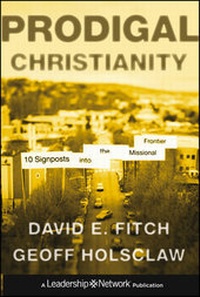
Prodigal Christianity
Description

More details
Other editions
Additional editions
Persons
Content
PREFACE AND ACKNOWLEDGMENTS
There’s nothing quite so irritating as the “much-vaunted expert.” Perhaps you know what I mean. We go to a conference. A person comes from some distant place, has an academic degree or two, has a book to sign, and now comes to speak to us on an issue we’re all dealing with in our churches (or our lives). He or she speaks as someone who has done the research and presents some insights, tells us what we’re doing wrong, and offers a solution or two. We are supposed to be encouraged, but in the end we leave with the distinct impression that it’s been a while since this person was actually in the situation we’re going through. We want to ask, “How is that working for you really?” but worry this might cause some embarrassment.
Geoff Holsclaw and I would like to disavow any presumption that we write this book as experts. It’s true we have some degrees, teach in a seminary, and pastor a church. Nonetheless, we write this book not as vaunted experts but as chastened sojourners. We’ve traveled the journeys we write about in this book. We have planted and led churches, and we write from these experiences. We are chastened sojourners—sojourners who have failed many times in the things about which we write. Nonetheless, you can still ask us, “How is that working for you?”
Our journey started about twelve years ago. My wife, Rae Ann, and I (Dave) moved to the northwest suburbs of Chicago to plant a church. We’d learned much about intentional Christian community in the city and accepted the call to go to the suburbs to plant a church. We were focused on gathering a community for the peoples outside the Christian bubble, the people who would no longer go to large megahalls or the traditional edifices we still call church. I wanted to be part of a relational community where church was a way of life that gives witness to the kingdom before those who know nothing about the kingdom.
That church became Life on the Vine (www.lifeonthevine.org). Soon after it started, Geoff and his wife, Cyd, joined us. We’ve been leading this community ever since. Several others have joined us along the way, and we’ve sent two other communities out to be planted in neighborhoods and helped others as well. During these years, we’ve been asked over and over again to talk about church in mission in a post-Christianized world. There have been literally hundreds of these theological and practical conversations along the way with people from all over North America.
Somewhere in the middle of this journey we encountered the fracturing of these many conversations. Our various conversation partners were dividing between those formerly known as Emergent and those who had emerged within the Neo-Reformed resurgence, most notably gathering around The Gospel Coalition, an Internet-based network of like minded Neo-Reformed leaders. (Please see note 2 in the Introduction for why we have chosen to refer to these friends by the moniker Neo-Reformed.) We observed firsthand the clashing of Emergent and Neo-Reformed visions and how they were coalescing around two opposing ways of thinking about church in mission. As things went on, neither option seemed capable of providing direction for us. From our point of view, both sides seemed to lack the ability to engage, that is, bring the transforming work of God in Christ across boundaries to those outside the influence of the Christian church. We needed guidance for on-the-ground missional engagement. Our churches were engaging issues of injustice, sexual confusion, pluralism of religions, and conflict that had now become part of regular life in the newly post-Christianized cultures of North America. What was the gospel in this situation? Where is the kingdom? How is God revealed in these places?
It is out of this journey that this book came into being.
The Process of Writing This Book
These past twelve years, I (Dave) have been assembling stuff—notes, lectures, presentations, blog posts—reflecting on the issues of the church making its way on this journey. Through teaching classes at Northern Seminary, coaching church plants, blogging, and copastoring, I had accumulated pages of reflections. Dialogues with Brian McLaren, Tim Keller, Tony Jones, Ed Stetzer, Alan Hirsch, and Mark Driscoll (whether online, in person, or through writing about them) were provoking discernments for the church in mission. And so somewhere between Brian McLaren’s A New Kind of Christianity, published in 2010, and John Piper’s “farewell Rob Bell” tweet in 2011 (at the publication of Bell’s Love Wins), two significant publishing events that drew attention to the Neo-Reformed/Emergent divide, I remember talking with an agent about how to pull all of this together. I wanted to offer some of these hard-won on-the-ground discernments to those who, like me, had grown weary of the fracturing and the bipolar options.
One day, I met Geoff at the local McDonald’s to talk and get feedback on my ideas for gathering this material together. All I really remember is that Geoff proposed “prodigal Christianity” for the organizing principle of the book. I was already familiar with Karl Barth’s (a famous German theologian) notion of the Son going into “the far country” of sinful humanity in order to return humanity back to the Father (a play on the parable about the prodigal son). This radical, excessive, prodigal journey of God in the Son compromises neither his divine nor his human nature. God fully enters our fallen context. This principle, which drove much of Barth’s missional description of God, seemed to galvanize much of what I was working on. It organized all the notes and lectures beautifully, offering a way beyond the impasses of either the emerging church or the Neo-Reformed. The more we talked about it in the following weeks, the more I liked it. In fact, we talked about writing it together. It couldn’t have made more sense.
And so this book was born. In McDonald’s.
Starting with my main themes, Geoff organized them into the outline for the book. We worked several weeks on that. Then, starting with my notes from teaching the missional theology class at Northern Seminary as well as other classes, I drafted the chapters with the stories I felt important. Geoff then revised those rough drafts, adding an occasional story from his perspective (he’s twenty years my junior). He also developed much of the biblical theology that undergirds the book. I revised Geoff’s revisions, and then Sheryl Fullerton, our wonderful editor at Jossey-Bass, did a further edit. One of our mutual friends from the Vine, Gordon Hackman, helped with a final edit, along with Geoff. All in all, the final result is a book that reads well and accomplishes much more than what I could have accomplished on my own. I’m convinced the writing is seamless, the theology better, and the perspective broader because Geoff and I wrote this book together.
Some Warnings
What has resulted is this book, Prodigal Christianity, which proposes a way of being Christian: in missional communities who live in such a way that we invite the kingdom of God into our lives and the neighborhoods around us. It asks anew the questions: What is the gospel? Where is the kingdom? How is God revealed in the Son and the Spirit? It recognizes the advances made in the past fifteen years from the various Emergent and Neo-Reformed groups. But it asks us to go further, to recognize the lacks in these theologies for mission. The book does not seek a compromise middle ground between these two camps; it proposes a way beyond them that learns from both but defies the categories of each. So be forewarned: this book will probably be looked at as liberal by the Neo-Reformed and as fundamentalist by the Emergents, but we hope you can avoid those labels as you read this book.
We could label the way forward that we propose in this book as “evangelical Anabaptist” or “radical evangelical.” For those who find these words troublesome, again, be warned. The book is evangelical in the way of the pioneering evangelicals of the twentieth century who believed unashamedly in the gospel that transforms lives and society. In the words of the old hymn, we believe “Jesus saves.” Yet it is also radical in the sense of the radical Anabaptist reformers of the sixteenth century in Europe who knew, in a time of massive upheaval, that Christians must leave the comfortable structures of the past and live together radically under Christ’s Lordship for the sake of mission. We must trust the Lord of the harvest and give up control of a lot of things evangelicals have sought to control in the past thirty years. In these ways, this book is both markedly evangelical and intensely radical.
Be forewarned as well that we offer no step-by-step process in this book to change our churches or our lives. Rather, we seek to shape imagination for the way God is working in the world. This, we suggest, will naturally lead to new ways of being God’s people in the world. But it will not look the same for everyone, and the steps needed in each context will be decidedly different. If you’re looking for a solution to the problems of your local church, you need read no further.
This is not to say that Prodigal Christianity does not provide some pointers to help us live the gospel anew in our contexts. The point of the book is to fund imagination for Christians to patiently inhabit our contexts, discern God’s work, and practice the kingdom in our...
