

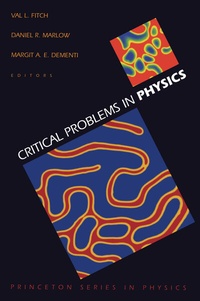
Critical Problems in Physics
1st Edition
Published on 5. April 2022
301 pages
978-0-691-22749-8 (ISBN)
Description

The past century has seen fantastic advances in physics, from the discovery of the electron, x-rays, and radioactivity, to the era of incredible solid state devices, computers, quarks and leptons, and the standard model. But what of the next? Many scientists think we are on the threshold of an even more exciting new era in which breakthroughs in a startling variety of directions will produce significant changes in our understanding of the natural world. In this book, a group of eminent scientists define and elaborate on these new directions.
Ed Witten and Frank Wilczek discuss string theory and the future of particle physics; Donald Perkins describes the search for neutrino oscillations; Alvin Tollestrup reveals dreams of a muon collider at Fermilab to probe the heart of "elementary" particles; and Robert Palmer anticipates a new generation of particle accelerators. Thibault Damour reviews classical gravitation and the relevant new high-precision experiments; Kip Thorne describes the exciting future for gravitational wave astronomy; and Paul Steinhardt examines the recent breakthroughs in observational cosmology and explains what future experiments might reveal. James Langer explores nonequilibrium statistics and relates it to the origins of complexity; Harry Swinney takes an experimentalist's view of the emergence of order in seemingly chaotic systems; and John Hopfield describes an extremely unusual dynamical system--the human brain. Bruce Hillman, M. D., discusses the recent developments in imaging techniques that have brought about outstanding advances in medical diagnostics. T.V. Ramakrishnan looks at high-temperature superconductors, which could eventually revolutionize the solid-state technology on which society is already highly dependent.
Ed Witten and Frank Wilczek discuss string theory and the future of particle physics; Donald Perkins describes the search for neutrino oscillations; Alvin Tollestrup reveals dreams of a muon collider at Fermilab to probe the heart of "elementary" particles; and Robert Palmer anticipates a new generation of particle accelerators. Thibault Damour reviews classical gravitation and the relevant new high-precision experiments; Kip Thorne describes the exciting future for gravitational wave astronomy; and Paul Steinhardt examines the recent breakthroughs in observational cosmology and explains what future experiments might reveal. James Langer explores nonequilibrium statistics and relates it to the origins of complexity; Harry Swinney takes an experimentalist's view of the emergence of order in seemingly chaotic systems; and John Hopfield describes an extremely unusual dynamical system--the human brain. Bruce Hillman, M. D., discusses the recent developments in imaging techniques that have brought about outstanding advances in medical diagnostics. T.V. Ramakrishnan looks at high-temperature superconductors, which could eventually revolutionize the solid-state technology on which society is already highly dependent.
More details
Other editions
Additional editions
Val L. Fitch | Daniel R. Marlow | Margit A.E. De menti
Critical Problems in Physics
Book
11/1997
Princeton University Press
€92.85
Article exhausted; check different version
Val L. Fitch | Daniel R. Marlow | Margit A.E. De menti
Critical Problems in Physics
Book
11/1997
Princeton University Press
€61.10
Article not available at the moment
Persons
Val L. Fitch, winner of the Nobel Prize in Physics and the National Medal of Science, is the James S. McDonnell Distinguished University Professor of Physics at Princeton University. He is a member of the President's Science Advisory Board and former president of the American Physical Association. Daniel R. Marlow is Professor of Physics, and Margit A. E. Dementi is a Lecturer in the English Department, both at Princeton University.
Content
- Cover Page
- Half-title Page
- Title Page
- Copyright Page
- Dedication Page
- Contents
- Preface
- 1. The 1946 Conference: Then and Now
- 1.1 Discussion
- 2. Nonequilibrium Physics
- 2.1 Introduction
- 2.2 Kepler's Snowflakes
- 2.3 Thoreau's Snowflakes
- 2.4 Metallurgical Microstructures
- 2.5 Solidification as A Free-Boundary Problem
- 2.6 Shape Instabilities and Singular Perturbations
- 2.7 Thermal Fluctuations and Sidebranches
- 2.8 A Field-Theoretic Description of Solidification Patterns
- 2.9 The Symmetry and Diversity of Snowflakes
- 2.10 Fracture Dynamics
- 2.11 The Physics of Complexity
- 2.12 Discussion
- 3. Dynamics, Computation, and Neurobiology
- 3.1 Biology and Physics
- 3.2 Neural Computation and Dynamics
- 3.3 Statistical and Collective aspects
- 3.4 Development and Environment
- 3.5 Evolution as A Source of Unity
- 3.6 Concluding Remarks
- 3.7 Discussion
- 4. Emergence and Evolution of Patterns
- 4.1 Near Equilibrium: The Base State
- 4.2 Instability of The Base State
- 4.3 Far Beyond The Onset of Stability: Experiments, Simulations, and Symmetry
- 4.4 Persistence of Order
- 4.5 Prospects
- 4.6 Discussion
- 5. High Temperature Superconductors
- 5.1 The Setting
- 5.1.1 The Atomic Arrangement
- 5.1.2 Electronic Structure
- 5.1.3 Mott Insulator
- 5.1.4 Doped Mott Insulator
- 5.2 The Insular Metal
- 5.2.1 Electrical Resistivity
- 5.2.2 Optical Conductivity
- 5.2.3 Angle-Resolved Photoemission Spectroscopy (Arpes)
- 5.3 The Metal In-Plane
- 5.3.1 Resistivity
- 5.3.2 The Hall Effect
- 5.3.3 Optical Conductivity
- 5.3.4 Single Particle Spectrum
- 5.3.5 Magnetic Excitations
- 5.4 Lower Energy Scale
- 5.5 The Superconducting State
- 5.6 Theories
- 5.7 Future
- 5.8 Discussion
- 6. The Ongoing Revolution In Medical Imaging
- 6.1 Discussion
- 7. Cosmological Challenges For The 21st Century
- 7.1 Introduction
- 7.2 Is The Universe Flat?
- 7.3 Do We Live In An Inflationary Universe?
- 7.4 Does Nmatter = 1?
- 7.5 If Matter & 1 and Fitotal = 1, What Else Is There?
- 7.6 Ultimate Challenge
- 7.7 Discussion
- 8. Gravitation and Experiment
- 8.1 Introduction
- 8.2 Experimental Tests of The Coupling Between Matter and Gravity
- 8.3 Tests of The Dynamics of The Gravitational Field In The Weak Field Regime
- 8.4 Tests of The Dynamics of The Gravitational Field In The Strong Field Regime
- 8.5 Was Einstein 100% Right?
- 8.6 Discussion
- 9. Gravitational Waves
- 9.1 Introduction
- 9.2 Ground-Based Laser Interferometers: Ligo & Virgo
- 9.2.1 Wave Polarizations, Waveforms, and How An Interferometer Works
- 9.2.2 Wave Strengths and Interferometer Arm Lengths
- 9.2.3 Ligo, Virgo, and The International Gravitational Wave Network
- 9.2.4 Narrow-Band Detectors
- 9.3 Lisa: The Laser Interferometer Space Antenna
- 9.4 Binaries Made of Neutron Stars, Black Holes, and Other Exotic Objects: Inspiral, Collision, and Coalescence In The Hf Ban
- 9.4.1 Wave Strengths Compared To Ligo Sensitivities
- 9.4.2 Coalescence Rates
- 9.4.3 Inspiral Waveforms and The Information They Can Bring
- 9.4.4 Testing Gr, Measuring The Cosmological Universe, Mapping Black Holes, and Searching For Exotic Objects
- 9.4.5 Coalescence Waveforms and Their Information
- 9.5 Other High-Frequency Sources
- 9.5.1 Stellar Core Collapse and Supernovae
- 9.5.2 Spinning Neutron Stars
- Pulsars
- 9.6 Low-Frequency Gravitational-Wave Sources
- 9.6.1 Waves From The Coalescence of Massive Black Holes In Distant Galaxies
- 9.6.2 Waves From Compact Bodies Spiraling into MAS -Sive Black Holes or Exotic Objects in Distant Galaxies
- 9.7 Conclusion
- 9.8 Discussion
- 10. Neutrino Oscillations D.H. Perkins
- 10.1 Some Neutrino Properties
- 10.2 Neutrino Oscillations
- 10.3 Solar Neutrinos
- 10.4 Atmospheric Neutrinos
- 10.5 Maximal Mixing
- 10.6 Appearance Experiments
- 10.7 Long Baseline Experiments
- 10.8 A Neutrino Crisis?
- 10.9 Discussion
- 11. The Tevatron Alvin Tollestrup
- 11.1 The Tevatron
- 11.2 The Factory Concept
- 11.3 The Magnet
- 11.4 Magnetic Measurement
- 11.5 Cryogenics
- 11.6 The Future
- 11.7 Some Physics Results
- 11.8 The Near Future
- 11.9 The Far Future
- 11.10 Conclusion
- 11.11 Discussion
- 12. High Energy Colliders
- 12.1 introduction
- 12.2 Physics Considerations
- 12.2.1 General
- 12.2.2 Required Luminosity For Lepton Colliders
- 12.2.3 The Effective Physics Energies of Hadron Colliders
- 12.3 Hadron-Hadron Machines
- 12.3.1 Luminosity
- 12.3.2 Size and Cost
- 12.4 Circular e+e - Machines
- 12.4.1 Luminosity
- 12.4.2 Size and Cost
- 12.5 e+e - Linear Colliders
- 12.5.1 Luminosity
- 12.5.2 Conventional RF
- 12.5.3 Superconducting RF
- 12.5.4 At Higher Energies
- 12.6 Colliders
- 12.7 Colliders
- 12.7.1 Advantages and Disadvantages
- 12.7.2 Design Studies
- 12.7.3 Status and Required R and D
- 12.8 Comparison of Machines
- 12.9 Conclusions
- 12.10 Discussion
- 13. Vistas in Theoretical Physics Edward Witten
- 13.1 Predictions and Post-Dictions in The Classic Period
- 13.2 The Mystery of The Cosmological Constant
- 13.3 The Big Questions
- 13.4 Outlook
- 13.5 Discussion
- 14. The Future of Particle Physics As A Natural Science Frank Wilczek
- 14.1 Triumph of The Standard Model
- 14.2 Deficiencies of The Standard Model
- 14.3 Unification: Symmetry
- 14.4 Unification: Dynamics, and A Big Hint of Supersymmetry
- 14.4.1 The Central Result
- 14.4.2 Implications
- 14.4.3 Why Supersymmetry is a Good Thing
- 14.5 The Farther Future: Connections
- 14.5.1 Matter
- 14.5.2 Cosmos
- 14.6 Discussion
