

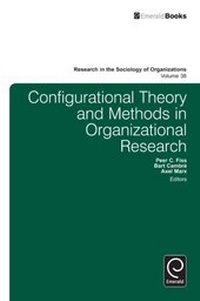
Configurational Theory and Methods in Organizational Research
1st Edition
Published on 2. May 2013
351 pages
978-1-78190-779-5 (ISBN)
Description

Some 20 years after the emergence of configurational theory as a key perspective in organization studies in the 1990s, this approach has yet to deliver on its promise. While we know that configurations the relative arrangement of parts and elements - matters, empirical research on configurations is just beginning to deliver on its promise.
All prices
More details
Series
Language
English
Place of publication
Bingley
United Kingdom
Target group
Professional and scholarly
File size
3,55 MB
ISBN-13
978-1-78190-779-5 (9781781907795)
Copyright in bibliographic data and cover images is held by Nielsen Book Services Limited or by the publishers or by their respective licensors: all rights reserved.
Schweitzer Classification
Other editions
Additional editions

Peer C. Fiss | Bart Cambre | Axel Marx
Configurational Theory and Methods in Organizational Research
Book
05/2013
Emerald Group Publishing Limited
€140.16
Shipment within 10-20 days
Content
List of Contributors.
Advisory Board.
Foreword: The Distinctiveness of Configurational Research.
Chapter 1 Configurational Theory and Methods in Organizational Research: Introduction.
Chapter 2 Crisp-Set Qualitative Comparative Analysis in Organizational Studies.
Chapter 3 The Two QCAs: From a Small-N to a Large-N Set Theoretic Approach.
Chapter 4 Configurational Analysis and Organization Design: Towards a Theory of Structural Heterogeneity.
Chapter 5 The Analysis of Temporally Ordered Configurations: Challenges and Solutions.
Chapter 6 Understanding Complementarities as Organizational Configurations: Using Set Theoretical Methods.
Chapter 7 Corporate Governance and Configuration Research: The Case of Foreign IPOs Listing in London.
Chapter 8 Corporate Social Responsibility: A Multilevel Explanation of Why Managers do Good.
Chapter 9 The Value of Configurational Approaches for Studying Digital Business Strategy.
Chapter 10 The Configurational Approach in Organizational Network Research.
Chapter 11 Country-Specificity and Industry Performance: A Configurational Analysis of the European Generic Medicines Industry.
Chapter 12 Applying Fuzzy Set Methodology to Evaluate Substitutes for Leadership.
Chapter 13 We Try Harder: Some Reflections on Configurational Theory and Methods.
Conclusion: The Path Forward.
Configurational Theory and Methods in Organizational Research.
Research in the sociology of organizations.
Research in the sociology of organizations.
Copyright page.
Advisory Board.
Foreword: The Distinctiveness of Configurational Research.
Chapter 1 Configurational Theory and Methods in Organizational Research: Introduction.
Chapter 2 Crisp-Set Qualitative Comparative Analysis in Organizational Studies.
Chapter 3 The Two QCAs: From a Small-N to a Large-N Set Theoretic Approach.
Chapter 4 Configurational Analysis and Organization Design: Towards a Theory of Structural Heterogeneity.
Chapter 5 The Analysis of Temporally Ordered Configurations: Challenges and Solutions.
Chapter 6 Understanding Complementarities as Organizational Configurations: Using Set Theoretical Methods.
Chapter 7 Corporate Governance and Configuration Research: The Case of Foreign IPOs Listing in London.
Chapter 8 Corporate Social Responsibility: A Multilevel Explanation of Why Managers do Good.
Chapter 9 The Value of Configurational Approaches for Studying Digital Business Strategy.
Chapter 10 The Configurational Approach in Organizational Network Research.
Chapter 11 Country-Specificity and Industry Performance: A Configurational Analysis of the European Generic Medicines Industry.
Chapter 12 Applying Fuzzy Set Methodology to Evaluate Substitutes for Leadership.
Chapter 13 We Try Harder: Some Reflections on Configurational Theory and Methods.
Conclusion: The Path Forward.
Configurational Theory and Methods in Organizational Research.
Research in the sociology of organizations.
Research in the sociology of organizations.
Copyright page.

