

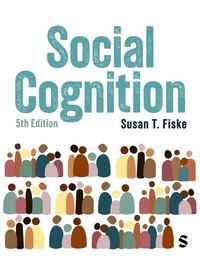
Social Cognition
From brains to culture
5th Edition
Published on 5. November 2025
584 pages
978-1-0362-0171-5 (ISBN)
Description

The social world is complicated and our minds are limited, so we take shortcuts. You have to make quick decisions - this person is dangerous, this one is not. The shortcuts we take mostly work well enough, because, after all, we survive. But some are deeply unjust, including racial or social class categories or other unfair stereotypes.
This book will help you understand how these shortcuts work, why they exist, and how they are changing.
This edition has been thoroughly revised to remove outdated content and add new information on AI and machine learning, as well as a brand new chapter on accuracy.
This is not a self-help book, but it will aid you as you navigate your social world. This is not a do-good book, but it will help you make a difference in the world. This is not fiction, but it tells some good stories. Social cognition captures a remarkable range of phenomena useful to individuals and to the human condition.
Susan T. Fiske is Emerita Eugene Higgins Professor of Psychology and Professor of Public Affairs, Princeton University. She is the only person to have won all three APS awards.
This book will help you understand how these shortcuts work, why they exist, and how they are changing.
This edition has been thoroughly revised to remove outdated content and add new information on AI and machine learning, as well as a brand new chapter on accuracy.
This is not a self-help book, but it will aid you as you navigate your social world. This is not a do-good book, but it will help you make a difference in the world. This is not fiction, but it tells some good stories. Social cognition captures a remarkable range of phenomena useful to individuals and to the human condition.
Susan T. Fiske is Emerita Eugene Higgins Professor of Psychology and Professor of Public Affairs, Princeton University. She is the only person to have won all three APS awards.
More details
Edition
Fifth Edition
Language
English
Place of publication
United Kingdom
Publishing group
SAGE Publishing (Digital)
Target group
College/higher education
Product notice
Reflowable
File size
1,79 MB
ISBN-13
978-1-0362-0171-5 (9781036201715)
Copyright in bibliographic data and cover images is held by Nielsen Book Services Limited or by the publishers or by their respective licensors: all rights reserved.
Schweitzer Classification
Other editions
Additional editions
Book
approx. 11/2025
5th Edition
SAGE Publications Ltd
€211.20
Not yet published
Book
11/2025
5th Edition
SAGE Publications Ltd
€194.50
Shipment within 3-4 weeks
Person
Susan T. Fiske is Eugene Higgins Professor, Psychology and Public Affairs, Princeton University (Ph.D., Harvard University; honorary doctorates, Universite Catholique de Louvain-la-Neuve, Belgium; Universiteit Leiden, Netherlands; Universitaet Basel, Switzerland; Universidad de Granada, Spain). She attended Harvard/Radcliffe College, majoring in Social Relations, where she met her graduate advisor and lifelong collaborator, Shelley Taylor. After her doctorate in social psychology, she worked at Carnegie-Mellon and the University of Massachusetts, Amherst, before moving to Princeton in 2000.
She investigates social cognition, especially cognitive stereotypes and emotional prejudices, at cultural, interpersonal, and neural levels. Author of about 400 articles and chapters, she is most known for work on social cognition, theories and research on how people think about each other: the continuum model of impression formation, the power-as-control theory, the ambivalent sexism theory, and the stereotype content model (SCM).
Her current SCM work focuses on the two fundamental dimensions of social cognition, perceived warmth (friendly, trustworthy) and perceived competence (capable, assertive). Upstream, perceived social structure predicts these stereotypes (cooperation-competition predicts warmth; status predicts competence). Downstream, specific emotions follow each warmth-x-competence quadrant (pride, disgust, envy, pity) and predict specific behaviors (active and passive help or harm). Using representative sample surveys, lab experiments, and neuro-imaging, Fiske lab has focused on varieties of dehumanization predicted by the SCM: dehumanizing allegedly disgusting homeless people, Schadenfreude toward the enviable rich, as well as paternalistic pity and prescriptive prejudices toward older people, disabled people, and women in traditional roles. Current work uses natural language analyses to explore spontaneous descriptions of others. Adversarial collaborations on research and adversarial alignments on theory are current projects to advance her science.
The U.S. Supreme Court cited her gender-bias testimony, and she testified before President Clinton's Race Initiative Advisory Board. These influenced her edited volume, Beyond Common Sense: Psychological Science in the Courtroom. Currently an editor of the Annual Review of Psychology, PNAS, Policy Insights from Behavioral and Brain Sciences, and Handbook of Social Psychology, she has written the upper-level texts Social Beings: Core Motives in Social Psychology (4/e) and Social Cognition: From Brains to Culture 6/e). She also co-wrote The Human Brand: How We Relate to People, Products, and Companies, which applies her models to how people perceive corporations. Her general-interest book, funded by a Guggenheim and the Russell Sage Foundation, is Envy Up and Scorn Down: How Status Divides Us.
She has been elected to the National Academy of Sciences, the American Academy of Arts and Sciences, and the American Philosophical Society. In 2020, she and Shelley Taylor shared the, Frontiers of Knowledge Award in Social Sciences, BBVA Foundation, Bilbao, Spain, for the 1984 publication of Social Cognition, all editions citation total 19,000. She has served as President of the Association for Psychological Science (APS), President of the Federation of Associations in Behavioral and Brain Sciences, as well as its FABBS Foundation, and President of the Society for Personality and Social Psychology. She has won Distinguished Scientific Contribution Awards from APA, SPSP, and SESP. Because it takes a village, her many graduate students and lab alumni conspired for her to win Princeton's Graduate Mentoring Award. She is grateful to be the only person so far to have won the three APS Awards: James (basic science), Cattell (applied science), and Mentoring.
She investigates social cognition, especially cognitive stereotypes and emotional prejudices, at cultural, interpersonal, and neural levels. Author of about 400 articles and chapters, she is most known for work on social cognition, theories and research on how people think about each other: the continuum model of impression formation, the power-as-control theory, the ambivalent sexism theory, and the stereotype content model (SCM).
Her current SCM work focuses on the two fundamental dimensions of social cognition, perceived warmth (friendly, trustworthy) and perceived competence (capable, assertive). Upstream, perceived social structure predicts these stereotypes (cooperation-competition predicts warmth; status predicts competence). Downstream, specific emotions follow each warmth-x-competence quadrant (pride, disgust, envy, pity) and predict specific behaviors (active and passive help or harm). Using representative sample surveys, lab experiments, and neuro-imaging, Fiske lab has focused on varieties of dehumanization predicted by the SCM: dehumanizing allegedly disgusting homeless people, Schadenfreude toward the enviable rich, as well as paternalistic pity and prescriptive prejudices toward older people, disabled people, and women in traditional roles. Current work uses natural language analyses to explore spontaneous descriptions of others. Adversarial collaborations on research and adversarial alignments on theory are current projects to advance her science.
The U.S. Supreme Court cited her gender-bias testimony, and she testified before President Clinton's Race Initiative Advisory Board. These influenced her edited volume, Beyond Common Sense: Psychological Science in the Courtroom. Currently an editor of the Annual Review of Psychology, PNAS, Policy Insights from Behavioral and Brain Sciences, and Handbook of Social Psychology, she has written the upper-level texts Social Beings: Core Motives in Social Psychology (4/e) and Social Cognition: From Brains to Culture 6/e). She also co-wrote The Human Brand: How We Relate to People, Products, and Companies, which applies her models to how people perceive corporations. Her general-interest book, funded by a Guggenheim and the Russell Sage Foundation, is Envy Up and Scorn Down: How Status Divides Us.
She has been elected to the National Academy of Sciences, the American Academy of Arts and Sciences, and the American Philosophical Society. In 2020, she and Shelley Taylor shared the, Frontiers of Knowledge Award in Social Sciences, BBVA Foundation, Bilbao, Spain, for the 1984 publication of Social Cognition, all editions citation total 19,000. She has served as President of the Association for Psychological Science (APS), President of the Federation of Associations in Behavioral and Brain Sciences, as well as its FABBS Foundation, and President of the Society for Personality and Social Psychology. She has won Distinguished Scientific Contribution Awards from APA, SPSP, and SESP. Because it takes a village, her many graduate students and lab alumni conspired for her to win Princeton's Graduate Mentoring Award. She is grateful to be the only person so far to have won the three APS Awards: James (basic science), Cattell (applied science), and Mentoring.
Content
Chapter 1: Introduction
Part I: Basic concepts in social cognition
Chapter 2: Dual modes in social cognition
Chapter 3: Attention and encoding
Chapter 4: Representation in memory
Part II: Understanding individual selves and others
Chapter 5: Self in social cognition
Chapter 6: Attribution of dispositions
Chapter 7: Heuristic judgments of probability
Part III: Making sense of society: Issues and groups
Chapter 8: Attitudes: Cognitive structure and process
Chapter 9: Stereotyping: Cognition and bias
Chapter 10: Prejudice: Interplay of cognitive and affective biases
Part IV: Beyond cognition: Affect, behaviour
Chapter 11: Affect and social cognition
Chapter 12: Behavior and cognition
Chapter 13: Accuracy and rationality
Part I: Basic concepts in social cognition
Chapter 2: Dual modes in social cognition
Chapter 3: Attention and encoding
Chapter 4: Representation in memory
Part II: Understanding individual selves and others
Chapter 5: Self in social cognition
Chapter 6: Attribution of dispositions
Chapter 7: Heuristic judgments of probability
Part III: Making sense of society: Issues and groups
Chapter 8: Attitudes: Cognitive structure and process
Chapter 9: Stereotyping: Cognition and bias
Chapter 10: Prejudice: Interplay of cognitive and affective biases
Part IV: Beyond cognition: Affect, behaviour
Chapter 11: Affect and social cognition
Chapter 12: Behavior and cognition
Chapter 13: Accuracy and rationality
