

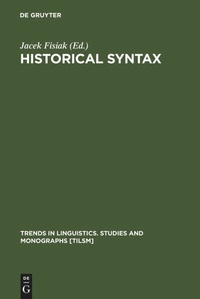
Historical Syntax
1st Edition
Published on 5. November 2010
XII, 636 pages
978-3-11-082403-2 (ISBN)
Description

No detailed description available for "Historical Syntax".
More details
Other editions
Additional editions
Jacek Fisiak
Historical Syntax
Book
01/1984
1st Edition
De Gruyter Mouton
€289.00
Article exhausted; check different version
Jacek Fisiak
Historical Syntax
Book
01/1984
1st Edition
De Gruyter Mouton
€199.95
Shipment within 10-20 days
Content
- Intro
- Preface
- List of conference participants.
- Internal reconstruction in pre-Japanese syntax
- Notes on syntactic change: Cooccurrence vs. substitution stability vs. permeability
- Translation and syntactic change
- Relativizers in Early Modern English: A dynamic quantitative study
- Irish complementation: A case study in two types of syntactic change
- Divergent word orderdevelopments in Germanic languages: A description and a tentative explanation
- Relatively attributive: The 'ezafe'-construction from Old Iranian to Modern Persian
- The reconstruction of particles and syntax
- On the strengths and weaknesses of a typological approach to historical syntax
- A valency framework for the Old English verb
- The distribution of the denominative adjective and the adnominal genitive in Old Church Slavonic
- If I was instead of if I were
- Comment on W. Manczak's paper
- Exbraciation in the Kru language family
- The origin of Old English conjunctions: Some problems.
- Levels of linguistic structure and the rate of change.
- Auxiliaries and auxiliarization in Western Muskogean
- Explorations into syntactic obsoleteness: English a-X-ing and X-ing
- Syntactic restructuring in the history of English
- Es war ein König in Thule ( ), Dem sterbend seine Buhle : On the rise and transformation(s) of morphosyntactic categories
- The choice of relative pronouns in 17th century American English.
- Towards a typology of relative clause formation strategies in Germanic
- Reconstructing word order in a polysynthetic language: From SOV to SVO in Iroquoian
- The study of eighteenth century English syntax
- 'Subjectless' constructions and syntactic change
- Semantic and pragmatic factors in syntactic change
- On the history of the verb-second rule in English
- Typology, universals and change of language
- Reconstructing comparative linguistics and the reconstruction of the syntax of undocumented stages in the development of languages and language families
- Verb-second, verb late, and the brace construction in Germanic: A discussion
