

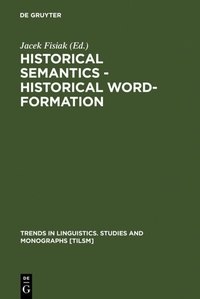
Historical Semantics - Historical Word-Formation
1st Edition
Published on 15. June 2011
XIII, 607 pages
978-3-11-085017-8 (ISBN)
Description

No detailed description available for "Historical Semantics - Historical Word-Formation".
More details
Series
Edition
Reprint 2011
Language
English
Place of publication
Berlin/Boston
Germany
Publishing group
de Gruyter Mouton
Target group
Professional and scholarly
US School Grade: College Graduate Student
Illustrations
Num. figs. and tabs.
Num. figs. and tabs.
File size
20,30 MB
ISBN-13
978-3-11-085017-8 (9783110850178)
Schweitzer Classification
Other editions
Additional editions
Jacek Fisiak
Historical Semantics - Historical Word-Formation
Book
11/1985
1st Edition
De Gruyter Mouton
€260.00
Shipment within 7-9 days
Jacek Fisiak
Historical Semantics - Historical Word-Formation
Book
01/1985
1st Edition
De Gruyter Mouton
€359.00
Article exhausted; check different version
Content
- Intro
- Preface
- List of conference participants
- The ordering of nominal compounds in Irish
- The semantic development of will
- Semantic shifts in Korean honoriflcation
- Prefixal negation of English adjectives: psycholinguistic dimensions of productivity
- Cross-linguistic comparison and the development of grammatical meaning
- Derivation, inflection, and semantic change in the development of the Chukchi verb paradigm
- Suppletion in word-formation
- Etymology and the lexical semantics of the Old English preverb be-
- Cognitive restrictions on the structure of semantic change
- On the origin of the suffix -ly
- Gender systems and semanticity: two case histories from Bantu
- Segmental phonology and word-formation: agency and abstraction in the history of Irish
- Deverbal nouns in Old and Modern English: from stem-formation to word-formation
- Where do concessives come from? On the development of concessive connectives
- The influence of semantic fields on semantic change
- On semantic change in a dynamic model of language
- Contact-induced semantic change and innovation
- Inferential features in historical semantics
- Diachronic irreversibility in word-formation and semantics
- Semantic development of borrowings
- Etymology and semantics. Theoretical considerations apropos of an analysis of the etymological problem of Spanish mañero, mañeria
- Lexical and syntactic semantics in historical aspect
- The synchrony-diachrony division in word-formation
- A historical perspective on the productivity of the suffixes -ness and -ity
- Word-formation, learned vocabulary and linguistic maturation
- La?amon's compound nouns and their morphology
- On the functional development of repetition in Antiguan Creole morphology, syntax, and discourse
- Modality and semantic change
- The lexicological analysis of older stages of languages
- 'Left' or 'right'?
- Index of authors
- Index of languages
