

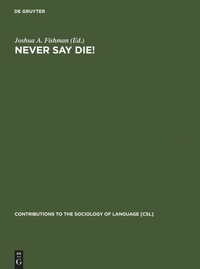
Never Say Die!
A Thousand Years of Yiddish in Jewish Life and Letters
1st Edition
Published on 14. December 2010
XVI, 763 pages
978-3-11-082080-5 (ISBN)
Description

No detailed description available for "Never Say Die!".
More details
Series
Edition
Reprint 2010
Language
English
Place of publication
Berlin/Boston
Germany
Publishing group
de Gruyter Mouton
Target group
Professional and scholarly
US School Grade: College Graduate Student
Illustrations
Num. figs. and tabs.
Num. figs. and tabs.
File size
31,84 MB
ISBN-13
978-3-11-082080-5 (9783110820805)
Schweitzer Classification
Other editions
Additional editions
Book
09/1981
1st Edition
De Gruyter Mouton
€240.00
Shipment within 15-20 days
Book
01/1981
1st Edition
De Gruyter Mouton
€169.95
Article exhausted; check different version
Content
- Intro
- Preface
- The Sociology of Yiddish: A Foreword
- PART I SOCIOHISTORICAL PERSPECTIVE
- The Reality of Jewishness versus the Ghetto Myth: The Sociolinguistic Roots of Yiddish
- The Yiddish Language: Its Cultural Impact
- Vegn der natsyonaler role fun yidish un der yidisher kultur [Concerning the Ethnohistorical Role of Yiddish and Yiddish Culture]
- Ume veloshn: yidish folk, yidish loshn [People and Language: Jewish Nationality and Yiddish Language]
- PART II ORTHODOXY: THEN AND NOW
- A Defense of Yiddish in Old Yiddish Literature
- Yidishkeyt un yidish [Jewishness and Yiddish]
- Di rekht fun 'loshn ashkenaz' bay dintoyres [The Rights of Yiddish in Suits in Rabbinic Courts] / Der vilner goen un yidish [The Sage of Vilna and Yiddish]
- Geule fun loshn [Redemption of Language]
- The Role of Yiddish in American Ultra-Orthodox and Hassadic Communities
- Who Needs Yiddish?
- Sounds of Modern Orthodoxy: The Language of Talmud Studies
- PART III MODERNIZATION MOVEMENTS AND MODERN ATTITUDES
- Di fir klasn [The Four Categories]
- Matesyohu mizes un di polemik vegn yidish [Matesyohu Mizes (Mattathias Mieses) and the Polemic about Yiddish]
- Zhitlovsky and American Jewry
- Mir bashuldikn un monen akhrayes! [We Accuse and Demand Responsibility!]
- Der blik az yidish iz der tamtsis fun yidishkayt - di sakone fun der formule 'lingvistish-sekularistish' [The View that Yiddish is the Quintessence of Jewishness - The Danger of the Formulation 'Linguistic-Secularistic']
- An ofener briv tsu undzer yidishistisher inteligents [An Open Letter to Our Yiddishist Intelligentsia]
- Who Needs Yiddish? A Study in Language and Ethics
- PART IV HISTORIC MOMENTS
- Attracting a Following to High-Culture Functions for a Language of Everyday Life: The Role of the Tshernovits Language Conference in the 'Rise of Yiddish'
- Di yidishe shprakh af der tog-ordenung fun der sholem-konferents in pariz, 1919 [The Yiddish Language on the Agenda of the Peace Conference in Paris, 1919]
- Tsu der efenung fun der yidish-katedre in yerushelayemer universitet [On the Inauguration of the Yiddish Chair at the University in Jerusalem]
- Address at the Dedication of the Leivick House in Israel, May 14, 1970
- Deklaratsye fun der velt-konferents far yidish un yidisher kultur in yerushelayem...dem 23stn-26stn oygust 1976 [Declaration of the World Conference for Yiddish and Yiddish Culture in Jerusalem... August 23-26, 1976]
- PART V FORMAL INSTITUTIONS OF LANGUAGE: THE PRESS, LITERATURE, THEATER, SCHOOLS
- Der 'bund' un der gedank vegn a yidish-veltlekher shul [The 'Bund' and the Idea of a Yiddish-Secular School]
- Tsvey shprakhn-eyneyntsike literatur [Two Languages - One Literature]
- Lererkursn far yidish in lodzher geto [Yiddish Courses for Teachers in the (Nazi) Ghetto of Lodz]
- The Night of the Murdered Poets
- An Educational Assessment of the Yiddish Secular School Movements in the United States
- The American Yiddish Press at Its Centennial
- Ida Kaminska and the Yiddish Theater
- Yiddish in the University
- PART VI MAINTENANCE AND SHIFT
- Di yidishe shprakh in undzer privat-lebn [The Yiddish Language in Our Private Life]
- The Struggle for Yiddish During World War I: The Attitude of German Jewry
- Di shprakhn bay yidn in umophengikn poyln [The Languages of Jews in Independent Poland]
- Lebediker untergang [Lively Death]/A loshn af tomid, nisht af dervayl [A Language for Always, Not Just for a While]
- Yiddish in Melbourne
- Knowledge, Use, and Evaluation of Yiddish and Hebrew among American Jewish College Students
- PART VII SOCIOLINGUISTIC VARIATION AND PLANNING
- Vegn zhargon oysleygn [About Spelling Zhargon ( = Yiddish)]
- Undzer mame-loshn [Our Mother Tongue]
- Vegn litvishn dialekt in kongres-poyln [Concerning the Litvak (= Northeastern) Dialect in Congress Poland] Note Berliner Zeyer gerekht [Absolutely Right]
- The 'Hidden Standard': A Study of Competing Influences in Standardization
- Politics and Linguistics in the Standardization of Soviet Yiddish
- Some Aspects of the Use of Pronouns of Address in Yiddish
- Bilingualism and Dialect Mixture Among Lubavitcher Hasidic Children
- Epilogue: Contributions of the Sociology of Yiddish to the General Sociology of Language
- Original Sources
- Index
