

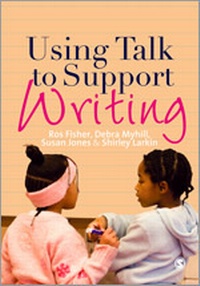
Using Talk to Support Writing
1st Edition
Published on 22. April 2010
200 pages
978-0-85702-704-7 (ISBN)
Description

Using Talk to Support Writing presents a new and innovative approach to the teaching of early writing. The authors discuss both theoretical and practical issues around using talk in the classroom to support children as they learn to write.
Set within the context of national concern for achievement in the development of writing ability, it addresses the gap in understanding early teaching and focuses on the exploration of how talk and writing interface. This includes:
- Numerous examples of teaching and activities for using talk to support writing
- Using extensive data from classrooms; video and audio recordings, and transcripts of children's talk
- Exploring three aspects of talk when used to support writing: talk for idea generation; talk for oral rehearsal and talk for reflection.
This book is for students on Primary ITT courses, particularly for English specialists. Students on M-level English and literacy courses will also find it useful.
Set within the context of national concern for achievement in the development of writing ability, it addresses the gap in understanding early teaching and focuses on the exploration of how talk and writing interface. This includes:
- Numerous examples of teaching and activities for using talk to support writing
- Using extensive data from classrooms; video and audio recordings, and transcripts of children's talk
- Exploring three aspects of talk when used to support writing: talk for idea generation; talk for oral rehearsal and talk for reflection.
This book is for students on Primary ITT courses, particularly for English specialists. Students on M-level English and literacy courses will also find it useful.
Reviews / Votes
'This book represents a new departure in education literature by its demonstration of a powerful partnership between theory and practice in early writing...Its uniqueness rests not only in the effective collaboration between professional researchers and teachers, but also in the inspiring way that this collaboration is portrayed...The research takes a fresh, focused look at what actually happens when children talk before, during and after writing, and how talk can be used to to develop specific writing skills...I would also recommend it to be read as a model of best practice in research partnership' -English four to eleven
'This book is essential reading for any teacher, literacy coordinator or student wanting to take a serious, research-based look at writing. It offers a superb balance between discussion of how to teach writing and how to inquire into the way that writing is taught in the classroom or school. The book's structure positions the reader in a dynamic relationship to the text, which promotes an active understanding of the pedagogical decisions teachers make and of the links between theory, research inquiry and practice. This innovative approach to writing about research is both inspired and inspiring' -
Sue Ellis
University of Strathclyde
More details
Language
English
Place of publication
London
United Kingdom
Target group
College/higher education
Professional and scholarly
ISBN-13
978-0-85702-704-7 (9780857027047)
Copyright in bibliographic data and cover images is held by Nielsen Book Services Limited or by the publishers or by their respective licensors: all rights reserved.
Schweitzer Classification
Other editions
Additional editions
Ros Fisher | Susan J. Jones | Shirley Larkin
Using Talk to Support Writing
Book
04/2010
1st Edition
SAGE Publications Ltd
€221.35
Article exhausted; check different version
Ros Fisher | Susan J. Jones | Shirley Larkin
Using Talk to Support Writing
Book
04/2010
1st Edition
SAGE Publications Ltd
€73.22
Shipment within 15-20 days
Persons
Susan Jones is a life-long educator, whose interest in best practice and research in teaching and learning led to a passion for effective communication. Actively facilitating and training education professionals, she also devotes much energy to keynote speaking, training trainers of adult audiences in presentation skills, and facilitating institutional change. She has presented to more than 20,000 people in the past decade alone. A leading expert on research-based classroom instruction and student achievement, she has helped educators translate research into practical strategies for teaching and learning. Her no-nonsense approach to instruction and leadership separates critical new research from speculation and skillfully presents the elements that positively impact achievement. She has served as past president of Florida ASCD, a member of the Board of Directors of ASCD, a trainer for the Bureau of Education and Research and has taught adjunct through four universities. Susan's experience includes more than two decades of K-12 classroom teaching experience, as well as service as Director of Program Development for Illinois Regional Offices of Education. In addition to Blueprint for Student Success and Backstage Pass, Susan is a contributing author to two brain-research based books. She has authored numerous articles and columns dealing with strategies to improve achievement. Debra Myhill is Professor of Education at the University of Exeter, UK, and Director of the Centre for Research in Writing, which promotes inter-disciplinary research, drawing on psychological, socio-cultural and linguistic perspectives on writing. Her research interests focus principally on writing and the teaching of writing, particularly linguistic and metalinguistic development, the composing processes involved in writing, the talk-writing relationship, and creative writing. Underpinning this research is the principle that literacy, especially writing, is a pathway to empowerment. Over the past twenty years, she has led a series of research projects in these areas, in both primary and secondary schools.
Key Publications
Chen, H. Myhill, D. A and Lewis, H. (2020) Developing writers across primary and secondary years: Growing into Writing. London: Routledge
Key Publications
Chen, H. Myhill, D. A and Lewis, H. (2020) Developing writers across primary and secondary years: Growing into Writing. London: Routledge
Content
Classroom Poster
Learning to Write - Debra Myhill
Exploring Classroom Talk through Action Research - Susan Jones
Being Involved in Research: The View from a School - Frances Dunkin
Talk to Generate Ideas - Ros Fisher
Lesson Plans for Idea Generation
Conscience Alley
Forum Theatre
Freeze-Frame
Using Music
Writing Aloud: The Role of Oral Rehearsal - Debra Myhill
Using Write Aloud in the Classroom - Rachael Milsom
Talk into Writing - Susan Jones
Lesson Plans for Write Aloud
Invisible Writing
Magic Pencil
Paired Writing
Talking to a Toy
Talk for Reflecting on Writing - Shirley Larkin
The Art of Reflection - Corinne Bishop
Talking about Writing: What the Children Told Us - Ros Fisher
Lesson Plans for Reflection
Evaluating Writing
A Step-by-Step Writing Guide
Thinking Cap
Two Ticks and a Wish
Managing Talk for Writing in the Classroom - Ros Fisher
My Favourite Lesson - Linda Bateman
Learning to Write - Debra Myhill
Exploring Classroom Talk through Action Research - Susan Jones
Being Involved in Research: The View from a School - Frances Dunkin
Talk to Generate Ideas - Ros Fisher
Lesson Plans for Idea Generation
Conscience Alley
Forum Theatre
Freeze-Frame
Using Music
Writing Aloud: The Role of Oral Rehearsal - Debra Myhill
Using Write Aloud in the Classroom - Rachael Milsom
Talk into Writing - Susan Jones
Lesson Plans for Write Aloud
Invisible Writing
Magic Pencil
Paired Writing
Talking to a Toy
Talk for Reflecting on Writing - Shirley Larkin
The Art of Reflection - Corinne Bishop
Talking about Writing: What the Children Told Us - Ros Fisher
Lesson Plans for Reflection
Evaluating Writing
A Step-by-Step Writing Guide
Thinking Cap
Two Ticks and a Wish
Managing Talk for Writing in the Classroom - Ros Fisher
My Favourite Lesson - Linda Bateman
