

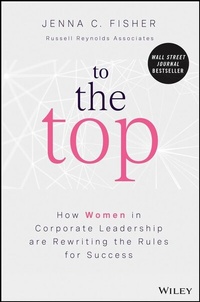
To the Top
Description

The Next-Generation Women Leadership Playbook
In To the Top: How Women in Corporate Leadership Are Rewriting the Rules for Success, accomplished leadership advisor Jenna Fisher reveals how the world faces a once-in-a-generation opportunity to close the gender gap at the top of organizations today.
You'll discover how traits often held by women--including compassion, empathy, communication, mentorship, and collaboration--are now in high demand. And why, in this time of volatility and disruption, women are standing on the most solid foundation for success than ever before.
Drawing on scientific research and the powerful stories of women business leaders who have already made it to the top, the book sets out how we can seize this opportunity in front of us. You'll learn:
* Why corporate progress for women has historically been stubbornly slow and strategies for breaking through systemic biases to take a seat at the top table
* Why women are particularly well-suited to lead companies through the complex challenges facing our world
* The specific leadership skills that are in high demand and how to develop a compassionate and commanding leadership presence
* The stories of women business leaders at the top of organizations today--their success, their missteps, and their lessons for success
An essential and insightful treatment of women leadership in a world that desperately needs more of it, To the Top is the first book since Lean In that promises to energize and accelerate the potential of woman leaders everywhere.
More details
Other editions
Additional editions
Person
Content
Introduction: A Post-Pandemic World 1
Part One The Third Revolution 15
1 The Myth of Progress 17
2 Meeting the Moment 41
3 Digital Empowerment 59
Part Two Leaps and Upward Bounds 81
4 Seen and Heard 83
5 The Art of the Ask 107
6 Up, Not Out 127
7 The Relationship Infrastructure 149
8 The Long Tail 171
Epilogue 195
Notes 203
Index 211
Introduction: A Post-Pandemic World
A few times a year, I am asked to talk to MBA students at leading business schools around the country about how to manage their careers. In 2022, I was speaking to a group of undergraduate students at a leading school, and at the end of the session we held a Q&A. In addition to their intelligence, savviness, maturity, and poise, what really stood out to me was that many of the women students asked me essentially the same questions:
- "How can I make my voice heard - and make it to the top?"
- "How should I negotiate my compensation, even when it feels awkward?"
- "How many boxes do I need to check before starting my own company?"
- "Is it really possible to have both a career and a family?"
These were some of the brightest and most accomplished women from all around the world, and yet the undertones of their questions made me realize - at the age of 21 - that they were already looking down the barrel towards their futures and questioning whether they could "have it all," whether they could succeed when they looked at how few women were at the top table today, and when they had seen so many talented women permanently step out of the labor force.
After everything that women have accomplished and the myriad ways in which things are so much better for us than they were only a generation ago, we still have some of the most talented and fiercest women questioning if they can rise to the highest ranks within corporations. It struck me that businesses and society are failing this generation of young women. We are so far from where we need to be in terms of gender parity.
As a partner at one of the top global leadership advisory firms, I have had a mission to get women to 50-50 representation at the highest levels of management and boards in corporate America, but for specific reasons I will break down in the chapters to come, it's not happening nearly fast enough. In the United States, women comprise 51% of the population; 47% of the workforce; and 70% of high school valedictorians; and yet (at the time of writing) Russell Reynolds Associates' research shows that only 9% of CEOs in the largest 100 companies in the S&P500 index are women.1 There are, in fact, about the same number of women CEOs in the S&P500 as there are CEOs named James or Michael.2 Over my 20-plus-year career, I have met thousands of eminently qualified and intelligent women with long lists of educational and career accomplishments who have struggled to make it all the way to the C-suite. It is a loss not just for these individuals, but for society as a whole.
So how do we get there?
As I thought more about the Q&A session with the undergrads, I realized that while some of the answers to these students' questions hadn't changed since I was myself a college student, some of them had - and drastically.
It made me think of a conversation I'd had with Christa Quarles in September 2020, a few months into the global Covid-19 pandemic that, as I write this, is still playing out around the world. Christa had been recently appointed as CEO of the global software company Alludo. She was a client-turned-friend who also happens to be a neighbor of mine in the suburbs of San Francisco. On a scheduled break between Zoom calls, we decided to throw on our sneakers and take a power "walk and talk," to discuss my concepts for this book. It was a welcome chance to check in with each other in person.
At this point the dramatic shift from office life to working remotely from home was still relatively new. Christa and I started comparing notes about how our professional lives had changed. Suddenly we had a luxury we'd craved for years: time. As working moms who were no longer spending two hours a day commuting in our cars to and from the office, we were able to see our children more and have family dinners together for the first time. And although I was working intensely, bouncing nonstop from meeting to meeting virtually, networking and writing reports from my craft-room-turned-home-office, I was getting more work done than ever.
It goes without saying that the pandemic resulted in untold personal and economic losses for millions. But some light was emerging from the darkness, and we were just beginning to see it.
"Christa, I can't imagine ever going back to the old way of working. I am getting a lot more accomplished than when I was sitting at my office desk. Am I crazy to think that this should be the new way forward?" (Little did I realize then that it would be more than two years before I would return to the office.)
"3,000 percent!" said Christa. "The pre-2019 office is a relic. Why would anyone ever want to go back to that artifact of a factory organization? In a digital economy we can talk to someone face-to-face from anywhere, we know how many deal closures you've made, and none of it is predicated on whether you did it inside an office. Who cares if you're picking your kids up from school at three o'clock when you're crushing it!"
This mindset was a complete change for Christa. Charismatic, with an acute intellect, a razor-sharp sense of humor, and endless reserves of energy, she'd ascended to the highest ranks in the male-dominated software industry, and before the pandemic had been attending every function, event, and leadership forum in her industry, flying across the country and around the world to meet customers and colleagues.
"If you'd asked me in 2019 whether I would ever become an advocate for remote work, I would have absolutely said no. I've got to corner that person in the elevator. I've got to stop people at the coffee machine. Being an in-person leader was part of my special sauce. I loved getting in front of that town hall meeting. I fed off the energy of it all."
Long before the lockdowns, many Alludo employees were already working hybrid or remotely in different locations across the world, from Ottawa to Tokyo, to Frankfurt, to Austin and Seattle. But it was an ad hoc approach that left some on the sidelines. The pandemic changed that, establishing a new normal that created the opportunity for a more inclusive work environment that took into account different approaches. The tech industry has historically been a man's world where the most vocal - or perhaps the tallest - get recognized. But Christa began to appreciate the individuals who were quietly getting it done.
"Do you think the universal remote work situation was empowering to certain personality types who may have been overlooked in the past?" I asked her. "And to women in particular?"
"The thing about remote meetings with larger groups is that everybody's Zoom box is the same size," Christa observed. "It enables you to go around the room, or I should say the screen, and ask people's opinions. It engenders a kind of equality. Everyone's viewpoint gets represented and it becomes much harder for a few people to dominate."
As Christa spoke, it occurred to me that we were in a rare moment in history where we could completely reset the workplace culture in a way that would be more inclusive. We were undergoing the biggest shift in how we work since the Industrial Revolution. And with more leaders like Christa at the helm who were reshaping organizations to allow for more multidimensional ways of working, communicating, and thinking, a long-overdue change could be here to stay. Through the forced circumstances of the lockdown, many of us were given our first delicious taste of what a healthy work-life balance could be. It showed us that this way of operating wasn't just new, but better - and it could potentially become the launch pad for more women to reach the highest level of corporate leadership. This was our chance to finally break through, in what Arianna Huffington described as a "Third Women's Revolution: The first one was giving us the vote; the second was giving us access to all jobs in the top of every profession; and the third one is women saying, 'We don't just want to be at the top of the world, we want to change the world, because the way the world has been designed is not working.'"3
Fundamental to this revolution is a workplace environment that's more authentic and welcoming to all genders, where leaders empower and enable the best from individuals, whether they are new moms pumping breast milk at home before jumping onto the next client call, a young, newly "out" gay Black man struggling to find his voice in large group meetings, or a "sandwich-generation" person in need of a more flexible schedule to care for an aging parent with dementia. It is about taking into consideration the life circumstances of an individual - male, female, or non-binary - and giving the trust and work style options necessary to bring out their best as professionals and create a pathway for them to rise in the organization. In short, it is nothing less than a transformation of the world and its social values to welcome all genders and backgrounds.
But it's not just the changing working practices that made me optimistic for women. The global pandemic helped to rewrite the rules on what it means to be a great leader. The seeds...
