

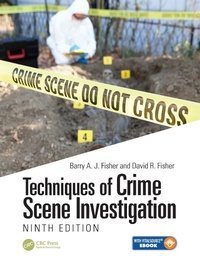
Techniques of Crime Scene Investigation
9th Edition
Published on 5. July 2022
368 pages
978-1-4987-5816-1 (ISBN)
Description

"Techniques of Crime Scene Investigation is a staple for any forensic science library and is routinely referenced by professional organizations as a study guide for certifications. It is professionally written and provides updated theoretical and practical applications using real casework. This text is a must-have for any CSI Unit or course teaching Crime Scene Investigation." - Kevin Parmelee, PhD, Detective (ret.), Somerset County, NJ Prosecutor's Office
Since the first English-language edition of Techniques of Crime Scene Investigation was published in 1964, the book has continued to be a seminal work in the field of forensic science, serving as a foundational textbook and reference title for professionals.
This Ninth Edition includes several new chapters and has been fully updated and organized to present the effective use of science and technology in support of justice. New coverage to this edition addresses the debunking of a few forensic science disciplines, long thought to have been based on sound science. The book provides students, crime scene investigators, forensic scientists, and attorneys the proper ways to examine crime scenes and collect a wide variety of physical evidence that may be encountered. While it is not possible to cover every imaginable situation, this book is a comprehensive guide that details and promotes best practices and recommendations.
In today's challenging environment, it is essential that law enforcement personnel thoroughly understand and meticulously comply with the forensic evidence procedures that apply to their function in the investigation process. Criminal investigations remain as complex as ever and require professionals from many disciplines to work cooperatively toward the fair and impartial delivery of justice. Practitioners and students alike need to be aware of the increased scrutiny that they will face in the judicial system. Judges are taking a more involved role than ever before as far as the evidence and testimony that they allow into their courtrooms. No longer will substandard forensic science or crime scene investigation be acceptable.
Key features:
Newly reorganized contents-including 4 brand new chapters-reflects a more logical flow of crime scene processes and procedures
Provides an overview of the crime scene investigation process and procedures, from the first officer on the scene through the adjudication of the case
Includes several new cases, photos, and updates in technological advances in both digital evidence and DNA in particular
Science and technology applied to CSI solves crimes and saves lives. Investigators, prosecutors, and defense attorneys must be able to use forensic tools and resources to their fullest potential and Techniques of Crime Scene Investigation serves as an invaluable resource to further this cause.
Since the first English-language edition of Techniques of Crime Scene Investigation was published in 1964, the book has continued to be a seminal work in the field of forensic science, serving as a foundational textbook and reference title for professionals.
This Ninth Edition includes several new chapters and has been fully updated and organized to present the effective use of science and technology in support of justice. New coverage to this edition addresses the debunking of a few forensic science disciplines, long thought to have been based on sound science. The book provides students, crime scene investigators, forensic scientists, and attorneys the proper ways to examine crime scenes and collect a wide variety of physical evidence that may be encountered. While it is not possible to cover every imaginable situation, this book is a comprehensive guide that details and promotes best practices and recommendations.
In today's challenging environment, it is essential that law enforcement personnel thoroughly understand and meticulously comply with the forensic evidence procedures that apply to their function in the investigation process. Criminal investigations remain as complex as ever and require professionals from many disciplines to work cooperatively toward the fair and impartial delivery of justice. Practitioners and students alike need to be aware of the increased scrutiny that they will face in the judicial system. Judges are taking a more involved role than ever before as far as the evidence and testimony that they allow into their courtrooms. No longer will substandard forensic science or crime scene investigation be acceptable.
Key features:
Newly reorganized contents-including 4 brand new chapters-reflects a more logical flow of crime scene processes and procedures
Provides an overview of the crime scene investigation process and procedures, from the first officer on the scene through the adjudication of the case
Includes several new cases, photos, and updates in technological advances in both digital evidence and DNA in particular
Science and technology applied to CSI solves crimes and saves lives. Investigators, prosecutors, and defense attorneys must be able to use forensic tools and resources to their fullest potential and Techniques of Crime Scene Investigation serves as an invaluable resource to further this cause.
More details
Edition
9th edition
Language
English
Place of publication
London
United Kingdom
Publishing group
Taylor & Francis Ltd
Target group
College/higher education
Product notice
Reflowable
Illustrations
184 Halftones, color; 47 Halftones, black and white; 184 Illustrations, color; 47 Illustrations, black and white
ISBN-13
978-1-4987-5816-1 (9781498758161)
Copyright in bibliographic data and cover images is held by Nielsen Book Services Limited or by the publishers or by their respective licensors: all rights reserved.
Schweitzer Classification
Other editions
Additional editions
David Fisher
Techniques of Crime Scene Investigation
Book
07/2022
9th Edition
CRC Press
€111.50
Shipment within 15-20 days
Person
Barry A. J. Fisher served as laboratory director for the L.A. County Sheriff's Department. He was president of the American Academy of Forensic Sciences, the International Association of Forensic Sciences, and American Society of Crime Laboratory Directors. He has consulted for the UN Office on Drugs and Crime, the US DOJ International Criminal Investigative Training Program, and lectures globally on CSI and forensic science. He holds BS and MS degrees in Chemistry and an MBA.
David R. Fisher is the director of the forensic science program at the New Jersey Institute of Technology. Before NJIT, he worked as a criminalist in the Department of Forensic Biology at the NYC Office of Chief Medical Examiner. He has worked on hundreds of criminal cases and has testified as an expert witness in DNA over 40 times. He is certified in criminalistics by the American Board of Criminalistics and is a Fellow of the American Academy of Forensic Sciences. David holds an MS in Forensic Science and a BS in Biochemistry and Cell Biology.
David R. Fisher is the director of the forensic science program at the New Jersey Institute of Technology. Before NJIT, he worked as a criminalist in the Department of Forensic Biology at the NYC Office of Chief Medical Examiner. He has worked on hundreds of criminal cases and has testified as an expert witness in DNA over 40 times. He is certified in criminalistics by the American Board of Criminalistics and is a Fellow of the American Academy of Forensic Sciences. David holds an MS in Forensic Science and a BS in Biochemistry and Cell Biology.
Content
I: The Crime Scene 1. Introduction 2. First on Scene and Crime Scene Personnel 3. Documenting the Crime Scene 4. Physical Evidence Collection 5. Crime Scene Reconstruction II. Physical Evidence 6. Fingerprint Evidence 7. Blood, Forensic Biology, and DNA 8. Forensic Traces 9. Impression Evidence 10. Firearms Examination 11. Arson and Explosives 12. Illicit Drugs and Toxicology 13. Document Evidence III: The Investigation and Special Considerations 14. Ethics in Crime Scene Investigation 15. Sexual Assault Investigation 16. Burglary Investigation 17. Motor Vehicle Investigation 18. Death Investigation 19. Digital Evidence and the Electronic Crime Scene 20. Report Writing, Testimony and The Future App A. Equipment for Crime Scene Investigation App B. Forensic Science Related Websites
