

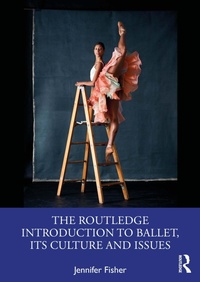
The Routledge Introduction to Ballet, its Culture and Issues
1st Edition
Published on 24. December 2024
208 pages
978-1-040-27320-3 (ISBN)
Description

As an introduction to ballet's history, culture, and meanings, this book draws on the latest ballet scholarship to describe the trajectory of a dance form that has risen to global ubiquity and benefited from many diverse influences along the way.
Organized around themes, the book explains how the manners, style, and hierarchies of ballet became such a strong part of its DNA. It addresses the origins of ballet's aristocratic vocabulary and the ways in which it may be interpreted now, incorporating meanings that range from the aesthetic to the spiritual and the political. The Routledge Introduction to Ballet, its Culture and Issues explores how dancers and audiences have experienced ballet, how popular films have represented it, and who has been excluded and how that could change. The chapters highlight the people, institutions, and works that helped to establish ballet's reputation, while also uncovering lesser-known influences and new ways of interpreting ballet. Lists of research resources-further readings, documentary films, and dance feature films-offer starting points for further avenues of learning. This book's central premise is that all dance reflects the culture in which it develops and is capable of embodying and disseminating new ideas.
This is the definitive introduction for anyone drawn to ballet or seeking to understand it, and those looking to develop a thorough understanding of how ballet developed, the cultures that formed it, and what it can mean for today's audiences, artists, and scholars.
Organized around themes, the book explains how the manners, style, and hierarchies of ballet became such a strong part of its DNA. It addresses the origins of ballet's aristocratic vocabulary and the ways in which it may be interpreted now, incorporating meanings that range from the aesthetic to the spiritual and the political. The Routledge Introduction to Ballet, its Culture and Issues explores how dancers and audiences have experienced ballet, how popular films have represented it, and who has been excluded and how that could change. The chapters highlight the people, institutions, and works that helped to establish ballet's reputation, while also uncovering lesser-known influences and new ways of interpreting ballet. Lists of research resources-further readings, documentary films, and dance feature films-offer starting points for further avenues of learning. This book's central premise is that all dance reflects the culture in which it develops and is capable of embodying and disseminating new ideas.
This is the definitive introduction for anyone drawn to ballet or seeking to understand it, and those looking to develop a thorough understanding of how ballet developed, the cultures that formed it, and what it can mean for today's audiences, artists, and scholars.
More details
Edition
1. Auflage
Language
English
Place of publication
London
United Kingdom
Publishing group
Taylor & Francis Ltd
Target group
College/higher education
Illustrations
54 Halftones, black and white; 54 Illustrations, black and white
ISBN-13
978-1-040-27320-3 (9781040273203)
Copyright in bibliographic data and cover images is held by Nielsen Book Services Limited or by the publishers or by their respective licensors: all rights reserved.
Schweitzer Classification
Other editions
Additional editions
Jennifer Fisher
The Routledge Introduction to Ballet, its Culture and Issues
Book
12/2024
1st Edition
Routledge
€57.00
Shipment within 15-20 days

Jennifer Fisher
The Routledge Introduction to Ballet, its Culture and Issues
Book
12/2024
1st Edition
Routledge
€196.00
Shipment within 15-20 days
Person
Jennifer Fisher is the author of Nutcracker Nation (2003), Ballet Matters (2019), and co-editor of When Men Dance: Choreographing Masculinities across Borders (2009). A professor at the University of California, Irvine, USA, she is the founding editor of Dance Major Journal, https://escholarship.org/uc/dmj. Formerly a performer and journalist, Fisher wrote about dance for the Los Angeles Times for many years and has published scholarly articles on topics that include ballet and whiteness, interviewing skills, ballet and gender, the dangers of "so-called" lyrical dance, and Anna Pavlova and the Swan Brand. She is also a ballet coroner whose most recent inquests into the death of Giselle were held at the San Francisco Ballet.
Content
Chapter 1 The ballet landscape
Chapter 2 Ballet is actually a form of ethnic dance
Chapter 3 The culture of ballet practice
Chapter 4 Gender, love, and ballet duets
Chapter 5 Ballet and exclusion
Chapter 6 Ballet and revolution
Chapter 7 Unpacking The Nutcracker
Chapter 8 Audiences and the dance of the spectator
Chapter 2 Ballet is actually a form of ethnic dance
Chapter 3 The culture of ballet practice
Chapter 4 Gender, love, and ballet duets
Chapter 5 Ballet and exclusion
Chapter 6 Ballet and revolution
Chapter 7 Unpacking The Nutcracker
Chapter 8 Audiences and the dance of the spectator
