

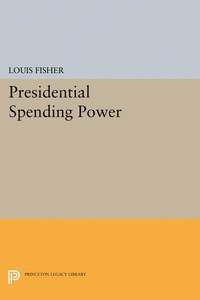
Presidential Spending Power
1st Edition
Published on 19. May 2015
362 pages
978-1-4008-6834-6 (ISBN)
Description

Each year billions of dollars are diverted by the President and his assistants from the purposes for which Congress intended them. Billions more are used in confidential and covert ways, without the knowledge of Congress and the public. Here is the first account of how this money is actually spent.
Louis Fisher writes: "When it comes to the administration of the budget, we find nothing that is obvious, very little that is visible. Our priorities here are peculiar. We fix upon the appropriations process, watching with great fascination as Congress goes about its business of making funds available to agencies. What happens after that point -the actual spending of money-rarely commands our attention."
To unravel the mystery, Louis Fisher has investigated different forms of discretionary action: the transfer of funds that initially financed the Cambodian incursion; impoundment during the Nixon administration; covert financing; the reprogramming of funds; and unauthorized commitments. He describes each of these devices in operation and provides the historical background of Presidential spending power.
In conclusion Louis Fisher presents a cogent and timely analysis of what can be done to improve Congressional control. Sufficient control, he maintains, cannot be achieved merely through the appropriations process, and he makes important recommendations designed to preserve discretionary authority while improving Congressional supervision.
Originally published in 1975.
The Princeton Legacy Library uses the latest print-on-demand technology to again make available previously out-of-print books from the distinguished backlist of Princeton University Press. These editions preserve the original texts of these important books while presenting them in durable paperback and hardcover editions. The goal of the Princeton Legacy Library is to vastly increase access to the rich scholarly heritage found in the thousands of books published by Princeton University Press since its founding in 1905.
Louis Fisher writes: "When it comes to the administration of the budget, we find nothing that is obvious, very little that is visible. Our priorities here are peculiar. We fix upon the appropriations process, watching with great fascination as Congress goes about its business of making funds available to agencies. What happens after that point -the actual spending of money-rarely commands our attention."
To unravel the mystery, Louis Fisher has investigated different forms of discretionary action: the transfer of funds that initially financed the Cambodian incursion; impoundment during the Nixon administration; covert financing; the reprogramming of funds; and unauthorized commitments. He describes each of these devices in operation and provides the historical background of Presidential spending power.
In conclusion Louis Fisher presents a cogent and timely analysis of what can be done to improve Congressional control. Sufficient control, he maintains, cannot be achieved merely through the appropriations process, and he makes important recommendations designed to preserve discretionary authority while improving Congressional supervision.
Originally published in 1975.
The Princeton Legacy Library uses the latest print-on-demand technology to again make available previously out-of-print books from the distinguished backlist of Princeton University Press. These editions preserve the original texts of these important books while presenting them in durable paperback and hardcover editions. The goal of the Princeton Legacy Library is to vastly increase access to the rich scholarly heritage found in the thousands of books published by Princeton University Press since its founding in 1905.
More details
Other editions
Additional editions
Louis Fisher
Presidential Spending Power
Book
04/2016
Princeton University Press
€122.20
Article not available at the moment
Louis Fisher
Presidential Spending Power
Book
03/2015
Princeton University Press
€46.80
Article not available at the moment

Louis Fisher
Presidential Spending Power
Book
11/1975
Princeton University Press
€14.24
Article exhausted; check different version
Louis Fisher
Presidential Spending Power
Book
11/1975
Princeton University Press
€61.90
Article exhausted; check different version
Person
Louis Fisher
Content
Frontmatter, pg. i
Contents, pg. vii
Acknowledgments, pg. xi
Introduction, pg. 1
1. Presidential Budgeting (1789-1921), pg. 9
2. Presidential Budgeting (1921-1975 ), pg. 36
3. Lump-Sum Appropriations, pg. 59
4. Reprogramming of Funds, pg. 75
5. Transfers Between Accounts, pg. 99
6. Timing of Obligations, pg. 123
7. Impoundment: Politics and the Law, pg. 147
8. Impoundment: The Nixon Legacy, pg. 175
9. Covert Financing, pg. 202
10. Executive Commitments, pg. 229
Conclusion, pg. 257
References, pg. 267
Table of Cases, pg. 333
Index, pg. 337
Contents, pg. vii
Acknowledgments, pg. xi
Introduction, pg. 1
1. Presidential Budgeting (1789-1921), pg. 9
2. Presidential Budgeting (1921-1975 ), pg. 36
3. Lump-Sum Appropriations, pg. 59
4. Reprogramming of Funds, pg. 75
5. Transfers Between Accounts, pg. 99
6. Timing of Obligations, pg. 123
7. Impoundment: Politics and the Law, pg. 147
8. Impoundment: The Nixon Legacy, pg. 175
9. Covert Financing, pg. 202
10. Executive Commitments, pg. 229
Conclusion, pg. 257
References, pg. 267
Table of Cases, pg. 333
Index, pg. 337
