

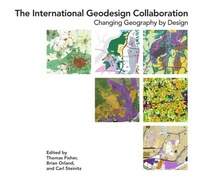
The International Geodesign Collaboration
Description

The International Geodesign Collaboration
Changing Geography by Design
Edited by Thomas Fisher, Brian Orland, and Carl Steinitz
The International Geodesign Collaboration (IGC) is a collaboration by teams from among global universities to understand better how geodesign can address major global and local challenges in settings that are widely dispersed and that differ widely in geography, climate, society, and scale. How do we identify and share the lessons and practices developed by a globally dispersed array of experts so that the resulting knowledge can be leveraged to solve our most pressing societal needs.
The IGC seeks to address this exceptionally complex problem while educating tomorrow's leader in planning for future change.
All prices
More details
Other editions
Additional editions

Persons
Content
Foreword by Jack Dangermond
Part I: The International Geodesign Collaboration
Improving our global infrastructure
Geodesign systems
Design assumptions
Geodesign innovations
Part II: Geodesign projects
How to read the projects in this book
Leibniz University Hannover, Germany
University of Georgia, United States
Beijing Forestry University, China
University College London, United Kingdom
Leibniz University Hannover, Germany
University of Ljubljana, Slovenia
Peking University, China
Università di Cagliari, Italy
The University of Manchester, United Kingdom
The Pennsylvania State University, United States
Hochschule Weihenstephan-Triesdorf, Germany
Politecnico di Milano, Italy
Tohoku University, Japan
Harvard University, United States
Harran University, Turkey
Virginia Polytechnic Institute and State University, United States
Ankara University, Turkey
University of Buenos Aires, Argentina
University of New South Wales, Australia
University of Thessaly, Greece
Ahmadu Bello University, Nigeria
Chulalongkorn University, Thailand
Ritsumeikan University, Japan
California State Polytechnic University, Pomona, United States
National Sun Yat-sen University, Taiwan
Iowa State University, United States
University of Seoul, South Korea
Oregon University System, United States
California State Polytechnic University, San Luis Obispo, United States
University of Virginia, United States
National University of Singapore, Singapore
Leibniz University Hannover, Germany (Lahn River region)
University of Illinois, Urbana-Champaign, United States
Universidade de São Paulo, Brazil
Federal University of Minas Gerais, Brazil
School of Environment and Architecture, Mumbai, India
Universidad Autónoma Metropolitana, Mexico
Swedish University of Agricultural Sciences, Sweden
University of Southern California, United States
University of North Carolina at Charlotte, United States
University of Basilicata, Italy
Texas A&M University, United States
Universidad Simón Bolívar, Venezuela
University College Dublin, Ireland
Georgia Institute of Technology, United States
Hiroshima University, Japan
San Diego State University, United States
University of California, Berkeley, United States
The University of Tokyo, Japan
Addis Ababa University, Ethiopia
National Institute for Environmental Studies, Japan
Part III: Reflections
IGC 2019: What we learned
How geodesign processes shaped outcomes
The natural language of geodesign
Individual relections
Afterword and the direction forward
