

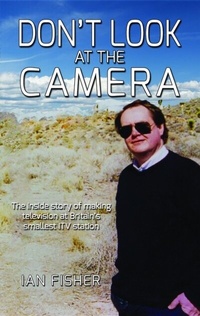
Don't Look at the Camera
Description

Don't Look at the Camera tells the extraordinary inside story of what it's like to spend a lifetime making television. Ian Fisher is an international award winning producer/director who started his television career as a news reporter and presenter. This first volume of his memoirs is an often hilarious, sometimes emotional journey through a series of adventures, regular occurrences in his working day.
As a reporter he impersonated a cabinet minister to secure an interview with the Home Secretary, tracked down Richard Branson's balloon at the end of his record-breaking trans-Atlantic flight, faced down a farmer who threatened to shoot him with a shotgun, and led the first television crew into Lockerbie after Pan Am Flight 103 crashed onto the town.
His programme-making exploits have been no less interesting, leading to encounters with some of the world's top experts in their specialisms. He tells of the man who masterminded the US hydrogen bomb project, whose first encouraging words on meeting him at the end of a five thousand mile journey were, "You know I don't want to do this", and of the scientist whose pipe set fire to his sports jacket half way through the interview.
Fisher says he's been lucky that the predominant sound in the crew vehicles and edit suites he's worked from has been laughter, and it finds its way into this book. But it's not exclusively a light-hearted take on life.
His involvement in covering the funeral of an 11 year old girl, murdered by a serial killer who the police took years to track down, is a heart rending story. And the description of events at Lockerbie on the night of the crash and over the subsequent days gives a unique insight into the pressures and dangers faced by journalists and crews reporting on world-level events.
Fisher has picked up a wide range of awards over the course of his career, including two medals from the prestigious New York Film & Television Festival, and his knowledge and experience are woven into the very fabric of this book. Don't Look at the Camera will have you laughing and weeping. But you'll also marvel at how much one person can fit in to a single life.
More details
Person
Content
Chapter 1 - Arm of a Princess
For the first time, Fisher reveals how he impersonated Princess Anne to ensure the success of a news report. Along the way there's a series of mishaps as he steals the police sandwiches, saves his cameraman from a fall to his death, and watches in horror as another member of his crew comes close to accidentally assassinating the Princess Royal. Elsewhere, he is faced with the embarrassment of explaining to the Chief Constable why the company film vehicle's road tax is out of date - two years running. This chapter is a madcap introduction to the trials and tribulations of making television, when the world rarely performs in the expected way.
Chapter 2 - The Manx Secret Nuclear Dump
Chapter 2 is the extraordinary tale, told here for the first time, of how a radioactive piece of America's nuclear history - a relic of the Cold War - finds its way to the back garden of a house on the Isle of Man thanks to the influence of Dr Edward Teller, the Hungarian-American scientist who masterminded the US Hydrogen bomb project. It's a chapter populated with heroes and some ground-breaking scientists - Tom Tuohy, who saved north-west England from being turned into a nuclear wasteland after a fire at the Windscale Nuclear Reactor in 1957; Ray Haroldsen, an electrician who turned the first test at a nuclear reactor in Idaho into a success when he connected its electrical output to the little town of Arco, population 995; Harold Agnew, the only man to witness the full trail of the development of the Atomic bomb, from Enrico Fermi's experiment on the floor of a racquets court at the University of Chicago in 1942 to its detonation on the Japanese city of Hiroshima three years later; and Edward Teller, one of those responsible for encouraging the Arms Race. Meeting each of them is a fascinating experience, and Fisher's razor-sharp observational skills are at their best.
Chapter 3 - Flights of Fancy
Aeronautical adventure is the theme of Chapter 3.. In a series of exciting adventures, Fisher takes to the skies. He tracks down Richard Branson and Per Lindstrand following their ditching in the Irish Sea after an epic and record-breaking hot air balloon flight across the Atlantic, before breaking the news live from a remote Irish phone box that Lindstrand has been plucked from the jaws of death at the last moment. He pilots an RAF fast jet with the future Chief of the Defence Staff before going for a Valentine's Night curry with the boys of 54 Squadron. Their hospitality shows no bounds when they spend the following week bombing his cameraman's cabbage patch on an hourly basis.
Chapter 4 - The American Dream
Fisher takes his crew to the United States for the first time. But with a non-existent budget, he's faced with finding someone else to pay, and it's a close run thing. He learns that, to be successful in New York, you've got to be larger than life. But while his adaptive quick thinking leads to success after he sets a trap for bankers on Wall Street, when it comes to ordering breakfast in a Broadway diner he discovers he's no more than a rank amateur.
Chapter 5 - Dark Days
In the final chapter the laughter stops as Fisher tries to come to terms with some of the most tragic events he's had to deal with. He's tasked with reporting on the funeral of an 11 year-old girl, abducted and murdered by one of Britain's most infamous serial killers, and learns a lesson about how callous television can be along the way. His description of events as he takes the first television crew into the smoke and flames of Lockerbie within minutes of the crash of Pan Am Flight 103 are compelling and moving. Told for the first time, he details the challenges he and his crew faced that night and in the following days.
Index
A comprehensive index of people, places and events
