

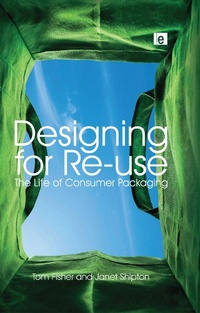
Designing for Re-Use
The Life of Consumer Packaging
1st Edition
Published on 1. December 2009
200 pages
978-1-136-54608-2 (ISBN)
Description

Packaging is ephemeral - its purpose is to be 'wasted' once we've removed the product it contains. Whilst we are encouraged to 'reduce, re-use and recycle', Designing for Re-Use proposes that domestic re-use is the 'Cinderella' of this trinity, because it is under researched and little understood.
The re-use of packaging could have a significant effect on the quantity of material that enters the waste stream and the energy and consequently carbon that is expended in its production - every re-used item is another item not purchased. The authors demonstrate that we do re-use - but usually despite, rather than because of, the actions of government and designers. The book shows that by understanding the ways in which actions of this sort fit with everyday life, opportunities may be identified to enhance the potential for re-use through packaging design.
The authors itemize the factors that affect the re-use of packaging, and analyse the home as a system in which objects are processed. Some of these factors relate to the specifics of the design, including the type of materials used and the symbolism of the branding. Other factors are more obviously social - for instance the effects on re-use of different consumer orientations. The book provides practical guidance from a design perspective, in the context of real-life examples, to provide professionals with vital design recommendations and evaluate how a practice orientated approach to understanding consumers' behaviour is significant for moving towards sustainability through design.
The re-use of packaging could have a significant effect on the quantity of material that enters the waste stream and the energy and consequently carbon that is expended in its production - every re-used item is another item not purchased. The authors demonstrate that we do re-use - but usually despite, rather than because of, the actions of government and designers. The book shows that by understanding the ways in which actions of this sort fit with everyday life, opportunities may be identified to enhance the potential for re-use through packaging design.
The authors itemize the factors that affect the re-use of packaging, and analyse the home as a system in which objects are processed. Some of these factors relate to the specifics of the design, including the type of materials used and the symbolism of the branding. Other factors are more obviously social - for instance the effects on re-use of different consumer orientations. The book provides practical guidance from a design perspective, in the context of real-life examples, to provide professionals with vital design recommendations and evaluate how a practice orientated approach to understanding consumers' behaviour is significant for moving towards sustainability through design.
Reviews / Votes
'An insightful and important study that highlights the limitations of recycling and a need to appreciate the complexity of human relationships with material artefacts in order to achieve progress towards sustainable consumption.' -Dr Tim Cooper, author of Longer Lasting Solutions (Gower 2010)'[Designing for Re-Use] shows an interesting approach and a different way of thinking about packaging and the use of our resources. It goes deep into consumer behavior and might actually inspire designers as well as consumers to design, and maybe even shop, for re-use.' -Treehugger
'Well referenced and researched, this book injects energy into the problem of how to deal with packaging waste. ...this is not another Blue Peter annual showing how to live the Good Life; rather, it is a worthy attempt at understanding how consumers relate to packaging in the privacy of their homes.' -Charles Newman, Resource Magazine
'Designing for Re-use will appeal to a variety of users including those studying product and packaging design methods. It will appeal to those interested in craft and environmentally based design disciplines. The book will also appeal to consumers interested in reducing their own carbon footprint and wanting to live in a more sustainable way- the book is a great advocate for sponsoring spontaneous creativity and encourages people to question if they should really be throwing away their waste packaging and thinking about secondary applications within their homes.' Jim Collingham, The Design Journal
More details
Language
English
Place of publication
London
United Kingdom
Publishing group
Taylor & Francis Ltd
Target group
Professional and scholarly
File size
9,95 MB
ISBN-13
978-1-136-54608-2 (9781136546082)
Copyright in bibliographic data and cover images is held by Nielsen Book Services Limited or by the publishers or by their respective licensors: all rights reserved.
Schweitzer Classification
Other editions
Additional editions
Book
12/2009
1st Edition
Earthscan Ltd
€215.41
Shipment within 3-4 weeks
Book
12/2009
1st Edition
Earthscan Ltd
€63.40
Shipment within 3-4 weeks
Persons
Tom Fisher is Professor of Art and Design at Nottingham Trent University.
Janet Shipton is Design and Development Director at Chesapeake Corporation.
Janet Shipton is Design and Development Director at Chesapeake Corporation.
Content
Introduction
1. History, Habits and Principles: Objects, People and Places
2. Material Factors
3. Ideas and Values
4. Spaces Habits and Routines
5. Reuse Practices and Design
6. Conclusion
1. History, Habits and Principles: Objects, People and Places
2. Material Factors
3. Ideas and Values
4. Spaces Habits and Routines
5. Reuse Practices and Design
6. Conclusion
