

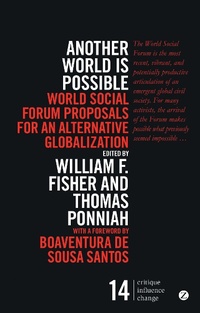
Another World Is Possible
World Social Forum Proposals for an Alternative Globalization
2nd Edition
Published on 14. May 2015
400 pages
978-1-78360-520-0 (ISBN)
Description

In 2001 the first World Social Forum was held in Porto Alegre, Brazil. The meeting was viewed by many at the time as a new manifestation of the global Left, a people's opposition to the World Economic Forum that stood as the first real front to global capitalism since the collapse of the Soviet Union. While many activists and intellectuals on the left have since become deeply critical of the Forum, newer movements, such as Occupy, the Arab Spring and the indignados, have built upon its successes and innovations.
Another World is Possible is the original collection of essays and demands from the heart of the 'movement of movements'. Based on the work of the first two annual meetings of the WSF, this classic collection not only set out the initial aims of the movements that came together, it also paved the way for the theoretical study of new social movements, their multiple and participatory character. Today, as many crises affect all our lives, it is time to revisit the original demands of a global solidarity movement, united in its determination to fight against the concentration of wealth, the proliferation of poverty and inequalities, and the destruction of our earth, and to reconstitute a global left.
Another World is Possible is the original collection of essays and demands from the heart of the 'movement of movements'. Based on the work of the first two annual meetings of the WSF, this classic collection not only set out the initial aims of the movements that came together, it also paved the way for the theoretical study of new social movements, their multiple and participatory character. Today, as many crises affect all our lives, it is time to revisit the original demands of a global solidarity movement, united in its determination to fight against the concentration of wealth, the proliferation of poverty and inequalities, and the destruction of our earth, and to reconstitute a global left.
Reviews / Votes
A brilliant series of collective thoughts by those who built the WSF on all the major topics of an emancipatory project for the twenty-first century. Indispensable reading for a new generation of activists. * Geoffrey Pleyers, author of Alter-Globalization * This new edition reminds us of not only how original and timely the World Social Forum was and what a global impact it had, but also of how changing times are challenging the WSF a decade and more later. Strongly recommended. * Peter Waterman, co-editor of World Social Forum: Challenging Empires * The best guidebook that I know for re-imagining a progressive politics responsive to the challenges of the twenty-first century. It brings together the ideas, language, and imaginings of the most articulate voices on the global stage. * Richard Falk, Princeton University * A fascinating and valuable reflection of political reality. * Roger S. Gottlieb, Tikkun * The Second World Social Forum was a carnival of ideas and solidarities. Another World is Possible captures superbly their many alternatives to neoliberalism and provides one big "Ya Basta" to the status quo. * Thomas Mertes, co-author of A Movement of Movements *More details
Series
Edition
2nd edition
Language
English
Place of publication
United Kingdom
Publishing group
Bloomsbury Publishing PLC
Target group
College/higher education
Professional and scholarly
ISBN-13
978-1-78360-520-0 (9781783605200)
Copyright in bibliographic data and cover images is held by Nielsen Book Services Limited or by the publishers or by their respective licensors: all rights reserved.
Schweitzer Classification
Other editions
Additional editions
William Fisher | Thomas Ponniah
Another World Is Possible
World Social Forum Proposals for an Alternative Globalization
Book
05/2015
2nd Edition
Zed Books Ltd
€39.80
Shipment within 3-4 weeks
Persons
William F. Fisher is professor of international development and social change in the International Development, Community, and Environment Department at Clark University, USA.
Thomas Ponniah is a professor of philosophy and politics in the School of Liberal Arts and Sciences at George Brown College in Toronto, an affiliate of the David Rockefeller Center for Latin American Studies, and a summer lecturer at Harvard University.
Thomas Ponniah is a professor of philosophy and politics in the School of Liberal Arts and Sciences at George Brown College in Toronto, an affiliate of the David Rockefeller Center for Latin American Studies, and a summer lecturer at Harvard University.
Content
Foreword to the critique influence change edition - Boaventura de Sousa Santos
Preface to the critique influence change edition - Thomas Ponniah and William F. Fisher
Foreword to the first edition - Michael Hardt and Antonio Negri
Preface to the first edition - William F. Fisher and Thomas Ponniah
Introduction: The World Social Forum and the Reinvention of Democracy - Thomas Ponniah and William F. Fisher
Part I: The Production of Wealth and Social Reproduction
Overview: Key Questions, Critical Issues - William F. Fisher and Thomas Ponniah
1. External Debt: Abolish the Debt in Order to Free Development - Eric Toussaint and Arnaud Zacharie
2. Africa/Brazil - Jacques d'Adesky
3. Financial Capital - ATTAC-France
4. International Trade - Bernard Cassen, ATTAC
5. Transnational Corporations - Joshua Karliner, CorpWatch and Karolo Aparicio, Global Exchange
6. Labour - Congress of South African Trade Unions; Jeff Faux
7. A Solidarity Economy - Economic Solidarity Group of Quebec; Sandra Quintela
Part II: Access to Wealth and Sustainability
Overview: Key Questions, Critical Issues - William F. Fisher and Thomas Ponniah
8. Environment and Sustainabity- Vandana Shiva; Sara Larrain
9. Water - A Common Good - Glenn Switkes and Elias Diaz Pena
10. Knowledge, Copyright and Patents - OXFAM, UK; Francois Houtart
11. Medicine, Health, AIDS - Sonia Correa
12. Food - APM World Network
13. Cities, Urban Populations - Erminia Maricato
14. Indigenous Peoples - Dionito Makuxi, Pina Tembe, Simiao Wapixana, Joel Pataxo, Lurdes Tapajos, Luiz Titia Pataxo Ha-Ha-Hae; Paulo Maldos
Part III: The Affirmation of Civil Society and Public Space
Overview: Key Questions, Critical Issues - William F. Fisher and Thomas Ponniah
15. The Media - Osvaldo Leon
16. Education - Bernard Charlot
17. Culture - Fatma Alloo, Luiza Monteiro, Aureli Argemi, Imruh Bakari, Xavi Perez
18. Violence - World March of Women; Fatima Mello
19. Discrimination and Intolerance - National Campaign on Dalit Human Rights; Lilian Celiberti
20. Migration and the Traffic in People - Lorenzo Prencipe
21. The Global Civil Society Movement - Latin American Social Observatory and Latin American Social Science Council; Vittorio Agnoletto
Part IV: Political Power and Ethics in the New Society
Overview: Key Questions, Critical Issues - William F. Fisher and Thomas Ponniah
22. The International Architecture of Power - Walden Bello; Teivo Teivainen
23. Militarism and Globalization - Marcela Escribano
24. Human Rights - Maria Luisa Mendonca
25. Sovereignty - Daniel Bensaid
26. Democracy - M. P. Parameswaran
27. Values - Michal Lowy; Celia Amoros
Epilogue: Social Movements' Manifesto
Appendices
Preface to the critique influence change edition - Thomas Ponniah and William F. Fisher
Foreword to the first edition - Michael Hardt and Antonio Negri
Preface to the first edition - William F. Fisher and Thomas Ponniah
Introduction: The World Social Forum and the Reinvention of Democracy - Thomas Ponniah and William F. Fisher
Part I: The Production of Wealth and Social Reproduction
Overview: Key Questions, Critical Issues - William F. Fisher and Thomas Ponniah
1. External Debt: Abolish the Debt in Order to Free Development - Eric Toussaint and Arnaud Zacharie
2. Africa/Brazil - Jacques d'Adesky
3. Financial Capital - ATTAC-France
4. International Trade - Bernard Cassen, ATTAC
5. Transnational Corporations - Joshua Karliner, CorpWatch and Karolo Aparicio, Global Exchange
6. Labour - Congress of South African Trade Unions; Jeff Faux
7. A Solidarity Economy - Economic Solidarity Group of Quebec; Sandra Quintela
Part II: Access to Wealth and Sustainability
Overview: Key Questions, Critical Issues - William F. Fisher and Thomas Ponniah
8. Environment and Sustainabity- Vandana Shiva; Sara Larrain
9. Water - A Common Good - Glenn Switkes and Elias Diaz Pena
10. Knowledge, Copyright and Patents - OXFAM, UK; Francois Houtart
11. Medicine, Health, AIDS - Sonia Correa
12. Food - APM World Network
13. Cities, Urban Populations - Erminia Maricato
14. Indigenous Peoples - Dionito Makuxi, Pina Tembe, Simiao Wapixana, Joel Pataxo, Lurdes Tapajos, Luiz Titia Pataxo Ha-Ha-Hae; Paulo Maldos
Part III: The Affirmation of Civil Society and Public Space
Overview: Key Questions, Critical Issues - William F. Fisher and Thomas Ponniah
15. The Media - Osvaldo Leon
16. Education - Bernard Charlot
17. Culture - Fatma Alloo, Luiza Monteiro, Aureli Argemi, Imruh Bakari, Xavi Perez
18. Violence - World March of Women; Fatima Mello
19. Discrimination and Intolerance - National Campaign on Dalit Human Rights; Lilian Celiberti
20. Migration and the Traffic in People - Lorenzo Prencipe
21. The Global Civil Society Movement - Latin American Social Observatory and Latin American Social Science Council; Vittorio Agnoletto
Part IV: Political Power and Ethics in the New Society
Overview: Key Questions, Critical Issues - William F. Fisher and Thomas Ponniah
22. The International Architecture of Power - Walden Bello; Teivo Teivainen
23. Militarism and Globalization - Marcela Escribano
24. Human Rights - Maria Luisa Mendonca
25. Sovereignty - Daniel Bensaid
26. Democracy - M. P. Parameswaran
27. Values - Michal Lowy; Celia Amoros
Epilogue: Social Movements' Manifesto
Appendices
