

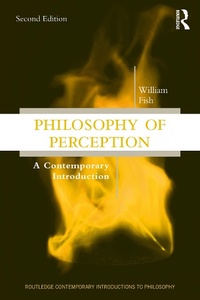
Philosophy of Perception
A Contemporary Introduction
2nd Edition
Published on 29. June 2021
290 pages
978-1-351-04949-8 (ISBN)
Description

The philosophy of perception investigates the nature of our sensory experiences and their relation to reality. In the second edition of this popular book, William Fish introduces the subject thematically, setting out the major theories of perception together with their motivations and attendant problems. While providing historical background to debates in the field, this comprehensive overview focuses on recent presentations and defenses of the different theories, and looks beyond visual perception to take into account the role of other senses.
The second edition organizes the contents into two main parts: the first deals with philosophical theories of perception, and the second covers key topics and issues in perception as they are discussed in philosophy, cognitive science, and psychology. Two completely new chapters have been added - one on color and color vision; and a second on the interaction between sense modalities - and other chapters have been significantly updated to include discussion of topics such as pre-twentieth-century philosophy of perception, phenomenal intentionality, color adverbialism, predictive processing approaches to perception, ecological approaches to perception, and in-depth discussions of the non-visual senses. Additional updates include fuller and easier-to-understand explanations of some important views that were glossed over in the first edition and greater coverage of research from the last 25 years. All chapter summaries, references, and Suggested Reading lists at the end of each chapter have been brought up to date and the volume now includes a more extensive index at the back of the book.
Key Features and Benefits:
The only single-authored textbook on philosophy of perception currently available
Devoted to contemporary theories and topics, but with appropriate historical coverage for fuller understanding of contemporary work
Each chapter includes a chapter overview, questions for further consideration, and an annotated list of Suggested Reading
Includes coverage of topics like:
the phenomenal principle
perception and hallucination
perception and content
naive realism and disjunctivism
intentionalism and representationalism
the nature of content
qualia theories and phenomenal intentionality
perception and empirical science
color and color science
theories of non-visual perception
Molyneux's problem
cross-modal illusions
multimodality
Key Changes to the Second Edition
The division of the book into two major parts: Part I on philosophical theories of perception, Part II on key interdisciplinary topics in perception
The addition of two new chapters on color and color vision, and interaction between different sense modalities
More topics from the last 25 years of philosophy of perception
Combined chapters on belief acquisition theories and intentional theories into one larger chapter
More material on the growing intersection of the philosophy and psychology of perception
Includes coverage of Molyneux's problem and of cross-modal illusions
Updated chapter summaries, references, and Suggested Reading lists at the end of each chapter
A summary table and a more extensive index
The second edition organizes the contents into two main parts: the first deals with philosophical theories of perception, and the second covers key topics and issues in perception as they are discussed in philosophy, cognitive science, and psychology. Two completely new chapters have been added - one on color and color vision; and a second on the interaction between sense modalities - and other chapters have been significantly updated to include discussion of topics such as pre-twentieth-century philosophy of perception, phenomenal intentionality, color adverbialism, predictive processing approaches to perception, ecological approaches to perception, and in-depth discussions of the non-visual senses. Additional updates include fuller and easier-to-understand explanations of some important views that were glossed over in the first edition and greater coverage of research from the last 25 years. All chapter summaries, references, and Suggested Reading lists at the end of each chapter have been brought up to date and the volume now includes a more extensive index at the back of the book.
Key Features and Benefits:
The only single-authored textbook on philosophy of perception currently available
Devoted to contemporary theories and topics, but with appropriate historical coverage for fuller understanding of contemporary work
Each chapter includes a chapter overview, questions for further consideration, and an annotated list of Suggested Reading
Includes coverage of topics like:
the phenomenal principle
perception and hallucination
perception and content
naive realism and disjunctivism
intentionalism and representationalism
the nature of content
qualia theories and phenomenal intentionality
perception and empirical science
color and color science
theories of non-visual perception
Molyneux's problem
cross-modal illusions
multimodality
Key Changes to the Second Edition
The division of the book into two major parts: Part I on philosophical theories of perception, Part II on key interdisciplinary topics in perception
The addition of two new chapters on color and color vision, and interaction between different sense modalities
More topics from the last 25 years of philosophy of perception
Combined chapters on belief acquisition theories and intentional theories into one larger chapter
More material on the growing intersection of the philosophy and psychology of perception
Includes coverage of Molyneux's problem and of cross-modal illusions
Updated chapter summaries, references, and Suggested Reading lists at the end of each chapter
A summary table and a more extensive index
Reviews / Votes
"I have been using the first edition of William Fish's Philosophy of Perception very successfully in my philosophy of perception courses. The second edition has all the virtues of the first: presenting a balanced account of the principal theories in the field, uncovering potentially problematic assumptions, and raising issues for further discussion - all written in an admirably clear and engaging style. The new edition contains discussions of recent work at the intersection of the philosophy and the science of perception, including chapters on color and color vision, interaction between sense modalities, and cross-modal illusions. Highly recommended."Frances Egan, Rutgers University
More details
Series
Edition
2nd edition
Language
English
Place of publication
London
United Kingdom
Publishing group
Taylor & Francis Ltd
Target group
College/higher education
Illustrations
1 Tables, black and white; 10 Line drawings, black and white; 10 Illustrations, black and white
ISBN-13
978-1-351-04949-8 (9781351049498)
Copyright in bibliographic data and cover images is held by Nielsen Book Services Limited or by the publishers or by their respective licensors: all rights reserved.
Schweitzer Classification
Other editions
Additional editions
Book
06/2021
2nd Edition
Routledge
€206.70
Shipment within 10-20 days
Book
06/2021
2nd Edition
Routledge
€67.70
Shipment within 10-20 days
Person
William Fish is Professor of Philosophy at Massey University, New Zealand. He is the author of Perception, Hallucination, and Illusion (2009) and the editor of Perception: Critical Concepts in Philosophy (Routledge, 2016).
Content
1. Introduction Part I: Philosophical Theories of Visual Perception 2. Sense Datum Theories 3. The Representational Principle and Intentional Theories 4. Adverbialism and Qualia Theories 5. Naive Realism Part II: The Philosophy of Perception and the Sciences of the Mind 6. The Philosophy of Perception and Vision Science 7. Color, Color Vision, and Color Science 8. Perception and the Nonvisual Sense Modalities 9. Multimodality
