

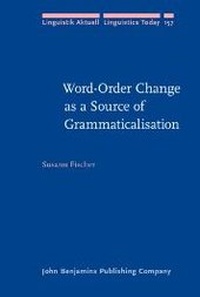
Word-Order Change as a Source of Grammaticalisation
1st Edition
Published on 30. June 2010
IX, 200 pages
978-90-272-8818-9 (ISBN)
Description

This book presents a new perspective on the interaction between word-order and grammaticalisation by investigating the changes that stylistic fronting and oblique subjects have undergone in Romance (Catalan, French, Spanish) as compared to Germanic (English, Icelandic). It discusses a great deal of historical comparative data showing that stylistic fronting and oblique subjects have (had) a semantic effect in the Germanic and in the Romance languages, and that they both appear in the same functional category. The loss of stylistic fronting and oblique subjects is seen as an effect of grammaticalisation, where grammaticalisation is taken to be a regular case of parameter change. In contrast to previous and recent approaches to grammaticalisation, however, the author shows that it is not the loss of morphology that triggers grammaticalisation with subsequent word-order changes, but that the word-order change sets off grammaticalisation in the functional categories, which is then followed by the loss of morphology.
More details
Other editions
Additional editions
Susann Fischer
Word-Order Change as a Source of Grammaticalisation
Book
06/2010
John Benjamins Publishing Co
€100.70
Shipment within 10-15 days
Person
Content
- Word-Order Change as a Source of Grammaticalisation
- Editorial page
- Title page
- LCC data
- Table of contents
- Acknowledgements
- 1. Introduction
- 1. Preface
- 2. Hypotheses and aims of the book
- 3. Diachronic data and electronic corpora
- 3.1 The electronic corpora used
- 3.2 Differences between the two phenomena investigated
- 2. Different views on grammaticalisation and its relation to word-order
- 1. Introduction
- 2. Historical views on grammaticalisation
- 2.1 The 18th and 19th centuries
- 2.2 The 20th century
- 3. Current views on grammaticalisation
- 3.1 Language change and the mechanisms of grammaticalisation
- 3.2 A case study: Explaining the change in the English modal system
- 4. Word-order and grammaticalisation
- 3. Historical overview of oblique subjects in Germanic and Romance
- 1. Introduction
- 2. A brief typological overview of the languages under investigation
- 2.1 The Old Germanic languages: Icelandic and English
- 2.2 The Old Romance languages: Catalan, French, and Spanish
- 2.3 Typological synopsis
- 3. Subjecthood
- 3.1 Testing subjecthood
- 3.2 Previous explanations and the problems they face
- 4. A diachronic perspective on oblique subjects
- 4.1 The Old Germanic languages
- 4.2 The Old Romance languages
- 5. Summary
- 4. Historical overview of stylistic fronting in Germanic and Romance
- 1. Introduction
- 2. The properties of stylistic fronting
- 2.1 Clause-boundedness
- 2.2 Focus
- 2.3 Relativized minimality
- 2.4 Head movement
- 2.5 The subject gap
- 3. Previous explanations and the problems they face
- 3.1 Obligatory movement vs. optional movement
- 3.2 XP vs. X° movement
- 3.3 Rethinking the trigger of stylistic fronting
- 4. The diachronic perspective on stylistic fronting
- 4.1 The Old Germanic languages
- 4.2 The Old Romance languages
- 5. Summary
- 5. Accounting for the differences and similarities between the languages under investigation
- 1. Introduction
- 2. Word-order, V movement and EPP checking
- 2.1 ... in the modern languages
- 2.2 ... in the old languages
- 2.3 Summary
- 3. Arguments in favour of an additional functional category
- 3.1 Verb-third orders in matrix clauses
- 3.2 Postverbal clitics in embedded sentences
- 3.3 Stylistic fronting without the subject gap
- 3.4 Stylistic fronting and oblique subjects
- 4. Narrow syntax and semantic effects
- 4.1 Semantic effects
- 4.2 Feature-driven movement
- 5. A conclusion
- 6. Explaining the changes
- 1. Introduction
- 2. Diachronic instability and the generative tradition
- 3. Grammaticalisation, minimalism, and the change in word-order
- 3.1 Explaining the loss of stylistic fronting and oblique subjects
- 3.2 Morphological changes follow syntactic changes
- 4. Conclusion
- References
- Name index
- Subject index
- The series Linguistik Aktuell/Linguistics Today
