

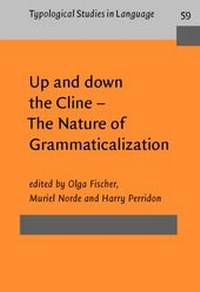
Up and down the Cline - The Nature of Grammaticalization
The Nature of Grammeticalization
1st Edition
Published on 28. May 2004
VIII, 406 pages
978-90-272-9547-7 (ISBN)
Description

The basic idea behind this volume is to probe the nature of grammaticalization. Its contributions focus on the following questions: (i) In how far can grammaticalization be considered a universal diachronic process or mechanism of change and in how far is it conditioned by synchronic factors? (ii) What is the role of the speaker in grammaticalization? (iii) Does grammaticalization itself provide a cause for change or is it an epiphenomenon, i.e. a conglomeration of causal factors/mechanisms which elsewhere occur independently? (iv) If it is epiphenominal, how do we explain that similar pathways so often occur in known cases of grammaticalization? (v) Is grammaticalization unidirectional? (vi) What is the nature of the parameters guiding grammaticalization? The overall aim of the book is to enrich our understanding of what grammaticalization does or does not entail via detailed case studies in combination with theoretical and methodological discussions.
More details
Other editions
Additional editions
Olga Fischer | Muriel Norde | Harry Perridon
Up and down the Cline - The Nature of Grammaticalization
Book
05/2004
John Benjamins Publishing Co
€132.50
Shipment within 10-15 days
Persons
Content
- Up and down the Cline - The Nature of Grammaticalization
- Editorial page
- Title page
- LCC page
- Table of contents
- Preface
- Introduction
- 1. Introduction
- 2. The principle of unidirectionality
- 3. Semantic change
- 4. Standardization
- 5. Reanalysis, polysemy and homonymy
- 6. Form
- 7. Outlook
- Notes
- References
- On directionality in language change with particular reference to grammaticalization*
- 1. Introduction
- 2. Universals of change and directionality constraints
- 3. Unidirectionality of grammaticalization
- 3.1. How important is unidirectionality?
- 3.2. Partially valid criticism
- 3.3. Invalid criticism
- 4. Antigrammaticalization and ``degrammaticalization''
- 4.1. Antigrammaticalization: The reversal of grammaticalization
- 4.2. Delocutive word-formation from function words and affixes
- 4.3. Back-formation of bound compound members
- 4.4. Adverb-to-verb/noun conversion
- 4.5. Phonogenesis
- 4.6. Loss of an inflectional category with traces
- 4.7. Retraction
- 5. Conclusion
- 5.1. Broader agendas
- 5.2. Terminology
- 5.3. Broad agreement
- Notes
- References
- Rescuing traditional (historical) linguistics from grammaticalization theory*
- 1. Introduction
- 2. Grammaticalization as anti-neogrammarian (or: a-historical linguistics as well as a-historical)
- 3. Grammaticalization as ahistorical
- 4. Unidirectionality and traditional historical linguistics
- 5. Grammaticalization as asynchronic
- 6. Conclusion - being fair to grammaticalization but at the same time (and overridingly) being fair to language history
- Notes
- References
- The English s-genitive
- 1. Introduction
- 2. The English s-genitive as a case of degrammaticalization
- 2.1. The grammatical status of possessive 's (POSS 's)
- 2.2. Why a case of degrammaticalization (if at all)? - Or: `Anything goes'
- 3. The development of POSS 's - a historical scenario
- 3.1. Stages towards POSS 's as a phrase marker
- 3.2. Phrasal lexicalization and (phrasal) N+N constructions
- 3.3. The new function of the s-genitive as a (definite) determiner
- 4. A case of degrammaticalization?
- Notes
- References
- An investigation into the marginal modals dare and need in British present-day English
- 1. Introduction
- 2. Aim
- 3. The classification of dare and need: Formal features
- 4. Material
- 5. The status of need and dare in British PDE
- 5.1. The status of need in the BNC
- 5.2. The status of dare in the BNC
- 6. Conclusion
- Abbreviations
- Notes
- Text sources
- References
- Redefining unidirectionality
- 1. Introduction
- 2. Defining unidirectionality
- 2.1. The semantic underpinning of unidirectionality
- 2.2. Examples of degrammaticalisation
- 2.3. Further discussions
- 3. Demodalisation as degrammaticalisation
- 4. Discussion
- 5. Conclusion
- Notes
- References
- From pronominalizer to pragmatic marker
- 1. Introduction
- 2. Defining grammaticalization and (uni)directionality
- 2.1. On the mechanisms of grammaticalization
- 2.2. (Uni)directionality in grammaticalization
- 3. The grammaticalization of pronominalizers into pragmatic markers
- 3.1. Japanese no
- 3.2. Mandarin de and other dialectal equivalents
- 3.3. Malay (em)punya
- 4. Implications for unidirectionality
- 4.1. Ontological levels
- 4.2. Conceptual networks/implicational maps
- 5. Conclusion
- Abbreviations
- Notes
- References
- Conditionals and subjectification
- 1. Introduction
- 2. From Middle to Early Modern English: The data
- 2.1. Semantic and structural trends
- 2.2. Preliminary hypothesis
- 3. From verb to conjunction
- 3.1. Categorial reanalysis
- 3.2. Subjectification
- 4. A deontic polysemy?
- 5. Implications of the results for a theory of semantic change
- Notes
- References
- Corpora
- Unidirectionality in the grammaticalization of modality in Greek
- 1. Introduction: Mood and modality
- 2. Mood and modality in Greek
- 2.1. A morphological imperative
- 2.2. Indicative and subjunctive
- 2.3. Modal auxiliaries
- 3. Conclusions and implications for the general theory
- Notes
- References
- How cognitive is grammaticalization?
- 1. The `auxiliation constraint'
- 2. The perfet perifràstic of Catalan
- 3. Step 1: From movement in space to inchoative aspect
- 4. Step 2: Inchoative constructions as discourse-structuring devices
- 5. Digression: Grammaticalization and areal convergence
- 6. Step 3: From `extra-heavy' foregrounding to aoristic tense
- 7. Digression: The `hot-news' perfect in contemporary Peninsular Spanish
- Notes
- References
- Perfect and resultative constructions in spoken and non-standard English
- 1. Introduction
- 2. The data
- 3. The Perfect and definite past time adverbs
- 4. Perfect and Simple Past
- 4.1. Recent Past
- 4.2. Experiential
- 4.3. Result
- 5. Is the Perfect changing?
- 6. Resultative constructions in Scottish English/Scots
- 7. Conclusions
- Notes
- References
- Grammaticalization and standardization
- 1. Introduction
- 2. Questions about the analysis of standardized languages
- 3. Unexplicated changes and explicated norms
- 3.1. The standardization of the constructions of necessity
- 3.2. From logophoric pronouns to discourse particles
- 4. From verb to particle - an interrupted change
- 4.1. Answers to questions
- 4.2. Compound co-ordinating conjunction
- 4.3. The ideology of agreement
- 5. Summary
- Abbreviations
- Notes
- References
- External factors behind cross-linguistic similarities
- 1. Introduction
- 2. The conjunction kun
- 2.1. Kun in the spoken variety of Finnish
- 2.2. Kun in the written variety of Finnish
- 3. The converb essa
- 3.1. Changes in the use of essa in literary Finnish
- 3.2. Translation contacts
- 3.3. The influence of Swedish
- 4. Summary and theoretical implications
- Abbreviations
- Notes
- References
- What constitutes a case of grammaticalization?
- 1. Introduction
- 2. An introduction to demonstrative-forms in Passamaquoddy
- 3. Demonstrative-forms in a verbless construction with two lexical NP terms
- 4. Demonstrative-forms in other verbless clauses
- 4.1. Clauses where the demonstrative-form agrees in the plural but not in the singular
- 4.2. Clauses where the demonstrative-form does not agree with the terms
- 4.3. The relevance of information structure
- 4.4. Grammatical status of the demonstrative-forms in Section 4
- 5. Discussion
- 6. Summary
- List of abbreviations
- Notes
- References
- Multi-categorial items as underspecified lexical entries
- 1. Introduction
- 2. Preliminaries: Kambera argument marking
- 3. The distinct functions of wàngu
- 3.1. Wàngu as an independent instrumental verb
- 3.2. Wàngu as the second verb in a verbal compound
- 3.3. Wàngu as either a verb or a preposition
- 3.4. Wàngu as the head of a prepositional phrase
- 3.5. Wàngu as ambiguous item with a clausal complement
- 3.6. Wàngu as a matrix verb
- 4. The wàngu ``grammaticalization chain'' is in fact only one lexical item
- 5. Conclusions
- Notes
- References
- The acquisition of polysemous forms
- 1. Introduction
- 2. bei2: Range of functions
- 3. Links between the functions
- 3.1. Shared semantics: Transfer, dative and permissive
- 3.2. The linkage of the passive construction to the `core'
- 3.3. Syntactic retention
- 4. Predictions on developmental sequence
- 5. Corpus and utterance extraction
- 6. Results and discussion
- 6.1. Frequency
- 6.2. Age of emergence
- 6.3. Collocation patterns
- 7. Conclusion
- Key
- Notes
- Corpus
- References
- Phonetic absence as syntactic prominence
- 1. Grammaticalization in isolating tonal languages
- 2. Phonetic erosion in Sinitic
- 2.1. Tonal registers in Sinitic
- 2.2. The neutral tone option and tone sandhi
- 3. The grammaticalized constructions examined
- 3.1. Cantonese
- 3.2. Hokkien
- 4. Materials and data collection and analysis
- 4.1. Controlling the data
- 4.2. The subjects
- 5. Discussion
- 5.1. Vowel quality
- 5.2. Duration
- 5.3. Fundamental frequency (F0)
- 5.4. Intensity
- 5.5. Summary
- 6. Significance
- 7. Conclusions
- List of abbreviations
- Notes
- References
- Grammaticalization of word order
- 1. Introductory remarks
- 2. Genitive construction in Old Lithuanian
- 2.1. General facts and previous research
- 2.2. Anchoring vs. non-anchoring relations in the genitive construction
- 2.3. Referentiality and word order in the Old Lithuanian genitive construction
- 2.4. The problem of foreign influence
- 3. The Lithuanian genitive construction from a diachronic point of view
- 3.1. Emergence of rigid word order as a process of grammaticalisation
- 3.2. Direction of extension of ordering patterns
- 4. On functional convergence between genitives and adjectives
- 5. The Lithuanian NP as a counterexample to typological word order tendencies
- 6. Concluding remarks
- Notes
- References
- Language index
- Name index
- Subject index
- The series Typological Studies in Language
