

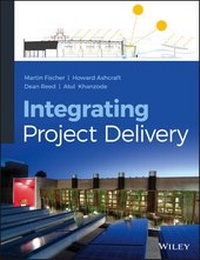
Integrating Project Delivery
Description

More details
Other editions
Additional editions
Persons
Content
Foreword xi
By William McDonough, FAIA, Int. FRIBA
Foreword xv
By Phillip G. Bernstein, FAIA, RIBA, LEED® AP, VP Strategic Industry Relations, Autodesk, Inc.
Preface xix
Acknowledgments xxvii
CHAPTER 1 What Would Make Us Proud? 1
1.1 Current State of Facility Performance 1
1.2 What If? 3
1.3 A Way Forward 5
Notes 9
References 9
CHAPTER 2 Transitioning to Integrated Project Delivery: The Owner's Experience 11
2.1 The Road to IPD 13
2.2 The Owner's Role 14
2.3 Organizing the Owner 18
2.4 Resistance from Within 19
2.5 Resistance from the AEC Community 20
2.6 Education and Training 21
2.7 The IPD Contract 22
2.8 The Right Level of Challenge 23
2.9 Frustrations 24
2.10 Target Value Design 25
2.11 Reliability 26
2.12 Value 26
2.13 Would You Do It Again? 28
2.14 Advice to Other Owners 28
2.15 Humanity and Morale 29
2.16 Summary 30
Note 30
References 30
CHAPTER 3 A Simple Framework 31
3.1 A Roadmap for Integrating Project Delivery 31
3.2 High-Performance Buildings 33
3.3 Integrated Systems 38
3.4 Process Integration 40
3.5 Integrated Organization 41
3.6 Integrated Information 42
3.7 Connecting the Dots 42
3.8 Applying the Simple Framework 48
3.9 Reflections 51
3.10 Summary 51
Notes 52
References 53
CHAPTER 4 Defining High-Performing Buildings 55
4.1 What Is a High-Performing Building? 55
4.2 What Does Success Look Like? 57
4.3 How Can This Be Done? 59
4.4 Interconnections 67
4.5 Reflections 67
4.6 Summary 69
Reference 69
CHAPTER 5 Achieving Highly Valuable Buildings 71
5.1 What Is a Highly Valuable Building? 71
5.2 What Does Success Look Like? 71
5.3 How Can This Be Done? 72
5.4 Real-Life Examples 89
5.5 Interconnections 92
5.6 Reflections 93
5.7 Summary 94
Note 95
References 95
CHAPTER 6 Integrating the Building's Systems 97
6.1 What Are Integrated Systems? 97
6.2 What Does Success Look Like? 98
6.3 How Can This Be Done? 99
6.4 Real-Life Examples 106
6.5 Interconnections 111
6.6 Reflections 112
6.7 Summary 112
Notes 113
Reference 113
CHAPTER 7 Integrating Process Knowledge 115
7.1 What Is Integrating Process Knowledge? 115
7.2 What Does Success Look Like? 115
7.3 How Can This Be Done? 116
7.4 Real-Life Examples 120
7.5 Interconnections 141
7.6 Reflections 142
7.7 Summary 143
Note 143
References 144
CHAPTER 8 Integrating the Project Organization 145
8.1 Introduction 145
8.2 What Is Integrated Organization? 147
8.3 What Does Success Look Like? 148
8.4 How Can This Be Done? 149
8.5 Real-Life Examples 167
8.6 A Case Study: Integrating the UCSF Medical Center Mission Bay Hospitals Project 176
8.7 Interconnections 185
8.8 Reflections 186
8.9 Summary 187
Notes 188
References 189
CHAPTER 9 Leading Integrated Project Teams 191
9.1 Introduction 191
9.2 What Are IPD Teams? 192
9.3 What Does Success Look Like? 192
9.4 How Can This Be Done? 193
9.5 Interconnections 206
9.6 Reflections 206
9.7 Summary 206
Notes 206
References 207
CHAPTER 10 Integrating Project Information 209
10.1 Why Bother? 209
10.2 What Is Integrated Information? 210
10.3 What Does Success Look Like? 212
10.4 How Can This Be Done? 215
10.5 Examples and Benefits of Integrated Information Systems 219
10.6 Interconnections 231
10.7 Reflections 232
10.8 Summary 232
Notes 233
References 233
CHAPTER 11 Managing with Metrics 235
11.1 What Are Measurable Value and Control? How Do They Relate? 235
11.2 What Does Success Look Like? 236
11.3 How Does a Project Team Measure and Control the Delivery of Value? 237
11.4 Interconnections 261
11.5 Reflections 262
11.6 Summary 262
Note 262
References 263
CHAPTER 12 Visualizing and Simulating Building Performance 265
12.1 What Are Simulation and Visualization? 265
12.2 What Does Success Look Like? 267
12.3 How Can This Be Done? 269
12.4 Real-Life Examples 285
12.5 Interconnections 290
12.6 Reflections 290
12.7 Summary 291
Notes 292
References 293
CHAPTER 13 Collaborating in an Integrated Project 295
13.1 So What's the Problem? 295
13.2 What Is Collaboration, Really? 296
13.3 What Does Success Look Like? 296
13.4 How Can This Be Done? 297
13.5 Real-Life Examples 309
13.6 Interconnections 313
13.7 Reflections 313
13.8 Summary 314
Notes 314
References 314
CHAPTER 14 Co-locating to Improve Performance 317
14.1 Aspirin for Integration 317
14.2 What Is Co-location, Exactly? 318
14.3 What Does Success Look Like? 318
14.4 How Can This Be Done? 319
14.5 Real-Life Example 329
14.6 Interconnections 333
14.7 Reflections 333
14.8 Summary 333
References 334
CHAPTER 15 Managing Production as an Integrated Team 335
15.1 What Is Integrated Production Management? 335
15.2 What Does Success Look Like? 335
15.3 How Can This Be Done? 336
15.4 Real-Life Example 339
15.5 Interconnections 352
15.6 Reflection 354
15.7 Summary 354
References 355
CHAPTER 16 Avoiding the Pitfalls of Traditional Contracts 357
16.1 Traditional Contracts Create an Inherently Antagonistic Environment 358
16.2 Traditional Contracts Are Based on a Piecework Business Model 358
16.3 Traditional Contracts Rigidly Divide Work Based on Traditional Roles 359
16.4 Traditional Contracts Constrain Communication to Specific and Inefficient Paths 360
16.5 Traditional Contracts Reward Individual, Not Group, Performance 361
16.6 Collaboration without an IPD Agreement Can Increase Risk 361
16.7 And if Traditional Contracting Is So Successful, How Do We Explain the Outcomes? 362
16.8 Summary 363
Notes 363
References 364
CHAPTER 17 Contracting for Project Integration 365
17.1 Introduction 365
17.2 Is the IPD Contract Really Necessary? 366
17.3 Deal First, Contract Second 367
17.4 The IPD Contracting Mindset 367
17.5 A New Business Model 369
17.6 A New Contract Structure 371
17.7 Negotiating the IPD Contract 381
17.8 IPD Contract Forms 383
17.9 A Parallel Path: The U.K. Experience 385
17.10 Interconnections 387
17.11 Reflections 388
17.12 Summary 388
Notes 388
References 390
CHAPTER 18 Delivering the High-Performing Building as a Product 391
18.1 What Is the High-Performing Building as a Product? 391
18.2 What Does Success Look Like? 392
18.3 How Can This Be Done? 395
18.4 Real-Life Examples 400
18.5 Summary 432
Notes 433
References 433
Afterword 435
By J. Stuart Eckblad, FAIA, VP Major Construction, UCSF Medical Center Creating a "Best for Project" Culture 435
Afterword 437
By Eric R. Lamb, Management Committee, DPR Construction Where to Next? 438
Index 439
Preface
"It is extension of application that discloses inadequacy of a theory, and need for revision, or even new theory. Again, without theory, there is nothing to revise. Without theory, experience has no meaning. Without theory, one has no questions to ask. Hence without theory, there is no learning."
-W. Edwards Deming
WHAT THIS BOOK IS ABOUT
The ideas and practices presented in this book are different than what most people think and do to design and build projects today. These different practices are needed because project teams need a strategy and a set of actions that allow them to overcome the challenges of the current "divide and conquer" approach to designing and building projects. Buildings have become more technically complex, the regulations that need to be considered more multifaceted, and the social and business expectations and pressures more intense. The increased technical complexity and the multifaceted regulatory constraints require the inclusion of experts that understand the specific technical systems to project teams. This increased specialization has led to fragmented project delivery, in part because the project management tools used on many projects are good at dividing the work up into chunks but less good at making sure that everyone's work fits together. The increased business and social pressures on building performance, however, demand a strategy to overcome this fragmentation, a strategy to integrate project teams and their work. That is why this book about integrating the delivery of building projects is needed now.
Because the practices for integrating project delivery are new, they can seem difficult. They certainly require different attitudes, skills, and behaviors. The new game is a plus-sum-not a zero-sum-game. The project team becomes a virtual enterprise. Companies become business partners rather than entities that cooperate when it serves their interests. People stop working in silos and exchange information frequently instead of periodically. This accelerates as experts learn that they can trust each other, which makes it possible for them to truly collaborate. Trust requires companies to operate open-book and people to admit mistakes, lack of confidence, and uncertainty. It also requires a culture that doesn't punish those who are honest. Project team members must work very hard to stay on the same page to be aligned in their work. Everyone on an integrated team commits to working in this new way, to give it their best. It's appropriate and necessary that this commitment extend to sharing risk of failure and rewards for great performance.
This is why we always recommend using a contract that supports integration. We believe that this new method of project delivery is better precisely because it requires agreement to business terms that do not allow project participants to "succeed" on their own. All partners, whether they are the owner, a designer, or a constructor, know that they can only succeed or fall short together. In this way, an integrated project delivery (IPD) agreement goes a long way to solving the "motivation" problem that plagues well-intentioned efforts to improve performance. Everyone on an integrated team, from the owner representatives to the workers who put the work in place, needs to know what it means to integrate their efforts.
This book explains a system we believe will enable people with different expertise and experience to consistently create valuable high-performance buildings. Our starting point is a recognition that the architectural and building systems and components of modern facilities are interdependent and must be integrated in design and construction to perform well. We explain theory and describe it in practice for each element of integration.
Our goal has been to write something of value for both experienced practitioners and students of the industry. It is our intention and hope to help readers understand four things:
- What the elements of integration are.
- How they interconnect.
- Why they are all necessary.
- How they have been and can be put into practice.
The book focuses mostly on design and construction. This is not to say that the use and operations phase of buildings is not as important. After all, buildings are designed and constructed to be used. However, without design and construction, there is no building to use and operate. We believe that the concepts we present are also useful to orchestrate the operations and repurposing phases of buildings, although the specifics and the examples would be different. While the examples throughout the book are from building projects, we believe that the concepts apply to other types of facilities, such as infrastructure and industrial projects.
HARDER WITHOUT A MAP
Everyone needs a map when venturing into unfamiliar territory. We wish we had had one when we started out. Now we do and offer that here, convinced that this will help advocates for integration, coaches, and leaders describe a complete system to project team members. Why do we think this? Because we've seen people on almost every project team struggle to understand why and how they can improve outcomes through integration. While most people we've met, especially the owner's team, are not satisfied with the way things are done now, they know what these are and how to do them. People with industry experience new to integrated delivery have only done things the old, fragmented way. Our sense is that most teams have tried to implement various techniques, methods, and software tools, especially building information modeling (BIM), without knowing how to plan, collaborate, and share their knowledge as partners. The industry culture of starting to work before looking at work processes, making do (Howell & Ballard, 1997; Koskela, 2004; Macomber & Howell, 2004), and attributing blame for failures undermines team learning and continuous improvement. Worst of all, the focus on reducing cost has short-circuited honest efforts to understand customer value well enough so it can be translated into tangible project objectives. It's no wonder the industry continually falls short in delivering what the customer really wanted.
Many, if not all, of the real-life examples in this book came about because a few people understood collaboration and were willing to show others. They encountered resistance and succeeded in overcoming it through education and persuasion. In many cases, the owner's project manager had to force the issue and make it clear that the only good option for doubters was to genuinely try to work differently or go to work on a conventional project.
We have chosen to describe what teams have done and achieved without describing the drama behind the scenes so that we could connect their experiences and accomplishments to the entire Simple Framework and its elements-the map we made-in just enough detail so that our map could be useful. Although we expect adoption of integrated practices to be challenging for some time, we are confident that the map the Simple Framework provides will make this easier and lead to much better outcomes.
HOW THIS BOOK IS ORGANIZED
We have tried to answer one or two big questions in each chapter, as shown in Table P.1.
Table P.1 Chapter Questions
Chapter Title Question 1 What Would Make Us Proud? What do we want to do and what can we do? 2 Transitioning to Integrated Project Delivery: The Owner's Experience What do owners who have used IPD think about what they can do to improve outcomes? 3 A Simple Framework What is the roadmap, the strategy to successfully produce a high-performance building? 4 Defining High-Performing Buildings What is a high-performing building? 5 Achieving Highly Valuable Buildings What makes a high-value building? 6 Integrating the Building's Systems How can systems be integrated to achieve a high-performing building? 7 Integrating Process Knowledge How can process knowledge be integrated? 8 Integrating the Project Organization What is an integrated project organization, and how is it created? 9 Leading Integrated Project Teams What is an integrated project delivery team, and how do you create, lead, and manage one? 10 Integrating Project Information What does it mean to integrate project information, why is this so important, and how can we do this? 11 Managing with Metrics How do we define and uphold the client's value goals for their unique high-performing building over the course of a project? 12 Visualizing and Simulating Building Performance How do we enable stakeholders to visualize and understand how their building will perform through every step of design, long before it is built? 13 Collaborating in an Integrated Project What does it mean to collaborate in an integrated...