

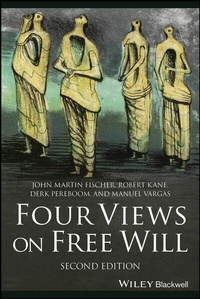
Four Views on Free Will
Description

A lively and engaging debate between four representative views on free will, completely revised and updated with new perspectives
Four Views on Free Will is a robust and careful debate about free will, how it interacts with determinism and indeterminism, and whether we have it or not. Providing the most up-to-date account of four major positions in the free will debate, the second edition of this classic text presents the opposing perspectives of renowned philosophers John Martin Fischer, Robert Kane, Derk Pereboom, and Manuel Vargas.
Substantially revised throughout, this new volume contains eight in-depth chapters, almost entirely rewritten for the new edition, in which the authors state their different positions on the debate, offer insights into how their views have evolved over the past fifteen years, respond to recent critical literature in the field, and interact and engage with each other in dialogue. In the first four chapters the authors defend their distinctive views about free will: libertarianism, compatibilism, hard incompatibilism, and revisionism. The subsequent four chapters consist of direct replies by each of the authors to the other three.
Offering a one-of-a-kind interactive conversation about the most recent work on the subject, Four Views on Free Will, Second Edition provides a balanced and enlightening discussion on all the key concepts and conflicts in the free will debate. Part of the acclaimed Great Debates in Philosophy series, it remains essential reading for undergraduate and graduate students, lecturers and scholars in philosophy, ethics, free will, philosophy of mind, political philosophy, law, and related subjects.
More details
Other editions
Additional editions
Persons
JOHN MARTIN FISCHER is Distinguished Professor of Philosophy at the University of California, Riverside. In 2017 he was named a University Professor in the University of California. He has held a UC Presidential Chair and is a Past President of the American Philosophical Association, Pacific Division. Fischer has published widely on the topics of this debate, including two monographs, The Metaphysics of Free Will and (with Mark Ravizza) Responsibility and Control: A Theory of Moral Responsibility. Four collections of his essays have been published by Oxford University Press: My Way: Essays on Moral Responsibility, Our Stories: Essays on Life, Death, and Free Will, Deep Control: Essays on Free Will and Value, and Our Fate: Essays on God and Free Will.
ROBERT KANE is University Distinguished Professor Emeritus of Philosophy and Law at The University of Texas at Austin, where he was named an inaugural member of the Academy of Distinguished Teachers in 1995. He is editor of two editions of Oxford Handbook of Free Will, and the author of nine books and eighty articles on mind, action, value, ethics, and free will, including Free Will and Values, Through the Moral Maze, The Significance of Free Will, Ethics and the Quest for Wisdom, and A Contemporary Introduction to Free Will. In 2017, Kane received the Albert Nelson Marquis Lifetime Achievement Award by Marquis Who's Who.
DERK PEREBOOM is Susan Linn Sage Professor in the Philosophy Department at Cornell University. His areas of research include free will and moral responsibility, philosophy of mind, and early modern philosophy, especially Kant. He is the author of Living without Free Will, Wrongdoing and the Moral Emotions, Consciousness and the Prospects of Physicalism, and Free Will, Agency, and Meaning in Life. He has published articles on free will and moral responsibility, consciousness and physicalism, nonreductive materialism, and on Kant's metaphysics and epistemology.
MANUEL VARGAS is Professor of Philosophy at the University of California San Diego. He writes about the overlap of moral and psychological issues concerning human agency and freedom, the history of philosophy in Latin America, and philosophical problems concerning social identities. He is the author of Building Better Beings: A Theory of Moral Responsibility, which was awarded the APA Book Prize in 2015. He is the author of the forthcoming Mexican Philosophy and the co-editor of Oxford Handbook of Moral Psychology and Rational and Social Agency: The Philosophy of Michael Bratman.
Content
Notes on Authors vi
Preface to the Second Edition viii
Acknowledgments ix
Some Terms and Concepts x
1 Libertarianism 1
Robert Kane
2 Compatibilism 51
John Martin Fischer
3 Hard Incompatibilism 92
Derk Pereboom
4 Revisionism 132
Manuel Vargas
5 Response to Fischer, Pereboom, and Vargas 173
Robert Kane
6 Response to Kane, Pereboom, and Vargas 189
John Martin Fischer
7 Response to Kane, Fischer, and Vargas 201
Derk Pereboom
8 Response to Kane, Fischer, and Pereboom 212
Manuel Vargas
Appendix: Some Free Will Debates 232
Bibliography 235
Index 253
