

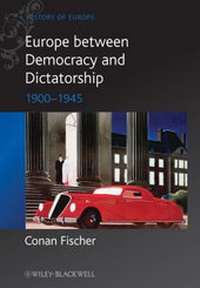
Europe between Democracy and Dictatorship
Description

Reviews / Votes
"Conan Fischer has written one of the finest short surveys of early twentieth-century Europe that I know, and one that will prove worthwhile to beginning students and advanced scholars alike." (European History Quarterly, 1 January 2015) "The book also contains a sufficient number of maps and illustrations, an important consideration from the point of view of students. In short, this is certain to become a standard text for the teaching of 20th-century European history. Summing Up: Highly recommended. All undergraduate collections." (Choice, 1 September 2011)More details
Other editions
Additional editions

Person
Content
Chapter One
The European Paradox
At the turn of the twentieth century Europe enjoyed unprecedented prosperity and a vibrant cultural life. The continent was also witnessing a series of scientific inventions and discoveries that were to shape decisively the historical experience of the coming century: wireless, radiation, the petrol engine, aviation and in medicine, to name but a few. International investment and trade underpinned the continent's economic strength and those who could afford to were able to travel freely across the continent, unimpeded by passport formalities or, for that matter, tiresome security checks.
Consumption and leisure were becoming increasingly accessible to society. The growing middle classes of Paris could enjoy shopping in the Bon Marché, Galeries Lafayette or at Au Printemps, Londoners could visit Harrods or from 1909 Selfridges, and the burghers of Berlin soon enough could enjoy a comparable experience in the city's great department store, KaDeWe (Kaufhaus des Westens). The seaside holiday or its equivalent was not just the privilege of the few, even if some traveled in third class railway carriages and lodged in cheap boarding houses, while others could enjoy the splendors of the grand hotels that sprang up along Europe's Atlantic and Mediterranean coasts.
Overcrowding and poverty weighed on many households in Europe's burgeoning cities, but dramatic improvements in public health and sanitation and rapid additions to the housing stock promised a more tolerable future. Modern urban transport networks made the dream of suburban living a reality for many and unemployment was relatively low in the industrialized regions of Europe, which continued to attract a stream of rural migrants. Illiteracy remained relatively widespread in Mediterranean and eastern Europe, but universal primary education had all but eliminated it in the center and northwest of the continent, where government was becoming increasingly accountable to an informed (male) electorate. Much was also changing in the workplace, as the principles of trade union representation and workplace consultation were conceded fitfully and unevenly in the industrialized economies and health and safety regulations were gradually tightened up.
One could embellish or add to this list of achievements almost indefinitely. If a certain fin de siècle, self-indulgent pessimism stalked the salons of the bored and wealthy and premonitions of doom haunted certain hypersensitive artists and intellectuals, this could not sweep away the underlying confidence of mainstream European society. Paris hosted a series of world fairs, at which France and the other exhibiting nations could show off their latest technological and artistic achievements. The 1889 World Fair had seen the construction of Gustave Eiffel's iconic wrought-iron tower, much criticized by architectural purists at the time and originally intended only to serve as a temporary structure for the duration of the fair itself. The 1900 fair was housed largely in the magnificent domed, iron and glass Grand Palais, decorated in art nouveau style, which encapsulated the unmistakable confidence and ambition of the Belle Epoque, the golden age, of the early twentieth century.
Expressionist painters, such as Egon Schiele or Ernst Ludwig Kirchner, may have scandalized their more conservative contemporaries, Pablo Picasso and Georges Braque may have seen their prewar artistic efforts dismissed as "mere" cubism, the first concert performance in Paris of Igor Stravinsky's Rite of Spring may have triggered fist fights within the audience, but such work reflected tellingly the accelerating pace of an increasingly urbanized, emancipated and metropolitan society. The French impressionist painters of the previous century had sometimes evoked a romantic past (in a radically novel fashion), but prewar expressionism was decidedly rooted in the present and looked to the future. Culture apart, in 1910 the German electrics giant AEG commissioned the architect and industrial designer Peter Behrens to create the world's first coordinated corporate brand1 as the evolution of a modern global economy gathered pace. France acknowledged the irresistible force of globalization when finally adopting Greenwich Mean Time in 1911.
Among the continent's prevailing political creeds, liberalism and socialism owed their credibility to an inherent belief in progress, and the willingness of conservatives to concede or even preempt reform spoke volumes. During the nineteenth century this self-confidence had combined with material and military strength to see Europe project its power worldwide, and by 1900 European imperialism neared the peak of its potential, dominating much of the globe. Even where Europeans did not rule directly, the continent's businessmen and financiers were ubiquitous as they invested, for example, in China, Turkey or Argentina, funding governments and developing trade across the globe. The City of London was central to this process, but Paris also played a major role and German capital strove to close the gap with these long-established imperial centers. Only the United States of America, itself the offspring of the European Enlightenment and peopled primarily by European immigrants and their descendants, promised to challenge Europe's position in any meaningful way.
The self-confidence of the age was reflected in a multitude of intimate, often minor, ways. In 1886 a doting uncle, a French bourgeois, sent his niece, Julie, an idiosyncratic wedding present. He admitted that the set of account books lacked somewhat in romantic charm, but insisted that orderly book-keeping should shape and guide Julie's future life. As he continued:
The second part of this book contains only blank paper. It is for recording at the year's end a detailed inventory of your assets. If all [your marital] expenses are deducted from your total fortune you will have the capital remaining to you when you arrive in Tunis, and which you will be able to add to, year by year, in order to provide your daughters with dowries.
But your fortune will vary not only with the level of your expenditure and receipts, but also with the rise and fall in the value of your investments. In order that you may know your real financial position you must note in this second part of the book each of your investments and its actual value at the time, according to its quoted price on the stock exchange.2
Investments could, indeed, fall, indicating that life was not without its risks. The European capitalist edifice had been built through the efforts of many losers as well as winners within an uneasy relationship between risk, struggle and reward. Interpretations of this process found their most extreme expression in the writings of so-called "social Darwinists," who argued that individual fortunes, and indeed the fortunes of entire societies, were defined by struggle and by the survival of the fittest. Such theories could and sometimes did assume racialist overtones that also provided a spurious moral justification for the European colonization of other continents.
Julie's uncle, however, had confined his thoughts to financial prudence. Such was clearly called for, but any investment would have been reduced to a mere gamble unless one held an inherently optimistic view of the future. And indeed, underlying optimism defined the Europe of 1900, shared by countless middle-class and working-class families for whom inheritance, a profession, a trade, or honest labor provided the wherewithal for a morally upstanding life, whether affluent or modest. Most families placed assets, however large or small, on the stock market, in government securities, in cooperative savings banks, building societies, or friendly societies. Urban sophisticates mocked the apocryphal (or not so apocryphal) peasant who simply stashed whatever gold he could accumulate under the mattress without a thought to the returns offered by rational investment. Capitalism, to give this process a name, had become deeply and inextricably embedded in society's wider values. It only remained to be asked what might ensue, if this inherent faith in a calculable form of progress were ever to be fundamentally disrupted.
And soon enough, twentieth-century Europe witnessed a succession of hammer blows that shattered these certainties and much besides. Confidence in the efficacy of reform, the wisdom of compromise or tolerance, and, ultimately, respect for humanity itself buckled and broke. The First World War initiated this destructive process and the Second World War brought it to its culmination, for which the extermination camps at Auschwitz-Birkenau serve as harrowing shorthand. The devastation wrought by the First World War was rationalized by the hope that this was truly a "war to end all wars," but beyond the unprecedented loss of life the crippling expense of modern warfare had rocked Europe's economy to its foundations. The accumulated wealth of a century or more was dissipated as the value of money melted away and faith in money as a just reward for effort and a secure medium of exchange evaporated. Commentators such as the economist John Maynard Keynes feared for the very existence of liberal capitalist society.
Map 1.1 Europe 1914.
This great inflation was at its most extreme in Germany (and the lands to its east) as pensions earned through a lifetime of hard and honest toil became worthless, as salaries that reflected expertise and professional dedication were reduced to a pittance, and as workers could no longer put bread and meat on the table because their pay...
