

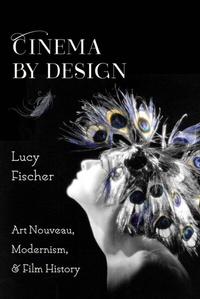
Cinema by Design
Art Nouveau, Modernism, and Film History
1st Edition
Published on 10. April 2017
288 pages
978-0-231-54422-1 (ISBN)
Description

Art Nouveau thrived from the late 1890s through the First World War. The international design movement reveled in curvilinear forms and both playful and macabre visions and had a deep impact on cinematic art direction, costuming, gender representation, genre, and theme. Though historians have long dismissed Art Nouveau as a decadent cultural mode, its tremendous afterlife in cinema proves otherwise. In Cinema by Design, Lucy Fischer traces Art Nouveau's long history in films from various decades and global locales, appreciating the movement's enduring avant-garde aesthetics and dynamic ideology.
Fischer begins with the portrayal of women and nature in the magical "trick films" of the Spanish director Segundo de Chomón; the elite dress and décor design choices in Cecil B. DeMille's The Affairs of Anatol (1921); and the mise-en-scène of fantasy in Raoul Walsh's The Thief of Bagdad (1924). Reading Salome (1923), Fischer shows how the cinema offered an engaging frame for adapting the risqué works of Oscar Wilde and Aubrey Beardsley. Moving to the modern era, Fischer focuses on a series of dramatic films, including Michelangelo Antonioni's The Passenger (1975), that make creative use of the architecture of Antoni Gaudí; and several European works of horror-The Abominable Dr. Phibes (1971), Deep Red (1975), and The Strange Color of Your Body's Tears (2013)-in which Art Nouveau architecture and narrative supply unique resonances in scenes of terror. In later chapters, she examines films like Klimt (2006) that portray the style in relation to the art world and ends by discussing the Art Nouveau revival in 1960s cinema. Fischer's analysis brings into focus the partnership between Art Nouveau's fascination with the illogical and the unconventional and filmmakers' desire to upend viewers' perception of the world. Her work explains why an art movement embedded in modernist sensibilities can flourish in contemporary film through its visions of nature, gender, sexuality, and the exotic.
Fischer begins with the portrayal of women and nature in the magical "trick films" of the Spanish director Segundo de Chomón; the elite dress and décor design choices in Cecil B. DeMille's The Affairs of Anatol (1921); and the mise-en-scène of fantasy in Raoul Walsh's The Thief of Bagdad (1924). Reading Salome (1923), Fischer shows how the cinema offered an engaging frame for adapting the risqué works of Oscar Wilde and Aubrey Beardsley. Moving to the modern era, Fischer focuses on a series of dramatic films, including Michelangelo Antonioni's The Passenger (1975), that make creative use of the architecture of Antoni Gaudí; and several European works of horror-The Abominable Dr. Phibes (1971), Deep Red (1975), and The Strange Color of Your Body's Tears (2013)-in which Art Nouveau architecture and narrative supply unique resonances in scenes of terror. In later chapters, she examines films like Klimt (2006) that portray the style in relation to the art world and ends by discussing the Art Nouveau revival in 1960s cinema. Fischer's analysis brings into focus the partnership between Art Nouveau's fascination with the illogical and the unconventional and filmmakers' desire to upend viewers' perception of the world. Her work explains why an art movement embedded in modernist sensibilities can flourish in contemporary film through its visions of nature, gender, sexuality, and the exotic.
All prices
More details
Language
English
Place of publication
New York, NY
United States
Publishing group
De Gruyter
Target group
Professional and scholarly
Edition type
Digital original
Illustrations
64 schw.-w. Abb., 64 b&w illustrations and 22 color plates
ISBN-13
978-0-231-54422-1 (9780231544221)
Schweitzer Classification
Other editions
Additional editions
Book
03/2017
Columbia University Press
€37.17
Shipment within 10-20 days
Book
03/2017
Columbia University Press
€108.94
Article not available at the moment
Person
Lucy Fischer is Distinguished Professor of English and Film Studies at the University of Pittsburgh and the author of eleven books, including Designing Women: Art Deco, Cinema and the Female Form (Columbia, 2003); Body Double: The Author Incarnate in the Cinema (2013); and Art Direction and Production Design (2015). She has held curatorial positions at The Museum of Modern Art and The Carnegie Museum of Art.
Content
Contents
List of Illustrations
Acknowledgments
Introduction
1. Art Nouveau and the Age of Attractions
2. Art Nouveau and American Film of the 1920s: Prestige, Class, Fantasy, and the Exotic
3. Architecture and the City: Barcelona, Gaudí, and the Cinematic Imaginary
4. Art Nouveau, Chambers of Horror, and "The Jew in the Text"
5. Art Nouveau, Patrimony, and the Art World
Epilogue: The 1960s and the Art Nouveau Revival
Notes
Index
List of Illustrations
Acknowledgments
Introduction
1. Art Nouveau and the Age of Attractions
2. Art Nouveau and American Film of the 1920s: Prestige, Class, Fantasy, and the Exotic
3. Architecture and the City: Barcelona, Gaudí, and the Cinematic Imaginary
4. Art Nouveau, Chambers of Horror, and "The Jew in the Text"
5. Art Nouveau, Patrimony, and the Art World
Epilogue: The 1960s and the Art Nouveau Revival
Notes
Index
