

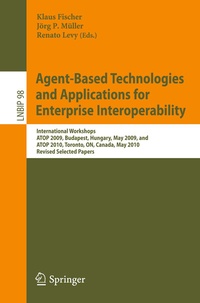
Agent-Based Technologies and Applications for Enterprise Interoperability
International Workshops ATOP 2009, Budapest, Hungary, May 12, 2009, and ATOP 2010, Toronto, ON, Canada, May 10, 2010, Revised Selected Papers
Published on 27. February 2012
X, 239 pages
978-3-642-28563-9 (ISBN)
Description

The ATOP (Agent-Based Technologies and Applications for Enterprise Interoperability) workshop series focuses on technologies that support interoperability in networked organizations, on successful applications of these technologies, and on lessons learned. In particular, ATOP brings together research combining ideas from MDA and SOA with agent technologies. The ATOP 2009 and 2010 workshops were held at the AAMAS conferences in Budapest, Hungary, in May 2009, and in Toronto, Canada, in May 2010.
The 11 papers presented here were carefully reviewed by three members of the international Program Committee and selected out of 25 contributions to the workshops. The topics covered are modeling interoperable systems; semantic approaches to enterprise interoperability; and interoperable business processes and business interactions. These papers are completed by an invited contribution reporting on OMG agent standardization.
The main goal was to collect approaches for the application of agent technologies in these areas. Current trends in the development of agent technologies are compared with recent developments in service-oriented and model-driven system design, with respect to their ability to solve interoperability problems.
More details
Other editions
Additional editions
Klaus Fischer | Jörg Müller | Renato Levy
Agent-Based Technologies and Applications for Enterprise Interoperability
International Workshops ATOP 2009, Budapest, Hungary, May 12, 2009, and ATOP 2010, Toronto, ON, Canada, May 10, 2010, Revised Selected Papers
Book
03/2012
1st Edition
Springer
€53.49
Shipment within 7-9 days
Content
- Title
- Preface
- Organization
- Table of Contents
- Modelling Interoperable Systems
- OMG Agent Standardization
- Introduction
- Core Concept Overview
- Agents and Agent Classes
- Agents and Roles
- Role Class and Role Assignment
- Agent and Role Assignments-and the ``Same as''Association
- Community and Community Class
- Open vs. Closed Ontology
- Conclusion
- A Model-Driven Approach for Executing Modular Interaction Protocols Using BDI-Agents
- Introduction
- Model Driven Tools for Development of Multi-Agent Systems
- Modular Protocols Model
- Modular Protocol Concepts
- Particular Propositions
- Speech Acts
- Editor for Modular Protocols
- Graph Updating Algorithm
- Combining Protocols as Modules
- Mapping Modular Protocols to Jadex BDI Agents
- Running the Composed Protocol
- Discussion
- Future Work
- Conclusion
- References
- Semantic Approaches to Enterprise Interoperability
- Semantic Matchmaking of Assets to Missions
- Introduction
- Mission Planning
- ISTAR Ontology
- Describing Mission Plans
- Semantic Matchmaking of Assets to Tasks
- Selection of Resources for Missions Using Agents
- Proposed Multiagent Architecture
- Choosing Deployable Configurations to Share Assets
- Evaluation
- Discussion and Related Work
- References
- Inter-organizational Interoperability through Integration of Multiagent, Web Service, and Semantic Web Technologies
- Introduction
- Requirements and Related Work
- Requirements Analysis
- Related Work
- Integrating Multiagent and Web Service Technologies
- Encapsulation of Web Service Resources
- Secure Inter-organizational Communication
- SOAP-Based Agent Communication
- Integrating Multiagent and Semantic Web Technologies
- Concept and Architecture
- Realization
- Evaluation
- Performance Evaluation
- Use Case
- Discussion
- Conclusion
- References
- An Integration of Semantically Enabled Service Oriented Architectures and Agent Platforms
- Introduction
- The COIN Platform
- Semantically Enabled Service Oriented Architecture
- Agents
- Combining WSMX and Agents for Service Composition
- Scenario
- Interoperable Services: Improving the Integration Process
- Service Requirements and Locating External Services
- Agent-Based Approach for Service Composition
- Service Composition with PIM4Agents
- Service Composition with JACK
- Automatic Composition of Services
- PDDL - Planning Domain Definition Language
- Semantics of PDDL
- Transformation of WSML Service to PDDL
- Limitations
- Discussion and Open Issues
- Related Work
- Conclusion and Future Work
- References
- Ontology Matching across Domains
- Introduction
- Related Work
- Overview of Approach
- Example
- Secure Ontology Matching Algorithm
- Conclusions and Future Research
- References
- Using Ontologies to Support Decentral Product Development Processes
- Introduction
- DeCPD Approach
- Network Layer
- Process Layer
- Product Model
- Background
- Related Work
- Ontologies for Formal Description of Product Models
- Ontologies as a Support for Product Model Data Exchange
- DeCPD Data Model
- CIM Level Models
- PSM Level Models
- Sample Use Case
- Conclusion and Outlook
- References
- Decentralized Semantic Service Discovery in Preferential Attachment Networks
- Introduction
- Related Work
- Formalizing the System
- Homophily as Similarity Factor
- Homophily Calculation
- System Operations
- Network Creation Process
- Semantic Distributed Search of Services
- Network Decay
- Experiments
- Network with Status Homophily
- Conclusions and Future Work
- References
- Interoperable Business Processes and Business Interactions
- Goal-Directed Approach for Process Specification and Service Selection in Customer Life Cycle Management
- Introduction
- Case Studies of Customer Care Management
- Health Care: Chronic Disease Management
- Telecommunication Domain: Customer Life Cycle Management (CLCM)
- Service Selection: Goal-Directed Approach
- Goal-Directed Coordination-Level Specification
- Goal-Directed Service Selection Algorithm
- Service Selection: Service-Oriented Approach
- Service Model
- Process Model
- Service-Directed Selection Algorithm
- Service Selection: Contrasting Service and Goal Direction
- Related Research
- Conclusions and Future Work
- References
- A Multi-agent Mediation Platform for Automated Exchanges between Businesses
- Introduction
- The Mediation Platform
- Concept of the Mediation Platform
- Using the Platform: An Example Scenario
- Functioning of JSA and JIA
- JSA
- JIA
- Institutional Agents
- Types of Agents
- Interpretation of Semantic Representations: List of SIPs
- Institutional Interpretation of Actions
- From Intentions to Action in JSA Agents
- Interpretation of the Action Declaration
- Interpretation of an Action Performance
- Life Cycle of an Obligation
- Interpretation and Monitoring of Other Agents' Obligations
- Mechanisms for Exceptions
- Illustration: Some Scenarios of Application
- Simple Client-Provider Exchange
- Implementation of the Credit Letter Protocol in JIA
- Institutional Communication
- Conclusion
- References
- MACSIMA: An Agent Framework for Simulating the Evolution of Negotiation Strategies in B2B-Networked Economies
- Introduction
- Purpose and Differentiation Factors of MACSIMA
- The MACSIMA Framework
- Generic Agent Types
- Interoperability Framework
- Interoperability Service Agent
- Negotiation Protocol
- Negotiation Module
- Parameterization of the Negotiation Module
- Parameterization of Learn Process
- Simulation and Evaluation Results
- The MACSIMA Multi-agent Simulation Framework
- Impacts of Evolutionary Adaptation
- Emergence of Niche Strategies
- Parameter Settings for Maximizing Overall Profit and Turnover
- Expert Parameterization Improves Outcome Stability
- Effects of a Heterogeneous Parameterization of the Agents
- Two-Pool-Mode
- Conclusions
- References
- Trust Evaluation for Reliable Electronic Transactions between Business Partners
- Introduction
- Related Work
- A Model for the Hysteresis of Trust and Betrayal
- Sinalpha
- The Simulated Textile Scenario
- Preselection of Trust
- Generation of Contractual Trust Evidences
- Experiments
- The Testbed
- Evaluation Metrics
- Results
- Interpretation of the Results
- Conclusions
- References
- Author Index
