

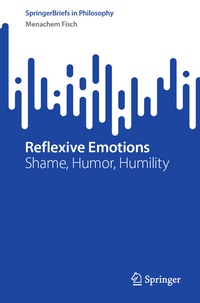
Reflexive Emotions
Description

This book looks closely at three first-order reflexive emotions-shame, humor and humility-that are shown to be not only exclusively human, but definitive of major aspects of human selfhood, agency and normativity. A separate chapter that covers second-order emotions, shows that when negative, they display a crucial and equally exclusive aspect of human normative self-critique.
In addition to jointly delineating agency, sapience, normativity, rationality, and the ability to critically self-reflect, this book further demonstrates the inevitable role of the we in the I (to paraphrase Axel Honneth), namely, how realizing one's full human potential necessarily requires engaging others. This book appeals to students as well as researchers and looks closely at how these three reflexive emotions bestow categorical value on otherness, rendering normative diversity not merely something to be tolerated or rationally overcome, but a rare and necessary blessing.
More details
Other editions
Additional editions
Person
Menachem Fisch is Joseph and Ceil Mazer Professor Emeritus of History and Philosophy of Science, Tel Aviv University, and Senior Fellow, Forschungskolleg Humanwissenschaften, The Goethe University, Frankfurt. He has published widely on confirmation theory, normativity, and agency, the limits of self-criticism, the transformative potential of dialogue, the rationality of framework transitions, and reflexive emotions.
His recent books include: The View from Within: Normativity and the Limits of Self-Criticism (with Y. Benbaji), (Notre Dame, 2011), Creatively Undecided: Toward a History and Philosophy of Scientific Agency (Chicago, 2017), Qohelet: Searching for a Life Worth Living (with D. Band), (Baylor, 2023), Dialogues of Reason: Science, Politics, Religion, with critical responses by Julie E. Cooper, Lorraine Daston, Suzanne Last Stone, Matthias Lutz-Bachmann, Thomas C. Schmidt, Till van Rahden, and Christian Wiese), forthcoming (Echter Verlag, 2025). He is recipient of the Humboldt Research Prize (2016) and an Honorary Doctorate from the Goethe University, Frankfurt (2017).
Content
Introduction.- Nussbaum in Review.- Shades of Shame.- Appreciating the Comical.- The Humble Self.- SecondOrder Emotions.-
All Together Now.- Bibliography.
