

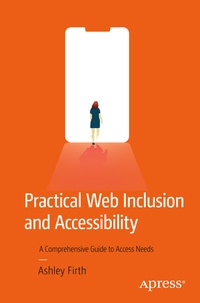
Practical Web Inclusion and Accessibility
Description

The web has to be inclusive. One in five people living in the UK have a disability. From Microsoft's "inclusive design" movement - creating adaptive controllers for users with a range of disabilities - to Beyoncé's site being sued for failure to be accessible, the importance of considering access needs is gaining mainstream attention. Recognizing and catering for a range of disabilities in our online platforms is key to achieving a truly inclusive web.
You'll be guided through a broad range of access needs, the barriers users often face, and provided practical advice on how your sites can help rather than hinder. Going beyond advice tailored solely for developers, this book offers potential improvements for designers, developers, user experience professionals, QA and testers, so that everyone involved in building a website can engage with the concepts without the need to understand how to code.
Learn about the very latest technology - such as natural language processing andsmart home tech - and explore its application accessibly. This book comes complete with practical examples you can use in your own sites and, for the first time in any web accessibility book, access needs experienced by those with mental health disorders and cognitive impairments are comprehensively covered.
Applicable to both new projects and those maintaining existing sites and looking for achievable improvements on them, Practical Web Inclusion and Accessibility gives you all the information you need to ensure that your sites are truly accessible for the modern, inclusive web.
What You Will Learn
-
Understand the vast range of disabilities that have online access needs
-
Apply the practical steps required to cater for those needs
-
Use new technology to open up exciting avenues for the sites you create and maintain
-
Approach accessibility from a full spectrum of online disciplines
-
Start thinking about users with specific disabilities and how it impacts your work
Anyone who wants to have a greater understanding of the inclusive web and considerations that should be made. You do not need to have coding knowledge.
More details
Other editions
Additional editions
Person
Ashley Firth is Head of Front-end Development and Accessibility at award-winning energy supplier Octopus Energy. Accessibility has been an obsession of his since he started this role and he has worked together with customers to understand their needs and use new technology to try to make an online experience as inclusive as possible. Ashley and Octopus Energy have won numerous customer and digital experience awards for their products, and their approach to web accessibility has been described as "best in class" by the Royal Institute for the Blind. Ashley was shortlisted for the 2018 Young Energy Professional of the Year for customer service, spoke at the Festival of Marketing on the importance of web accessibility, and was part of eConsultancy's first ever Neurodiversity report. He is a published writer for Web Designer Magazine on accessibility and acts as a consultant to other companies to help them improve their approach to accessibility. Before Octopus Energy, Ashley ran the Front-end team at Digital and CRM agency, Tangent, helping to build sites for clients such as Walkers, Carlsberg, SAP, and the Labour Party, and before that, at experiential start-up, Fishrod Interactive, helping to make installations for WWE, Sky, and Budweiser. You can find him on Twitter and Instagram @MrFirthy.
Content
1. The Accessibility Problem.- 2. Blindness.- 3. Low vision and Color blindness.- 4. Motor disabilities.- 5. Deafness and Hard of hearing.- 6. Cognitive Impairments.- 7. Mental Health.- 8. Imagery.- 9. Communication.- 10. New technologies.- 11. Tools and QA.- 12. Conclusion.
